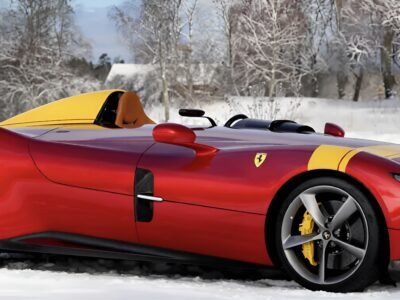
Before the Daytona SP3 ever turned a wheel, before Ferrari revived its naturally aspirated V12 for a mid-engine limited-edition supercar, there was a quieter, more understated beginning to the Icona series: the Monza SP1 and SP2. Unveiled in 2018, these two cars were Ferrari’s first attempt at a new kind of special edition — not a race car reborn for the road, and not a hypercar chasing lap times, but a rolling sculpture built purely to celebrate the romance of open-top, front-engine racing from Ferrari’s earliest and most glamorous era. Of the pair, the Monza SP2 is the one built for two, and it remains one of the most striking, most collectible cars Ferrari has ever produced.
The Birth of the Icona Series
Ferrari’s Icona series began life at Capital Markets Day in Maranello in 2018, when the company unveiled two closely related but distinct models simultaneously: the single-seat Monza SP1 and the twin-seat Monza SP2. The idea behind Icona was to give Ferrari’s design team a rare kind of freedom — the chance to build a car with no compromises around comfort, practicality, or even a windshield, purely to distill the essence of an era into a modern shape.
For the Monza twins, that era was the 1950s, when Ferrari’s open-cockpit racing barchettas dominated endurance events across Europe. Cars like the 750 Monza, 860 Monza, and 166 MM were stripped-down, purposeful machines built for speed above all else, and the Monza SP1 and SP2 were conceived as a modern reinterpretation of that raw, elemental driving experience.
SP1 Versus SP2: One Seat or Two
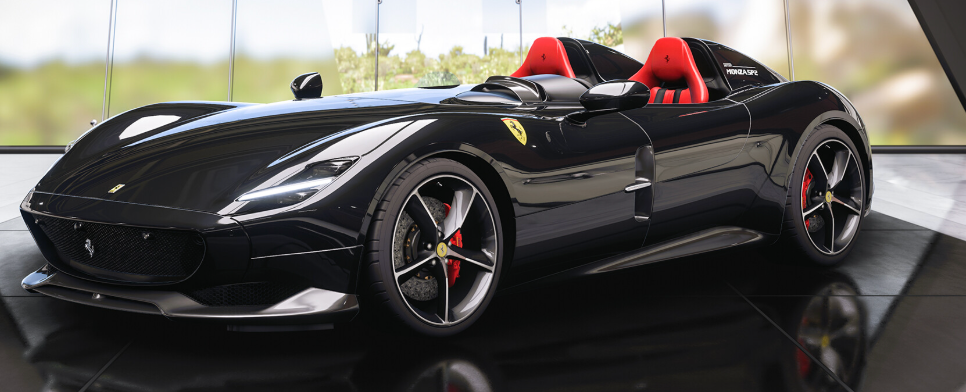
The most obvious distinction between the two Monza models is baked right into their names: the SP1 is a strict single-seater, built for a driver who wants nothing between themselves and the road, while the SP2 adds a second seat, turning the experience into something that can be shared. Ferrari designed the SP2’s cockpit with a subtle asymmetry, tucking the passenger seat slightly behind the driver’s to preserve the aerodynamic profile and visual purity of the single-seat design as closely as possible.
This two-seat layout makes the SP2 the more usable, more social version of the pair, and in practice it has proven to be the more popular choice among collectors, in part because it retains nearly everything special about the SP1’s design while opening the car up to be enjoyed with a passenger. Both cars, notably, were built without a roof, a windshield, or even conventional door openings in the traditional sense, staying true to the barchetta ideal of minimal bodywork and maximum exposure to the driving experience.
Design Details and the Virtual Wind Shield
Stripping away a windshield entirely presents an obvious problem at speed, and Ferrari’s solution was one of the more clever engineering flourishes of the entire project: a small deflector positioned ahead of the driver, paired with a carefully sculpted air channel that redirects turbulent air up and over the cockpit. Ferrari calls this system the ‘virtual wind shield,’ and it allows occupants to drive at high speed with minimal buffeting despite the complete absence of glass in front of them.
Visually, the Monza SP2 carries forward the flowing, single-piece bodywork of the SP1, with a long, sculpted hood, a low beltline, and minimal ornamentation. The rear deck is kept clean and uncluttered, evoking the simplicity of 1950s racing bodywork, while modern touches like slim LED headlights and contemporary proportions keep the car from feeling like a costume piece. It is a design built around a single continuous gesture rather than a collection of separate details, and that restraint is part of what makes it feel timeless rather than retro.
Power and Performance
Underneath the Monza SP2’s dramatic bodywork sits a chassis and running gear derived from the Ferrari 812 Superfast. Power comes from a 6.5-liter naturally aspirated V12 producing roughly 810 horsepower, tuned specifically for the Icona cars and paired with a seven-speed dual-clutch transmission sending power to the rear wheels. Ferrari quotes a 0 to 60 mph time in the range of 2.9 seconds, with a top speed in excess of 186 mph.
Because the Monza SP2 dispenses with a roof, windshield, and much of the interior structure found in a conventional road car, it is lighter than many of its contemporaries despite sharing mechanical bones with the 812 Superfast. That reduced weight, combined with the naturally aspirated V12’s eagerness to rev, gives the SP2 a rawer, more visceral character than most modern Ferraris, closer in spirit to the open-cockpit racers that inspired it than to anything currently in Ferrari’s regular model lineup.
Exclusivity and Production Numbers
True to the Icona series’ philosophy, the Monza SP1 and SP2 were never meant to be common sights. Ferrari built a combined total of 499 examples across both models, with deliveries beginning in the summer of 2019 and continuing through 2022. Pricing started at roughly 1.6 million euros before options, and as with all of Ferrari’s most exclusive cars, allocation was reserved for a hand-selected group of longtime clients and collectors rather than being open to general order.
Ferrari also wrapped the ownership experience in additional touches meant to reinforce the cars’ status as more than transportation. Buyers were offered custom apparel and accessories developed in partnership with luxury houses like Loro Piana and Berluti, extending the gentleman-driver theme of the cars themselves into the broader ownership experience.
A Growing Collector’s Market
Because so few were built and even fewer come up for sale, the Monza SP1 and SP2 have become highly sought after on the secondary market, with prices climbing well beyond their original list price as collectors recognize their significance within the Icona lineage. Public auction results have shown just how far values have risen: a 2021 Monza SP2 sold for nearly five million dollars in 2026, while a Monza SP1 changed hands for well over three and a half million dollars in a separate sale the year prior. These results place the Monza twins among the strongest-performing modern Ferraris in the collector market, reflecting both their scarcity and their importance as the cars that started the entire Icona concept.
The Foundation for What Followed
Looking back, the Monza SP1 and SP2 matter for more than their own design and performance. They established the template that Ferrari would follow with every subsequent Icona release, including the Daytona SP3: extreme exclusivity, a naturally aspirated V12 engine untouched by hybrid assistance, a design language rooted in a specific chapter of Ferrari’s racing history, and a level of customization and ownership experience reserved for the brand’s most trusted clients. Without the Monza twins proving that this formula could work, and that collectors would embrace cars built around pure emotion rather than outright performance records, it’s fair to say the Daytona SP3 might never have existed in its current form.
The Monza SP2, in particular, occupies a special place within that story. As the more usable, two-seat version of Ferrari’s first Icona experiment, it managed to capture nearly everything dramatic and uncompromising about the SP1 while making the experience something that could be shared. That balance between purity and practicality, however slight the concession, has helped make the SP2 not just historically important, but genuinely one of the most desirable modern Ferraris in existence.