listen to the audio of the article
Some cars are built to win races. Others are built to sell in volume. And then there are cars built simply to make a statement — to remind the world what a manufacturer is capable of when cost, practicality, and compromise are taken off the table entirely. The Ferrari Daytona SP3 belongs firmly in that last category. It is not a car designed to be driven to the office or to top a sales chart. It exists as a rolling piece of automotive art, a limited-production supercar that pays tribute to one of the most storied moments in Ferrari’s racing history while showcasing the very best of what the marque’s engineers and designers can do when given free rein.
Born From the Icona Series
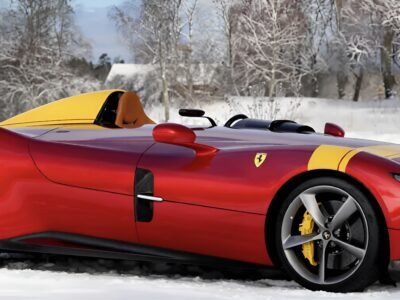
The Daytona SP3 is the second entry in Ferrari’s “Icona” (Italian for “icon”) series, a lineage that began with the Monza SP1 and SP2 in 2018. The Icona concept is simple in principle but extraordinarily difficult in execution: take the design language and spirit of Ferrari’s most celebrated historic race cars and reinterpret them using every modern tool available — advanced aerodynamics, contemporary materials, and the latest powertrain technology — without simply copying the past. The result is meant to feel both nostalgic and unmistakably new.
Ferrari unveiled the Daytona SP3 on November 20, 2021, at the Mugello Circuit during the Ferrari Finali Mondiali event, positioning it as the successor to the Monza twins within the Icona lineup. Where the Monza cars drew inspiration from Ferrari’s front-engine sports prototypes of the late 1960s, the Daytona SP3 looks to a slightly different chapter of that same era, one defined by closed-cockpit, mid-engine racing prototypes.
The Name Behind the Name
The “Daytona” in Daytona SP3 is a direct reference to one of Ferrari’s most triumphant moments in endurance racing: the 24 Hours of Daytona in 1967. That year, Ferrari’s factory team pulled off a stunning 1-2-3 finish, with the Ferrari 330 P4 leading a trio of Ferrari prototypes across the finish line in a coordinated, almost choreographed conclusion to the race. It was a defining show of dominance, and the image of those three Ferraris crossing the line together has remained a touchstone of the brand’s motorsport identity ever since.
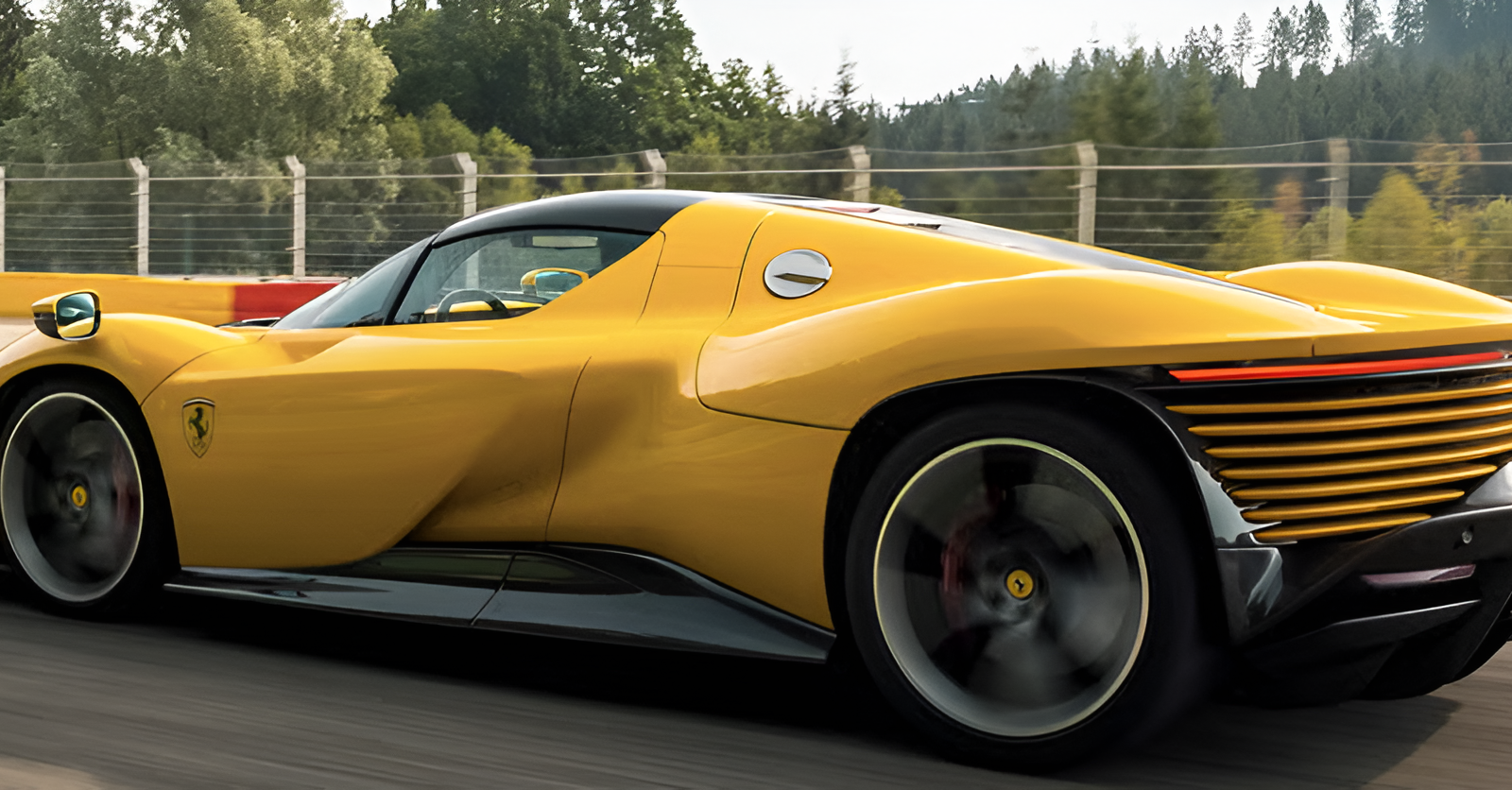
The Daytona SP3’s styling draws directly from that era’s prototypes — the 330 P3/4, the 350 Can-Am, and the 412 P among them — translating their voluptuous, curvaceous bodywork and purposeful stance into a shape that still looks entirely at home on today’s roads. Ferrari’s chief design officer, Flavio Manzoni, oversaw the design, blending historical cues with contemporary surfacing so the car reads as an homage rather than a costume.
Design and Engineering
Visually, the Daytona SP3 is defined by dramatic, sculpted flanks, a low-slung targa-top silhouette, and butterfly doors that open upward and outward, revealing integrated air channels that help feed the engine and manage airflow around the cabin. The removable targa roof panel nods to the open-cockpit nature of the racing prototypes that inspired it, letting owners experience the engine note and open-air driving that the original Daytona-winning cars offered.
Underneath the theatrical bodywork sits a chassis derived from the LaFerrari Aperta, Ferrari’s own recent hypercar platform, ensuring the SP3 pairs its retro-inspired shape with genuinely modern underpinnings. The body itself is built from a carbon-fiber monocoque and panels, keeping weight in check despite the car’s substantial visual presence. Ferrari relied purely on passive aerodynamics for the SP3 — there are no active aero elements, movable wings, or adjustable spoilers. Every vent, channel, and curve is doing its job through pure shape alone, a deliberate choice that keeps the design clean and true to the era it references.
The Heart of the Car: A Naturally Aspirated V12
Perhaps the most significant technical detail of the Daytona SP3 is what it doesn’t have: a turbocharger or a hybrid electric system. At its core sits a 6.5-liter naturally aspirated V12, the same F140 engine family found in the Ferrari 812 Superfast, tuned here to produce 840 PS — roughly 829 horsepower — making it one of the most powerful naturally aspirated production engines Ferrari has ever built. Power is sent through a seven-speed dual-clutch transmission to the rear wheels only, keeping the drivetrain layout focused and mechanical.
This matters because the Daytona SP3 marks Ferrari’s first return to a naturally aspirated, mid-mounted V12 engine in a limited-edition car without any hybrid assistance since the legendary Ferrari Enzo, which debuted back in 2002. In an era when nearly every high-performance Ferrari relies on some combination of turbocharging and electrification, the SP3’s engine is something of a farewell letter to a format that is quickly disappearing from new car design, largely due to tightening emissions regulations. For enthusiasts, that alone makes the car historically significant, independent of its styling or exclusivity.
Exclusivity by Design
True to the Icona series’ philosophy, the Daytona SP3 was never intended to be widely available. Ferrari capped production at just 599 units, built between 2022 and 2025, with every single example allocated to hand-selected clients before the car was even formally revealed to the public. Pricing started at approximately $2.25 million per car before options, and Ferrari’s famously extensive personalization program — allowing bespoke color combinations, interior trims, and finishes — meant many buyers spent considerably more customizing their individual cars.
Despite the steep price, demand vastly outpaced the limited production run, as is typical for Ferrari’s most exclusive models. Only clients with strong existing relationships with the brand, often longtime collectors with significant prior Ferrari ownership, were given the opportunity to purchase one. By the time the final example rolled off the line, all 599 cars had been built and delivered, closing out the production run entirely.
A Fitting Send-Off
To mark the car’s connection to its racing lineage, Ferrari staged a memorable tribute: the Daytona SP3 shared a track with two original 330 P4 race cars and a 412 P, recreating the spirit of that famous 1967 photo finish more than five decades later. It was a fitting nod to the history the SP3 was built to honor, bridging Ferrari’s past and present in a single symbolic lap.
A Car Built for the Moment It Was Made
The Ferrari Daytona SP3 occupies an interesting place in automotive history. It arrives at a moment when the industry is rapidly shifting toward electrification and forced induction, making its naturally aspirated V12 feel almost like a farewell performance for an engine format that shaped decades of Ferrari’s identity. Combined with its extreme exclusivity, hand-built construction, and direct homage to one of the marque’s greatest racing triumphs, the Daytona SP3 isn’t just another entry in Ferrari’s lineup — it’s a deliberate, limited-time celebration of everything that made the brand’s V12 heritage so compelling in the first place. For the small number of owners who managed to secure one, it represents not just a supercar, but a piece of Ferrari’s history brought vividly back to life.