listen to the audio of this article
When Rolls-Royce revived its historic Coachbuild division with the one-off Sweptail in 2017, the response from ultra-wealthy clientele was immediate. Multiple patrons approached the brand seeking an equally personal automotive masterpiece. Three of these individuals, unrelated but united by a shared passion for contemporary yacht design, became the genesis of the Rolls-Royce Boat Tail. Unveiled in 2021 as the first series born from the brand’s newly formalized Coachbuild program, the vehicle quickly gained global renown as the most expensive new automobile ever produced.
Three Cars, Three Bespoke Stories
Only three examples of the Rolls-Royce Boat Tail exist globally, and unlike traditional limited production runs, no two models are remotely alike. Each car was conceived through months of collaborative dialogue between Rolls-Royce’s Coachbuild division and individual clients, resulting in an automotive biography rather than a standard car commission.
The first commission, finished in a shimmering oceanic blue lacquer infused with metallic crystal flake, generated widespread press coverage attributing ownership to Jay-Z and Beyoncé. Its rear hosting suite was specifically engineered to chill Armand de Brignac champagne to its exact serving temperature. A subsequent commission took an entirely different tone, featuring a cognac-toned finish infused with oyster and rose-gold metallic flake. This second vehicle housed a deployable presentation case within its rear deck designed specifically to display the client family’s pearl and gemstone collection, creating a motorcar built literally around a family business.
The Architectural Butterfly Hosting Suite
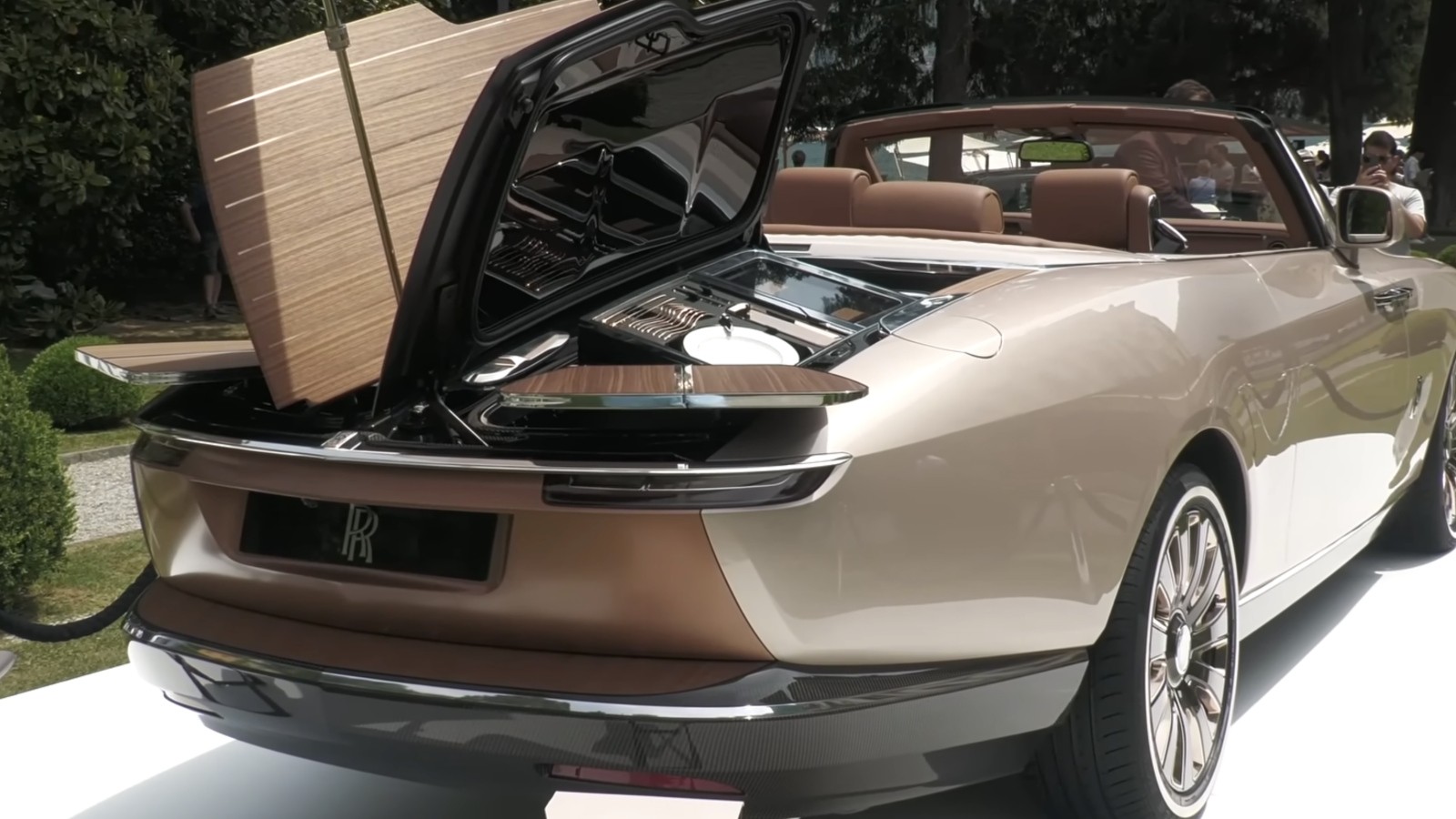
The defining feature of the Rolls-Royce Boat Tail sits beneath its elongated, nautical rear deck. At the press of a button, two lockable panels hinged at the center swing open in a sweeping, symmetrical butterfly motion. Rolls-Royce designers drew inspiration for this mechanism from the cantilevered architectural structures of Santiago Calatrava, with the head of Coachbuild design describing the assembly as a true engineering marvel.
Opening the panels reveals a fully staged entertaining suite rather than a traditional luggage trunk. The space houses a bespoke champagne chest complete with two chilled bottles, refrigerated storage, and a matched set of custom cutlery and crockery created entirely without spare parts. Flanking the chest, rotating cocktail tables finished in matching wood open to reveal interlocking leather and carbon-fiber stools crafted by Italian furniture maker Promemoria. A center-mounted parasol extends to shade the entire arrangement, offering a modern reinterpretation of the wooden rear decks found on vintage 1932 Rolls-Royce Boat Tail models.
Seamless Design and Artisanal Materials
Viewed from any perspective, the 5.8-meter-long Boat Tail reads as a single, uninterrupted surface. Rolls-Royce designers deliberately eliminated visible body panel breaks to give the vehicle the seamless silhouette of a yacht hull. At the front, the traditional Pantheon grille was softened and integrated directly into the front end rather than mounted as an isolated piece, flanked by modern horizontal daytime-running lights.
Wood craftsmanship plays a central role alongside the custom exterior paints. Book-matched Caleidolegno open-pore wood veneer lines the rear deck and cabin, while specific commissions incorporate varnished teak paneling inlaid with genuine mother-of-pearl. Inside, the cabin favors an analog, minimalist dashboard over digital screens to maintain a timeless aesthetic. The interior also features the iconic fiber-optic Starlight Headliner, electrochromic privacy glass, and dual two-sided bespoke timepieces engineered to be worn on the wrist or mounted in the dashboard fascia as a car clock.
Under the Hood: V12 Performance and Specs
Mechanically, the Boat Tail utilizes Rolls-Royce’s proprietary aluminum platform shared with the flagship Phantom sedan. Power originates from a 6.75-liter twin-turbocharged V12 engine producing roughly 562 horsepower (419 kW).
Rolls-Royce intentionally avoids publishing official acceleration numbers for the vehicle, emphasizing that Coachbuild creations are designed for effortless gliding rather than competitive track metrics. The top speed is electronically capped at 155 mph, matching the ceiling of other modern flagship models in the lineup.
Price Tag and Legacy in Automotive History
While Rolls-Royce has never published official price figures due to the confidential nature of Coachbuild commissions, industry reporting from the model’s 2021 debut estimated the base cost at roughly $28 million. Later reporting on customized individual models placed final figures between $30 million and $38 million depending on the scope of bespoke materials and integrated objets d’art.
No further Boat Tail models will be produced. With all three commissions delivered to private collectors worldwide—including one registered in Ajman, UAE—the Boat Tail stands alongside the Sweptail and subsequent Droptail series as proof of Rolls-Royce’s willingness to engineer a vehicle around a client’s individual lifestyle.
Video Deep Dive: The Rolls-Royce Boat Tail Debut
To see the butterfly rear deck, custom hosting suite, and grand proportions of this Coachbuild masterpiece in motion, watch the official video presentation highlighting the design and craftsmanship of the vehicle:
Watch the Official Feature: Rolls-Royce Boat Tail World Premiere