In 2026, the world’s oldest glassworks—a dynasty born in the fires of Murano in 1295—finds itself at a pivotal crossroads. This is the story of Barovier & Toso, a brand that is not merely preserving a legacy, but actively redefining what it means to be a custodian of light in the contemporary world.
The Current Era: A New Chapter
This is a time of deliberate and profound renewal. Under the strategic vision of CEO Andrea Signoroni—the company’s first-ever CEO, appointed in 2024—and the artistic direction of Luca Nichetto, who took on the newly created role in May 2025, Barovier&Toso is embarking on a transformation crystallized in the “2026 Chapter 1” project.
This isn’t about discarding the past but weaving it into the fabric of the future. The brand’s seven-century history isn’t treated as a relic, but as a “living resource” from which to draw inspiration for innovation. The goal, in Signoroni’s own words, is to strengthen a historic identity while making it more open, contemporary, and international.
Design: A Dialogue Between Memory and the Future
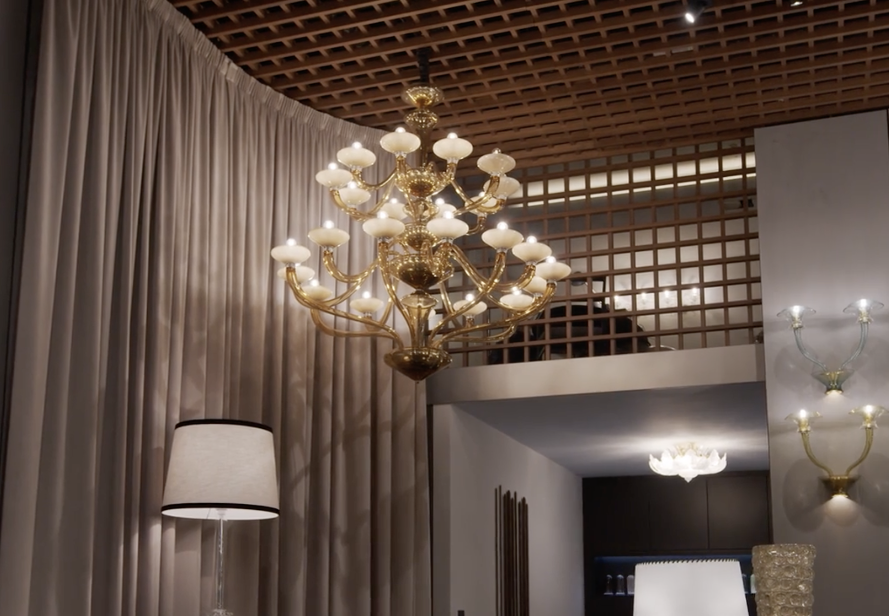
The brand’s design language has evolved into a sophisticated dialogue where tradition and innovation are inseparable. This is most vividly on display at Milan Design Week 2026, where the “2026 Chapter 1” installation transformed the Milan showroom on Via Durini into an immersive, almost sacred space—a “treasure chest” where light and matter converse.
The new collections, created by a roster of international designers, exemplify this philosophy:
NICHETTO®: The “Etime” lamp explores geometry, a cubic volume born from the intersection of square and circle, while the “Aurora” table lamp reinterprets the traditional oil lamp—replacing oil and wick with discreet modern lighting while preserving the intimacy of the original ritual.
García Cumini: Their “Agave” collection won the 2025 Archiproducts Design Award in the Lighting category, translating the resilience of the agave plant into light. Its distinctive texture comes from the exclusive “rugiada” (dewdrop) technique—spreading glass granules over the incandescent surface to capture and refract light, creating a vibrant, three-dimensional effect.
Emmanuel Babled: The “Lithos” vases explore glass as a “geological substance.” A reactive mineral powder is used to generate bubbles and inclusions, making each piece unique and evoking the formations of ancient rock.
Studio Lani: The “Olori” vases celebrate strength and femininity, inspired by the layered collars of traditional African adornment, reimagined in sculpted glass.
Keiji Ashizawa: The “Kado” vase is conceived as “small architecture” inspired by ikebana, using precise inclinations and surfaces to guide a compositional gesture.
Claesson Koivisto Rune: “Podio” introduces a modular vase system with lids, allowing for stackable, architectural compositions.
Yet the brand’s design story is not solely about the new. At the heart of their identity is the Coppa Barovier, a Renaissance masterpiece housed today in the Murano Glass Museum and dated by the museum itself to around 1460–1470. It’s worth noting, in the interest of precision, that the museum’s own scholarship considers its popular attribution to master glassmaker Angelo Barovier to be a mistaken 19th-century belief—Angelo was renowned as a technical innovator rather than a documented enamel painter, and the cup’s actual maker remains unknown. The name has stuck regardless, and pieces in this tradition remain part of Barovier&Toso’s living catalogue today, produced using historic techniques—a tangible link to a past that continues to inform the present.
The Source: Murano, Venice
The source of Barovier&Toso’s magic is singular and unchanging: the island of Murano, Venice. Every piece is handcrafted in its historic furnaces by master artisans who are the custodians of a tradition passed down for generations. The brand is a testament to the unique alchemy of this place, where the fragile, exacting secrets of glassmaking have remained on the island for longer than seven centuries.
A defining element of its heritage and quality is the “Cristallo Veneziano” (Venetian Crystal). Developed by Angelo Barovier in the 15th century—with the Venetian Republic granting him exclusive production rights in 1455—this formula is unique for its total absence of lead and arsenic, granting the glass extraordinary transparency and brilliance. This formula is still used today, allowing master glassmakers to work safely while achieving exceptional results. The creation of a single piece follows what’s often described as a trilogy of time: an afternoon for preparation, firing overnight, a day of crafting, and then a day for cooling and finishing.
Price: The Value of a Living Artifact
To speak of price for Barovier&Toso is to speak of value. You are not simply buying a lamp or a vase; you are acquiring a piece of history, a handcrafted artwork that embodies centuries of mastery. The price reflects the immense skill, the unique materials, and the time required to create each piece.
The market for their work ranges dramatically. A 20th-century goblet or a pair of leaf bowls might appear at auction with an estimate in the low hundreds of dollars, while a pair of large table vessels could sell for several times that. Vintage sconces from the 1940s can be priced in the thousands on the secondary market.
However, their bespoke, contemporary pieces represent a different tier of luxury. The company offers extensive customization options, allowing clients to collaborate with product consultants to alter everything from the size and color of a lamp to the design of a completely bespoke creation. Each customized product is a unique, hand-blown piece from the Murano furnace, making its final price a reflection of a genuinely collaborative artistic process. A new, award-winning design like the “Agave” suspension lamp represents the pinnacle of this philosophy, with pricing that reflects its status as a modern, sculptural piece.
Beyond the gallery, the brand has also established a dedicated space for the fine arts. A new Barovier&Toso ARTE gallery in Murano, housed in the historic Palazzo Barovier&Toso, is dedicated to contemporary artists who use glass as a medium, further blurring the lines between masterful design and pure art.
A Legacy of Light
In the contemporary era, Barovier&Toso is more than a glassworks; it is a guardian of an ancient flame. By embracing a future shaped by international design talent, innovative techniques, and a profound respect for its heritage, it continues to tell a story that began over 700 years ago, ensuring its light will burn brighter and more relevant than ever.