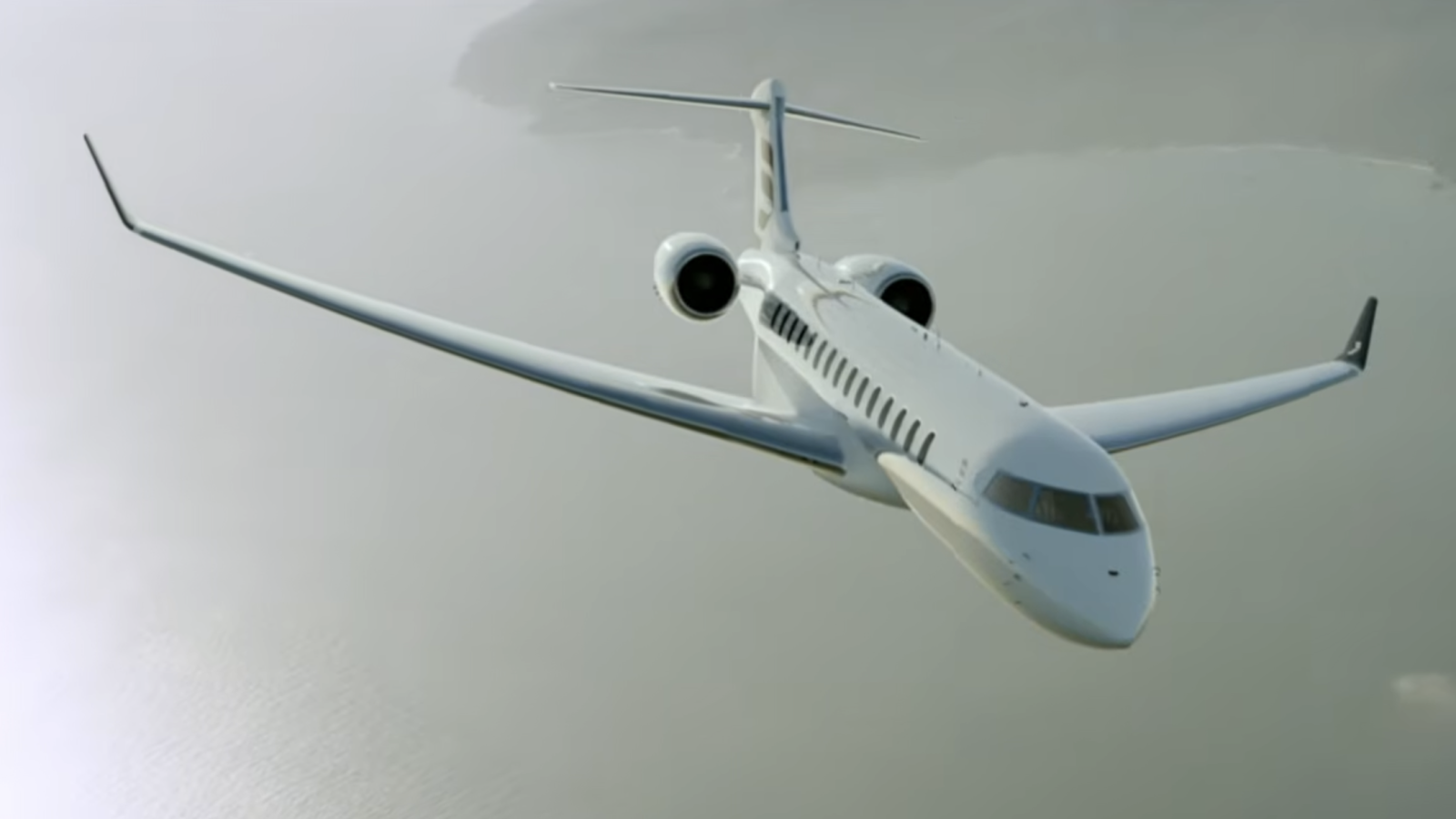
There is a particular kind of quiet that settles over a cabin once an aircraft passes Mach 0.90. In most business jets, that quiet is an illusion, masking a fuselage working hard against the onset of buffet and shock. Aboard the Bombardier Global 8000, the quiet is real. The wine in the glass barely moves. The wing, engineered to flex rather than fight the air around it, simply keeps working.
That is, in miniature, the entire pitch behind Bombardier’s new flagship: a business jet built not just to go farther than anything else in its class, but to get there faster than any civilian aircraft has flown since Concorde retired in 2003.
The Fastest Civil Aircraft in Two Decades
The headline number is Mach 0.95. That is the Global 8000’s certified top operating speed, and Bombardier is not shy about what it means: the fastest civil aircraft built since Concorde, and, by the company’s own accounting, the fastest business jet ever produced. Typical cruise sits closer to Mach 0.85, but the aircraft has room to spare—during flight testing on the closely related Global 7500 platform, the airframe briefly touched supersonic speeds, a feat matched by no other passenger jet in the intervening two decades.
The speed comes from a redesigned transonic wing, which Bombardier calls the Smooth Flĕx Wing, paired with two General Electric Passport engines producing 18,920 pounds of thrust apiece—nearly 38,000 pounds combined. The Passport engines share their architecture with the fuel-efficient CFM LEAP engines now powering new-generation Airbus and Boeing airliners, scaled down and tuned for a very different mission: getting one aircraft, carrying as few as eight passengers, across an ocean as quickly and quietly as possible.
Range tells the rest of the story. At 8,000 nautical miles with a full payload, the Global 8000 can connect Dubai and Los Angeles, London and Perth, or Singapore and Los Angeles without a fuel stop. New York to Singapore—long treated as the ultimate proving ground for ultra-long-range business jets—sits right at the edge of what the aircraft can do nonstop, depending on winds and payload, a route Bombardier itself has cited as within reach. At the aircraft’s typical cruise speeds, a flight that long would run somewhere in the neighborhood of 17 to 18 hours in the air, a genuinely brutal stretch made bearable, Bombardier argues, by everything happening on the other side of the cockpit door.
A Cockpit Built for Automation, Not Just Speed
Up front, the Bombardier Vision Flight Deck trades the clutter of a traditional cockpit for a suite of large, dimmable displays built around fly-by-wire controls and a fighter-jet-style sidestick. The centerpiece is Bombardier’s Combined Vision System, which fuses high-definition synthetic terrain imagery with a real-time enhanced-vision camera feed on the primary flight display—giving pilots a clear, layered picture of the runway and surrounding terrain even in poor visibility or darkness. A cursor-control device on the center console lets pilots navigate flight plans and system menus the way one might scroll a playlist, part of a broader push toward deep automation that defines the Global 8000’s flight deck as much as its speed does.
Four Rooms, Not Three
Where the Global 8000 most clearly distinguishes itself from its predecessor, the Global 7500, is in the cabin. Rather than the traditional three-zone layout, Bombardier has built the 8000 around four distinct living spaces—stretched across roughly 2,637 cubic feet, among the largest cabins in business aviation—arranged as a club suite, a conference and dining suite, an entertainment zone, and a full Principal Suite at the rear.
That Principal Suite is the aircraft’s signature feature: a genuine, fixed, full-size bed rather than a converted daytime seat, with some configurations offering an en suite bathroom with a stand-up shower—a rarity even among aircraft in this rarefied category. Forward of it, the conference suite seats up to six around a table equipped for real work, backed by a galley typically fitted with a convection oven, coffee system, and refrigerated storage.
The seating throughout draws on Bombardier’s Nuage architecture, the first new business-jet seat design introduced in three decades, built around a floating base and a tilting headrest. Push the recline control and the chaise doesn’t simply lean back—it lifts the legs above the heart, into what Bombardier calls the industry’s first true zero-gravity seating position, designed specifically to counter the physical toll of a long-haul flight. Overhead, a 55-inch 4K display, the largest fitted to any business jet, anchors the entertainment suite.
Engineering Against Jet Lag
Much of the Global 8000’s cabin engineering is aimed squarely at the thing every ultra-long-range flier actually pays for: arriving somewhere without feeling like you just crossed an ocean. The cabin altitude, a genuine differentiator in this category, is just 2,691 feet at a 41,000-foot cruise—among the lowest of any aircraft in production, and a meaningful factor in reducing fatigue on flights that stretch past 15 hours.
The air itself gets similar attention. Bombardier’s Pŭr Air system pairs a hospital-grade HEPA filter, capable of capturing up to 99.99 percent of airborne particles including viruses, allergens, and bacteria, with an activated-carbon filter that strips out volatile organic compounds, odors, and gases. Layered on top is Soleil, Bombardier’s circadian-rhythm lighting system, the first of its kind fully integrated with the aircraft’s flight management system, designed to nudge a passenger’s body clock toward the destination time zone rather than the one they left behind.
A Decade in the Making
The Global 8000 name has actually been in circulation since 2010, when Bombardier first announced it alongside a sibling program called the Global 7000. That original 8000 concept was a shorter-cabin, three-zone aircraft, trading roughly eight feet of cabin length for an extra 600 nautical miles of range. It never made it to market in that form. The Global 7000 did, entering service in 2018 under the name Global 7500 and quickly establishing itself as one of the most successful aircraft in Bombardier’s history.
It wasn’t until EBACE 2022, the European business aviation show in Geneva, that Bombardier revived the Global 8000 name—this time not as a shrunken variant of the 7500, but as an extended one. The relaunched aircraft kept the 7500’s four-zone cabin and overall footprint, then pushed range and speed further still, largely through a software update to the shared GE Passport engines that unlocked additional thrust and, eventually, that Mach 0.95 top speed. It was a notable reversal of the usual industry pattern, in which manufacturers stretch or shrink an existing airframe to create a new model; here, Bombardier essentially asked the same aircraft to simply do more.
The program’s single flight-test vehicle logged more than 150 hours in the air, backed by roughly 1,000 hours of ground rigging tests, before Bombardier held a formal entry-into-service ceremony at its Aircraft Assembly Centre in Mississauga, Ontario, on December 8, 2025. The first aircraft went to Patrick Dovigi, a Bombardier customer of more than 15 years, who traded in his Global 7500 for the new flagship in front of an audience of employees, suppliers, and government officials—a fitting bookend to a program that had, in one form or another, been in development for a decade and a half.
How It Stacks Up
The Global 8000’s most direct rival is the Gulfstream G700, and the comparison is close enough that the choice between them has become one of the more debated questions in ultra-long-range business aviation. Both aircraft are priced within roughly a million dollars of each other and burn similar amounts of fuel per hour, but they were designed around different priorities. The Global 8000 is built around range and raw speed, extracting every possible nautical mile and knot from its GE Passport engines. The G700 is built around cabin volume and livability, with a roughly 56-foot interior—slightly longer, wider, and taller than the Global 8000’s—and sleeping arrangements for 13 of its 19 passengers, versus the Global 8000’s advantage of roughly 250 nautical miles of additional range.
Which aircraft wins really depends on how a given owner intends to use it. For buyers who prioritize the shortest possible time aloft and the longest possible nonstop reach, the Global 8000’s speed and range make the case for themselves. For those who see the cabin less as a vehicle and more as a second office or residence, Gulfstream’s larger, more thoroughly zoned interior—complete with 20 oval windows and its own circadian lighting system—remains the aircraft to beat. Bombardier, notably, has also emphasized runway performance as a point of differentiation: the Global 8000’s redesigned wing lets it operate from roughly 30 percent more airports worldwide than its closest rival, opening up smaller or shorter runways that would otherwise be off-limits to an aircraft of this size and range.
The Price of Arriving Fresh
All of this comes at a price that has crept upward as the program has matured, with Bombardier’s list price for the Global 8000 now sitting in the neighborhood of $78 million to $82 million before options—and a fully customized interior, drawing on the same bespoke design language Bombardier has extended to collaborations like its recent partnership with couturier Elie Saab, can add several million dollars more.
It is, by any measure, an extraordinary amount of money for an airplane. But the Global 8000’s case for itself has never really been about carbon fiber or leather. It’s about what happens when a flight this long simply asks less of the person taking it: less fatigue, less noise, less of the physical toll that used to be the unavoidable cost of covering real distance in a single hop. Bombardier spent more than a decade chasing a specific, narrow goal—build the fastest, farthest-reaching business jet in the sky, and make the experience of using it feel almost incidental to the destination. With the Global 8000 now in service, that goal has, for the moment, been met.