In the hushed, elegant salons of 1930s Paris, where good taste was the currency of the realm, a new color exploded onto the scene like a firework in a cathedral. It wasn’t the soft, romantic pink of a ballerina’s tutu or the gentle blush of a porcelain shepherdess. This was a color with attitude—a color that refused to be ignored. It was “bright, impossible, impudent, becoming, life-giving, like all the lights and the birds and the fish in the world put together,” as one contemporary admirer put it. This was Shocking Pink, and it was the radical, unforgettable creation of Elsa Schiaparelli, the designer who made fashion her playground and turned the rules of style upside down.
The Birth of a Revolution
The year was 1937. Europe was teetering on the edge of catastrophe, but in the world of haute couture, Elsa Schiaparelli was too busy stirring up her own kind of revolution to notice. The Italian-born designer, who had become the great rival of Coco Chanel in the Parisian fashion scene, was never content with the status quo. While Chanel was perfecting the little black dress and the tailored suit, Schiaparelli was busy turning clothing into art, collaborating with Surrealist painters like Salvador Dalí and Jean Cocteau, and creating garments that were as much about ideas as they were about elegance.
Her signature hue was born from a simple but inspired act of alchemy: Schiaparelli took magenta—a bold, reddish-purple shade that was already considered quite daring—and added just a small amount of white. The result was nothing short of electric. It was a pink that seemed to vibrate with energy, a shade so intense it almost hurt to look at. It was the color of a tropical flower, the inside of a seashell, the flush of excitement on a lover’s cheek—all intensified to the point of absurdity. It was, in every sense of the word, shocking.
The inspiration for this audacious color was as unconventional as Schiaparelli herself. Some say she was inspired by the vivid silks of the Orient, or the fiery, saturated colors of Peruvian sunsets that she had seen on her travels. Others whisper a more glamorous story: that the color was inspired by a magnificent 17-carat pink diamond owned by one of her most famous clients, the heiress and fashion icon Daisy Fellowes. According to this legend, Schiaparelli saw the gem and immediately knew she had to capture its impossible brilliance in fabric. Wherever the spark of inspiration came from, the color was an instant sensation, and the fashion world would never be quite the same.
source: Elle Decoration
The “Shocking” Empire
Schiaparelli was so utterly captivated by her creation that she decided to name her new perfume after it. Launched in the same year, 1937, the fragrance was called simply “Shocking,” and it was an olfactory declaration of war on conventional femininity. The scent itself—a lush, opulent blend of flowers and spices, with a heavy dose of animalic musk—was designed to be overwhelming and unforgettable. It was the olfactory equivalent of her shocking pink: bold, sensual, and utterly uncompromising.
But it was the perfume’s packaging that truly cemented the color’s place in fashion history. The bottle was designed by the artist Leonor Fini, a close friend of Schiaparelli and a fellow member of the Surrealist circle. Fini shaped the bottle like a dressmaker’s mannequin, its voluptuous curves famously inspired by the Hollywood sex symbol Mae West. The figure was unmistakably female, exaggeratedly so, with a tiny waist and generous hips that seemed to mock the slender, boyish figures that had been in vogue since the 1920s. This sensuous, curvy bottle was presented in a box of pure, undiluted Shocking Pink, creating a complete, immersive experience of the color that began the moment a customer laid eyes on it.
From that moment on, Shocking Pink became the house’s signature, a visual shorthand for Schiaparelli’s daring, whimsical, and defiant spirit. It appeared everywhere: on dramatic evening gowns that seemed to glow in the dim light of Parisian ballrooms; on the packaging for her other perfumes; on accessories ranging from hats to gloves to handbags; and even on the tips of her own cigarettes, which she smoked from a long, elegant holder. The color was a statement of identity, a way of saying, “I am here, I am bold, and I refuse to be overlooked.”
A Symbol of Liberation
To understand the true significance of Shocking Pink, one must understand the cultural context in which it emerged. In the 1930s, pink was overwhelmingly associated with innocence, youth, and delicate femininity. It was the color of a little girl’s nursery, of Valentine’s Day hearts, of the softest, most traditional notions of womanhood. It was a color that whispered, never shouted. Schiaparelli, who was never one to follow the rules, reclaimed pink as a color of power, audacity, and unapologetic sexuality. She saw its potential to shock, to challenge, and to empower.
As one fashion historian put it, this “violent hue was startling, overt—femininity as warfare. It represented a woman who was liberated and sexually brazen, the kind of woman Schiaparelli wanted to dress.” In a world where women were still fighting for basic rights and freedoms, Shocking Pink was a sartorial battle cry. It was the color of a woman who knew her own mind, who refused to be pigeonholed, who embraced her sexuality as a source of strength rather than shame.
This was a direct challenge to the philosophy of Schiaparelli’s great rival, Coco Chanel. Chanel famously preferred neutral tones—black, white, beige—colors that she believed were timeless and elegant. She once declared that “women are too often dressed in pink and blue,” dismissing the colors as frivolous. Schiaparelli, with her love of Surrealism and her belief in fashion as a form of artistic expression, saw things very differently. For her, color was emotion, color was meaning, color was the very essence of life itself. And no color embodied that philosophy more perfectly than Shocking Pink.
Shocking Pink Takes Over the World
The color’s power was not confined to the rarefied world of Parisian haute couture. It quickly caught on far beyond Schiaparelli’s atelier, becoming a favorite of the bold and the beautiful. The legendary fashion editor Diana Vreeland, who would later revolutionize American Vogue, was a passionate devotee. She loved to pair Shocking Pink with tangerine and crimson, creating vibrant, daring color combinations that were entirely her own. She called it “the navy blue of India,” a phrase that captured its exoticism, its intensity, and its universal appeal.
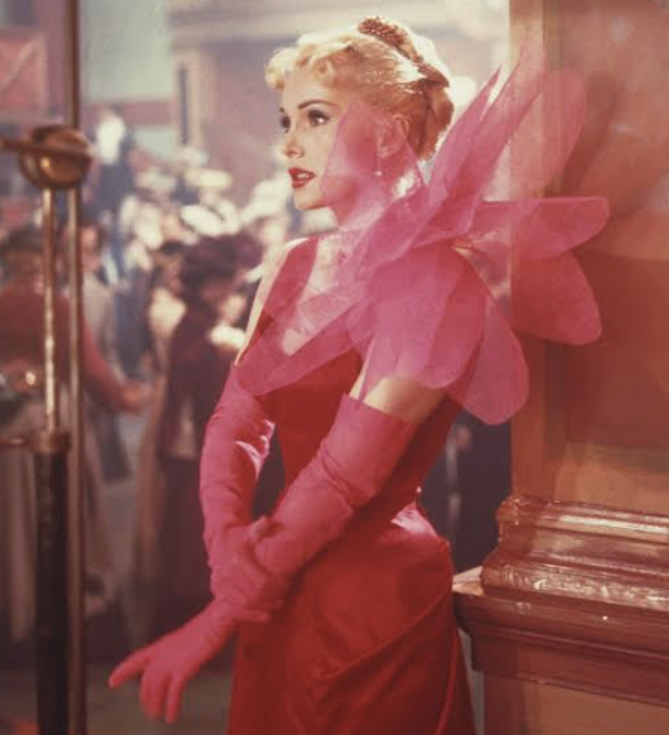
In Hollywood, the color became synonymous with glamour and seduction. When Marilyn Monroe sealed her status as a sex symbol in the 1953 musical Gentlemen Prefer Blondes, it was in a strapless, Shocking Pink gown that seemed to radiate heat. The dress became one of the most iconic costumes in cinema history, a perfect match for Monroe’s breathy voice and unmistakable charisma. Decades later, Zsa Zsa Gabor shimmered in a Schiaparelli dress of the same unforgettable shade in the 1952 film Moulin Rouge, proving that the color was just as potent on screen as it was on the runway.
The influence of Shocking Pink extended far beyond fashion. It appeared in interior design, in graphic art, in advertising, and in popular culture. It became a symbol of the 1980s, with its obsession with excess and power dressing, and it has continued to be a potent force in contemporary culture. From the pink pussy hats of the Women’s March to the vibrant pink of Barbie’s world, the shade that Schiaparelli invented continues to resonate, a testament to its enduring power and versatility.
The Science and Psychology of Shocking Pink
There is something almost primal about the impact of Shocking Pink. Color psychologists have long noted that pink is a color that calms and soothes—it is often used in prisons and hospitals to reduce aggression and anxiety. But Shocking Pink is something else entirely. Its intensity is closer to red than to conventional pink, and red is the color of passion, danger, and excitement. It raises heart rates, increases adrenaline, and demands attention. Shocking Pink does all of this and more, combining the energy of red with the femininity of pink to create something that is both alluring and unsettling.
The fashion industry, of course, has long understood the power of color to influence mood and behavior. Schiaparelli was not the first designer to use color as a statement, but she was certainly one of the most effective. Her understanding of color was intuitive and deeply personal—she once said that “color is the essence of life,” and she approached it with the same passion and creativity that she brought to everything else. Shocking Pink was not just a shade; it was an idea, a philosophy, a way of seeing the world.
The Legacy of Shocking Pink
Elsa Schiaparelli closed her couture house in 1954, the year before she published her witty, irreverent autobiography, Shocking Life. But the legacy of her signature color has never faded. It remains a color of defiance, creativity, and unapologetic joy. It is the color of the modern woman—bold, confident, and unafraid to stand out.
The house of Schiaparelli was revived in the 21st century, and “Schiap” pink continues to be a powerful tool in its modern collections. Designers like Bertrand Guyon and Daniel Roseberry have embraced the color as a direct line to the house’s Surrealist, rule-breaking roots, using it in everything from stunning evening gowns to whimsical accessories. In 2023, the color made a spectacular return to the runway, confirming that Shocking Pink is as relevant today as it was nearly a century ago.
More than just a shade, Shocking Pink is the color of an idea—the idea that fashion should be fun, fearless, and have the power to shock. It is a color for those who, as Schiaparelli said of herself, are “definitely difficult.” It is a color for women who refuse to be ignored, who embrace their sexuality and their power, who understand that fashion is not just about clothing but about identity, about communication, about making a statement.
Shocking Pink in the 21st Century
Today, Shocking Pink is everywhere. It is the color of Lady Gaga’s iconic outfits, of the viral pink dresses that dominate social media, of the unapologetically feminine aesthetic that has become so popular in recent years. It is the color of the modern feminist movement, a symbol of strength, solidarity, and the refusal to be silenced. It is the color of joy, of celebration, of the simple, radical act of being yourself.
Fashion historians often note that Schiaparelli was ahead of her time, and nowhere is this more evident than in her use of color. She understood, long before anyone else, that pink could be a weapon, a shield, a statement of intent. She saw its potential to shock, to challenge, to inspire. And in creating Shocking Pink, she gave the world a gift that has never stopped giving.
Elsa Schiaparelli’s Shocking Pink is more than just a color—it is a legacy. It is the story of a woman who refused to play by the rules, who saw fashion as a form of art and a means of self-expression, who understood that sometimes, the most radical thing you can do is wear a dress that screams with joy. It is the color of defiance, of creativity, of unapologetic femininity. And it is a reminder that even in the darkest times, there is always room for a little bit of shock.
So the next time you see a flash of vibrant, electric pink, remember the woman who made it possible. Remember Elsa Schiaparelli, the Surrealist, the rebel, the visionary. Remember that this color was born from a moment of inspiration and a lifetime of audacity. And remember that Shocking Pink is not just a shade—it is a way of life.