The bars, kitchens and late-night rooms shaping the city now. Start in Príncipe Real and let the evening unfold.
A Century of Private Tradition
Tucked away in one of the most expensive zip codes in the United States lies The Los Angeles Country Club (LACC), a 320-acre oasis of tranquil greenery shrouded in decades of privacy and prestige. Flanked by Beverly Hills and the bustling towers of Century City, this ultra-exclusive club boasts a rich history, strict traditions, and world-renowned course architecture.
Founded in 1897 as the “Los Angeles Golf Club,” the institution migrated across several locations during the sport’s early boom in Southern California. Its humble beginnings featured a makeshift clubhouse built inside an abandoned windmill — a detail so central to the club’s origin story that the first course was nicknamed “The Windmill Links.” From there, the club moved briefly to a site nicknamed the “Convent Links,” behind a convent near Rosedale Cemetery, before finally settling in 1911 on its permanent flagship location straddling Wilshire Boulevard. That property, still home to the club today, spans roughly 320 acres and connects to Wilshire Boulevard’s own namesake developer, Henry Gaylord Wilshire, who was himself an original member of the club back in 1897.
For generations, LACC maintained an intensely private profile, routinely turning down requests to host major televised tournaments. But the club’s reputation for exclusivity ran deeper than simple privacy — it became legendary in Hollywood circles for its long-standing refusal to admit actors, entertainers, and comedians as members. The stories are practically folklore in Los Angeles golf history: a member who once nominated an actor for membership saw not only the actor rejected but his own membership revoked as punishment. Bing Crosby, an accomplished golfer in his own right, was turned away and instead spent his career playing at nearby Lakeside Golf Club. Groucho Marx’s famous line — “I refuse to join any club that would have me as a member” — became something of a self-fulfilling prophecy when clubs like LACC obliged him by keeping their doors shut to entertainers, sending him instead to the Jewish-founded Hillcrest Country Club across town. The one celebrated exception was actor Randolph Scott, who reportedly talked his way past the ban by insisting, “I’m no actor, and I’ve got pictures to prove it,” helped along by his marriage into an established industrial fortune.
Ronald Reagan was, in fact, a member of LACC — but this is generally attributed to his standing as a former U.S. president rather than to his earlier career as a Hollywood actor and president of the Screen Actors Guild. The club’s restrictive membership practices extended well beyond the entertainment industry; like many elite clubs of its era, LACC also excluded Jewish and Black members for decades, and only began integrating in earnest under mounting social and legal pressure through the late twentieth century. Unlike its Hollywood-friendly neighbors — Riviera, Bel-Air, Hillcrest, and Lakeside among them — LACC long favored an old-money, oil-and-industry membership over Hollywood fanfare, a posture that shaped its identity for the better part of a century.
The Crown Jewel Layouts
The property features two distinct, 18-hole championship courses, with hidden tunnels running beneath Wilshire Boulevard seamlessly connecting the two sides of the property, so that members and, briefly, U.S. Open galleries could move between them without ever setting foot on the street above.
The North Course
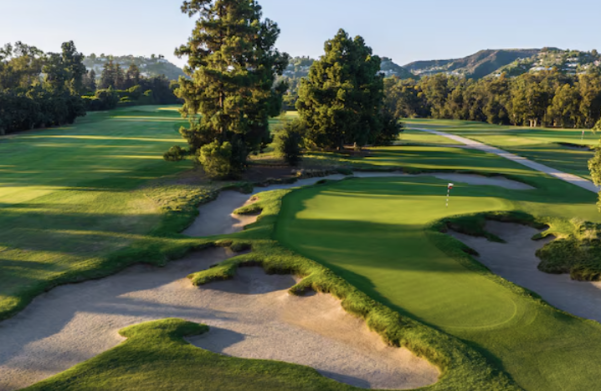
The layout’s roots trace back to the club’s founders, who laid out the original fairways upon arriving at the Wilshire site in 1911. English architect Herbert Fowler redesigned the course in the early 1920s, and it was golf architect George C. Thomas Jr. — fresh off his celebrated work at Bel-Air and Riviera, the other two jewels in his Los Angeles trio — who, working alongside associate William P. Bell, reshaped the North Course into its now-legendary form by 1927–28. The result is a course renowned for rugged terrain, dramatic elevation changes, and a natural dry riverbed (the barranca) snaking through the front nine as a signature hazard, with the routing famously described as a “course-within-a-course” for the way it loops and doubles back across the property.
Between 2006 and 2010, the club undertook a major restoration project, bringing in architect Gil Hanse and his partner Jim Wagner in 2009 to lead the effort, assisted by Thomas historian and biographer Geoff Shackelford. Archived photographs, written club records, and physical excavation of long-buried landforms guided the work, as decades of tree growth, shrunken greens, and worn-down, over-rounded bunkers had dulled much of Thomas’s original design. Hanse’s team also revived a long-forgotten short hole — nicknamed “Little 17” — a roughly 110- to 120-yard par 3 with a distinctive perched green that Thomas himself had preserved from Fowler’s original design but left out of regular play. It now exists as an alternate hole in the routing, a charming nod to the course’s layered history.
The South Course
Redesigned by Gil Hanse and Geoff Shackelford, with construction beginning in 2015 and the course reopening in 2016, the South Course offers a shorter, more charming, and traditional parkland-style alternative to its daunting northern sibling. Drawing inspiration described by the architects as being “in the spirit of Augusta National,” it favors wide fairways transitioning into native grasses, minimal punishing rough, and intricate green complexes over the North’s rugged, hazard-strewn intensity. Like its sibling, the South Course shares the tunnel system beneath Wilshire Boulevard, with holes on either end sitting on the north side of the boulevard and the bulk of the routing crossing to the south.
Stepping Into the Global Spotlight
Though historically publicity-shy, LACC modernized its approach in the 21st century, a shift underscored by the fact that more than 90 percent of the club’s members ultimately voted to approve bringing a major championship to their grounds. The club hosted the prestigious Walker Cup in 2017, where Team USA defeated Great Britain & Ireland 19 to 7 on the freshly restored North Course. However, its true introduction to the wider sports world arrived when the USGA selected LACC to host the 123rd U.S. Open in 2023 — the first U.S. Open in Los Angeles in 75 years, and the club’s first major championship broadcast to a national audience.
The tournament showcased the course’s signature variety: a par 3 at the 11th that can stretch to nearly 300 yards paired elsewhere in the round with the tiny 15th, which often plays at just 90 yards, alongside a front-nine pairing of a short, 330-yard par-4 6th and a long, 284-yard par-3 7th. That volatility, combined with jagged bunkers, blind tee shots, heavy sloping fairways, and sweeping vistas of the Los Angeles skyline, made for a demanding, occasionally divisive test — reigning champions Brooks Koepka and Matt Fitzpatrick, along with Viktor Hovland, were among the players who publicly criticized the blind shots and severe slopes on the kikuyu-grass fairways and rough. Wyndham Clark, however, thrived in the conditions, winning his first major title at 10-under-par 270 and holding off a hard-charging Rory McIlroy by a single stroke.
Today, the club stands as a striking monument where historic golf architecture merges with the luxury of old-school Southern California exclusivity — a place whose walls, both literal and social, kept the wider world out for over a century before finally opening, if only briefly, for its close-up.
Architectural Restoration of the North Course
The 2009–2010 restoration of the North Course by Gil Hanse and Jim Wagner, with historical guidance from Geoff Shackelford, brought the layout back to its golden-age roots as shaped by George C. Thomas Jr. and Billy Bell. Rather than modernizing the course, the team leaned on archival photographs, written club records, and physical excavation of buried features to guide the work, restoring a routing and set of green sites that had been slowly eroded by decades of tree growth and maintenance drift.
- Bunkering Style: Hanse’s team moved the course away from the standardized, circular sand traps it had evolved into over the decades, reviving the rugged, visually striking bunkering style originally crafted by Thomas’s associate, William P. Bell.
- The Barranca: The design team cleared away decades of overgrown brush to re-expose the natural dry riverbed threading through the front nine. It remains one of the course’s defining hazards, forcing players to navigate around and across it repeatedly.
- “Little 17”: Hanse’s team resurrected the short, roughly 110-to-120-yard hole with its distinctive perched green — a hole Fowler originally designed and that Thomas chose to preserve rather than alter, even after it fell out of regular use for decades.
- Extreme Par-3 Contrast: The restoration preserved Thomas’s unique routing quirks on the back nine, most notably the par-3 11th, which can stretch to nearly 300 yards, set against the tiny par-3 15th, which often plays at just 90 yards — one of the most dramatic yardage swings between two holes of the same par anywhere in championship golf.
- Half-Par Holes: The front nine offers its own rhythm-breaking pair in the short, 330-yard par-4 6th followed immediately by the long, 284-yard par-3 7th, creating swings in difficulty that keep players and spectators alike off balance throughout the round.
Major Championship Legacy
LACC’s tournament history highlights its transition from an isolationist enclave to a global stage:
| Year | Event | Notable Outcome / Champion |
| 1926 | Los Angeles Open | Inaugural event won by Harry Cooper |
| 2017 | The Walker Cup | Team USA defeated Great Britain & Ireland, 19–7 |
| 2023 | U.S. Open | Wyndham Clark won his first major title, holding off Rory McIlroy |