For more than 80 years, this Wisconsin-born company has defined what a premium kitchen appliance can be — not just a box that keeps food cold, but a precision instrument built to preserve freshness, elevate design, and last for decades. Its history is unusually personal for an industrial manufacturer: a single family has owned and run the company since its founding, and the same instinct that drove its founder to build a better freezer in his own basement still shapes how Sub-Zero, and its sibling brands Wolf and Cove, are built today. What began as a one-man engineering problem in Depression-era Wisconsin has grown into a company whose name is now shorthand, in real-estate listings and design magazines alike, for a kitchen that spared no expense.
A Company Born from a Personal Need
Sub-Zero’s origin story is as personal as it gets. Westye F. Bakke, the son of Norwegian immigrants, moved to Madison, Wisconsin, in the mid-1920s and found work as a refrigerator salesman, first for Frigidaire and later for York, an industrial refrigeration company. In the 1930s, while his young son Bud was diagnosed with juvenile diabetes, Bakke began tinkering with refrigeration prototypes on the side, searching for a reliable way to keep his son’s insulin at a safe, consistent temperature. That very personal problem became the seed of an entire industry.
It was also during this period, amid the Great Depression, that Bakke’s reputation as a skilled refrigeration engineer reached architect Frank Lloyd Wright, a fellow Wisconsinite. Wright hired Bakke as a consultant to design custom refrigeration units for several of his projects, including the Johnson Wax Building and the Wingspread estate. That collaboration — which predates Sub-Zero’s founding by more than a decade — gave Bakke an early education in marrying engineering with architectural design, an ethos that would define the company he later built.
In 1943, not satisfied with selling other companies’ refrigerators, Bakke built his first free-standing freezer from scrap in his own basement, bending the coils into shape by hand and improvising materials that were scarce during wartime. Two years later, on August 20, 1945, he officially founded the Sub-Zero Freezer Company in Madison, Wisconsin, starting with just three employees, including his teenage son Bud. The name itself came from the achievement at the heart of the product: the introduction of the first ultra-low-temperature food preservation system capable of reliably holding temperatures below zero — literally “sub-zero.”
Bud Bakke, who had joined the company as one of its original three employees, went on to earn agriculture and mechanical engineering degrees from the University of Wisconsin before returning full-time to lead product development. Working alongside designer Bob Kelly, he helped refine the company’s early models, sourcing better interior lighting and developing the freezer drawers that remain a familiar feature of home refrigerators today. Bud eventually took over leadership of the company from his father in the early 1970s, and his own son, Jim Bakke, later became the third generation of the family to run Sub-Zero, a role he still holds today as President and CEO.
A Legacy of Firsts
What set Sub-Zero apart from the beginning was a relentless focus on innovation:
- Dual refrigeration — in the mid-1950s, Sub-Zero introduced separate, sealed refrigeration systems for the refrigerator and freezer compartments, preventing food odors and moisture from transferring between the two and keeping food fresher for longer.
- Built-in, cabinet-flush design — in the late 1950s, as kitchen designers began pursuing a “total kitchen” look, Sub-Zero pioneered the built-in refrigeration category, introducing the first cabinet-flush unit with a recessed front that let each appliance be customized to match a kitchen’s décor. The approach became so closely associated with the brand that by the 1960s, “Sub-Zero kitchen” had entered the real-estate lexicon as shorthand for a home that gets all the high-end details right.
- NASA-inspired air purification — in 2008, Sub-Zero introduced an air purification system based on technology originally developed for NASA, which scrubs ethylene gas and odors from the air inside the refrigerator roughly every 20 minutes, helping produce stay fresh far longer than in a standard fridge.
- Integrated and furniture-style refrigeration — on September 1, 1964, Sub-Zero launched a line of refrigerated units designed to be built into bar counters, dining furniture, and even living-room tables. By 1967, built-in models had become Sub-Zero’s best-selling format, accounting for roughly 70% of all sales, further cementing the brand’s reputation for design flexibility.
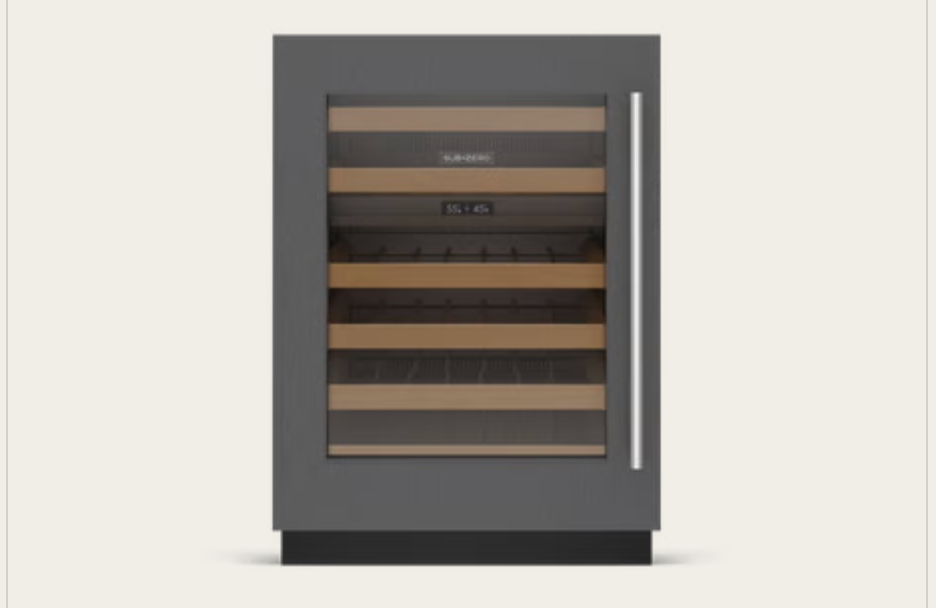
- Dedicated wine preservation — in 1999, Sub-Zero launched its 400 Series wine storage units, engineered with independent temperature zones to guard against what the company calls wine’s four enemies: heat, light, humidity, and vibration. It was the company’s first major expansion beyond food refrigeration.
Expanding the Family: Wolf and Cove
Sub-Zero didn’t stay a single-product company forever. In 2000, the company acquired the residential appliance line of the Wolf Range Company, a manufacturer with more than 75 years of experience building ranges and cooktops for professional kitchens, bringing that same commercial-grade temperature control into home kitchens for the first time under the Sub-Zero umbrella. The company introduced more than a dozen new Wolf products in the years that immediately followed the acquisition, and by 2005 had grown the young cooking division to several times its original size, unveiling the PRO 48 professional-style refrigerator that same year as a showcase of the two brands working in tandem. Wolf products today span kitchen ranges, cooktops, wall ovens, warming drawers, and ventilation equipment.
Then, in 2018, the family grew again. Sub-Zero and Wolf launched Cove, a line of dishwashers introduced at the Architectural Digest Design Show and positioned as the specialist in all things clean, completing a full trifecta of kitchen appliance brands after roughly six years of research and development. Cove dishwashers launched with an industry-best five-year warranty on all parts and service, and the brand was folded into the same nationwide network of service providers that had long supported Sub-Zero and Wolf, so owners of all three brands could rely on a single, familiar standard of support.
Today, Sub-Zero Group, Inc. is a privately held, family-owned American manufacturer now in its third generation of family leadership — Jim Bakke, Westye’s grandson, serves as President and CEO. The company specializes in high-end refrigeration, cooking, and dishwashing products under its Sub-Zero, Wolf, and Cove brands, with headquarters in Madison, Wisconsin, and manufacturing facilities in nearby Fitchburg, Wisconsin, and in Goodyear, Arizona.
Quality Control
Quality control at Sub-Zero is famously rigorous. The company puts every single refrigerator it manufactures through intensive quality testing using a specially designed computer program — a 100% testing standard the company says is exclusive to Sub-Zero within its industry. In a further test of its own claims, Sub-Zero even grows its own lettuce in-house just to verify that produce still stays fresh after two weeks inside one of its refrigerators. Individual components are pushed even further before a design is approved for production: major parts undergo extreme stress testing, and finished units are cycled through their doors and controls hundreds of thousands of times to simulate decades of everyday use before a single model reaches a showroom floor.
A Brand Built to Last
Sub-Zero appliances occupy a firmly premium tier of the market — prices for its refrigerators start around $9,000 — but the company positions that cost around longevity and performance rather than novelty. Its appliances are designed and tested with a target lifespan exceeding 20 years, and the seals on Sub-Zero doors are engineered so tightly that some owners report frozen food staying solid even after several days without power.
That reputation for durability sits alongside a design pedigree the company has cultivated for decades, dating back to Frank Lloyd Wright’s early endorsement. Sub-Zero appliances remain a fixture in high-end residential design and are regularly found in the homes of celebrities and design-conscious homeowners across the country, and the company runs an ongoing Kitchen Design Contest that has recognized design professionals from around the world for nearly three decades. The company has also leaned into sustainability in recent years: more than 75% of the stainless steel and up to half of the plastic used in Sub-Zero refrigerators is recycled material, a practice the company says keeps hundreds of tons of scrap out of landfills each year, and dozens of Sub-Zero models carry the Energy Star rating for efficiency.
More than eight decades after Westye Bakke bent his first coils by hand in a Madison basement, that same combination of personal obsession and engineering discipline still defines the brand — one that started as a father’s attempt to keep his son’s insulin cold, and grew into one of the most recognized names in American luxury design.