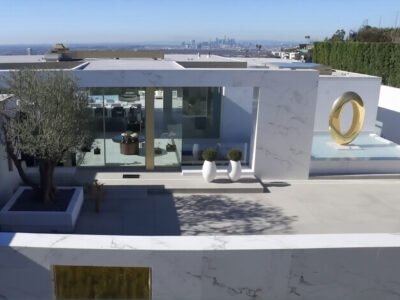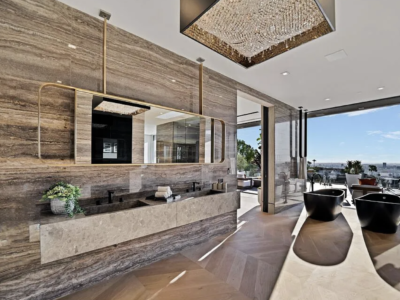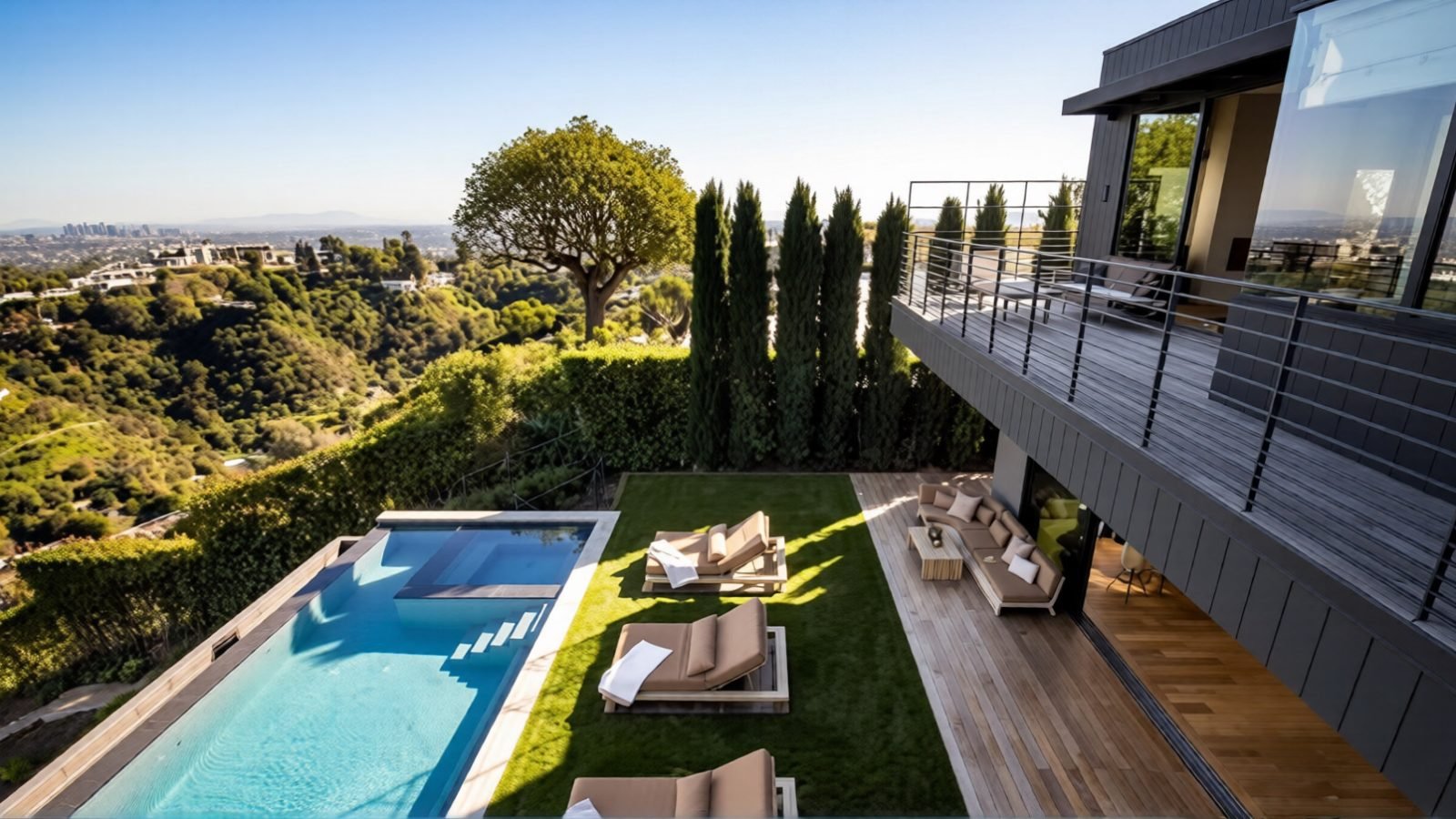
Beyond its record-setting sale price, 10671 Chalon Road stands as a fascinating case study in luxury home design. The estate acts as an architectural bridge, bringing together sleek modern minimalism and the golden age of classic Hollywood design. Set on a knoll in lower Bel-Air, moments from the Hotel Bel-Air, the compound pairs a contemporary main mansion with a historic guest house designed by one of Los Angeles’s most celebrated architects.
The estate last changed hands in December 2021, when a tech CEO paid $133 million for the property — one of the highest residential prices ever recorded in Los Angeles County and roughly $48 million more than the $85 million the previous owner, Japanese businessman Hideki Tomita, had paid for it in 2018. Altogether the compound spans four contiguous parcels totaling roughly 4.6 acres, tucked into the same enclave of lower Bel-Air that surrounds the Hotel Bel-Air and sits only minutes from both UCLA and the Bel-Air Country Club — an area of Los Angeles long favored by entertainment and business figures seeking privacy behind hedges and gates rather than street-facing grandeur.
The property’s history reflects the broader arc of Bel-Air real estate over the past century: a mid-century estate quietly built for a private family in the 1940s, later joined — after decades of separate ownership — to a strikingly contemporary neighbor commissioned by a fashion-and-hospitality-adjacent international clientele in the 2000s, and ultimately assembled into a single trophy compound that has traded hands twice in the last decade for record-setting sums.
The Pawson-Designed Main Residence
The primary residence at 10671 Chalon Road is a work of minimalist design. Spanning 18,023 square feet of living space with 6 bedrooms and 10 bathrooms, it was envisioned by the internationally renowned English minimalist architect John Pawson — reportedly his only completed residential project in Los Angeles — and was built between 2009 and 2010. The house is composed essentially of two stacked volumes, with the upper level cantilevered dramatically over the lower one. Pawson’s signature clean lines and open volumes are paired with warm, textural interior finishes curated by luxury design firm Atelier AM, while landscape designer Jonathan Bell laid out the surrounding grounds.
The home’s amenities are more restrained than the sprawling entertainment complexes found in some of Bel-Air’s newest megamansions, but still decidedly high-end: a home theater, a private gym and spa area, a subterranean level with staff quarters and a children’s playroom, and a motor court for arriving guests. The property commands sweeping views stretching from downtown Los Angeles across the basin toward the Pacific.
The surrounding grounds include a lighted tennis court, a cabana, and two swimming pools — one serving each of the estate’s two residences. It is worth flagging a common mix-up in online coverage of Los Angeles’s priciest homes: several real-estate round-up articles attach a very different, far more extravagant set of amenities to this address — a nightclub, a full-service commercial salon and spa, a 40-seat theater, a 10,000-square-foot sky deck, five swimming pools, a putting green, and a 400-foot outdoor running track. Those features actually describe a separate, unrelated Bel-Air megamansion (a much larger, 21-bedroom modern spec estate built by a different developer), and there is no evidence any of them exist at 10671 Chalon Road. The mansion at Chalon Road is a considerably more restrained, architect-led residence rather than an amenity-stacked spec build, and its real amenity list — while still lavish by ordinary standards — is far shorter than the one that regularly gets attached to it online.
Pawson, born in Yorkshire in 1949, never formally qualified as an architect — after an early stint studying in Japan under designer Shiro Kuramata, he founded his own London studio in 1981 and built his reputation designing austere, light-filled spaces for clients including Calvin Klein (whose Madison Avenue flagship became his career-defining commission), Jil Sander, and hotelier Ian Schrager, as well as churches, a Cistercian monastery in the Czech Republic, and London’s Design Museum. The Chalon Road commission is regarded as one of his few completed private residences in Los Angeles.
The interiors were shaped by Atelier AM, the Los Angeles design firm founded in 2002 by husband-and-wife team Michael and Alexandra Misczynski. Known for keeping a low public profile despite a client roster that has included Tom Cruise and collaborations with architects such as Richard Meier, the Misczynskis built their reputation on a restrained, materials-driven aesthetic that mixes European antiques and rough-hewn textures into contemporary architecture — an approach well suited to softening the austerity of a Pawson shell without compromising its clean geometry.
The Paul R. Williams Guest House
Directly adjacent sits the independent secondary residence at 10693 Chalon Road. This 6,341-square-foot guest house was built between 1941 and 1943 by legendary architect Paul R. Williams, providing an additional 5 bedrooms and 5 bathrooms of mid-century Hollywood elegance in a Colonial-influenced style. Williams — one of the first prominent Black architects in the United States and a favorite of the era’s Hollywood elite — designed the structure roughly seven decades before Pawson’s minimalist mansion rose beside it, giving the compound its unusual split personality.
Williams overcame significant racial barriers to build one of the most prolific careers in American architecture. Orphaned as a child and raised in Los Angeles, he became the first Black member of the American Institute of Architects in 1923, at age 29, and went on to work on nearly 3,000 buildings over roughly five decades — private homes for Hollywood stars such as Frank Sinatra and Lucille Ball alongside civic landmarks, churches, and hospitals. He was posthumously awarded the AIA Gold Medal in 2017, becoming the first Black architect to receive the honor.
The $133 million paid for the Chalon Road compound places it among a small cluster of nine-figure Bel-Air trades in recent years, a neighborhood where deals of this scale have become almost routine at the very top of the market: the Chartwell Estate on Bel Air Road sold for $150 million in 2019, and a Nimes Road property fetched $110 million in a 2025 sale. Unlike many of those record-setting neighbors, however, the Chalon Road compound draws its value less from sheer scale or amenity count than from its architectural pedigree — pairing a rare completed Pawson residence with an equally rare surviving Williams-designed guest house on a single title.
Together, the two residences form a private sanctuary that is unusual even by Bel-Air standards: a single walled and gated compound spanning two architectural eras, connected by little more than a private drive and a shared sense of seclusion just minutes from UCLA and the Bel-Air Country Club. Where the main house trades on restraint and negative space, the guest house trades on period detail and craftsmanship — and it is that contrast, more than the amenity count, that makes 10671 Chalon Road a genuinely distinctive property even in a neighborhood accustomed to superlatives.