High above the Bel-Air Country Club, on a private knoll in the section of the neighborhood known as Lower Bel Air, sits a French colonial-style estate that has quietly tracked the arc of two very different fortunes. 10911 Chalon Road was Elon Musk’s first major real estate purchase and, for a time, his primary Los Angeles residence. Today it belongs to Chinese gaming billionaire William Ding, founder of NetEase — and it just returned to the market for $49.8 million, roughly $20.8 million above what Ding paid for it in 2020.
From Rental to Trophy Purchase
Elon Musk’s relationship with the property predates his ownership of it. He first rented the Chalon Road mansion around 2010, before buying it outright in December 2012 for $17 million, according to property records and contemporaneous reporting. It was, at the time, his first big-ticket real estate purchase and the anchor of what would become a sprawling Bel Air real estate footprint — Musk went on to acquire several more nearby properties on Chalon and Somera Roads over the following years, including a home once owned by actor Gene Wilder.
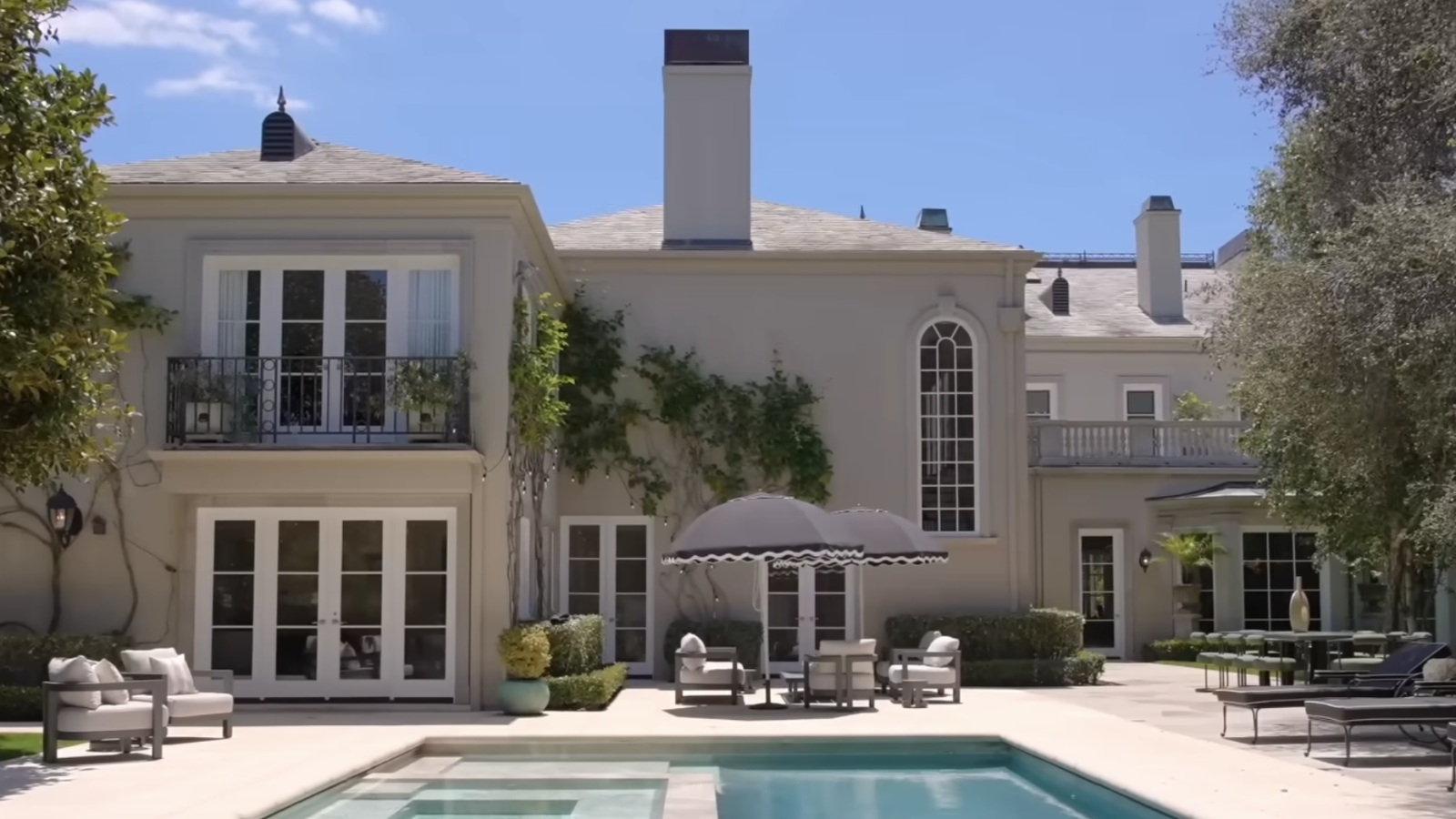
The Chalon estate itself was built in 1990 and sits on roughly 1.7 acres. Structured as a grand French colonial, it offered Musk seven bedrooms, a two-story library, a wine cellar, a home theater, a tennis court, and sweeping views toward the Bel-Air Country Club below and the Los Angeles skyline beyond. Forbes writer Hannah Elliott, who toured the home with Musk for a 2012 cover story, described a “deep, dark wine cellar,” a “two-story stark white library complete with rolling ladder,” and a home theater outfitted for video games — details that later became part of the property’s lore as one of the defining Silicon Valley executive homes of the 2010s.
Musk’s declaration of owning no home sets off a rapid liquidation of his California real estate portfolio — at the time reported to include six Bel Air properties and a Northern California estate collectively worth more than $100 million. The Chalon Road mansion, initially asking $30 million, sold within weeks. By June 2020, records show it had changed hands for $29 million.
The buyer was tied to William Ding, the Chinese billionaire founder and CEO of NetEase, one of China’s largest internet and online gaming companies. Ding built his fortune from a company he started in 1997 with roughly $60,000 in seed capital; NetEase has since grown into a diversified technology conglomerate spanning gaming titles like Fantasy Westward Journey and Eggy Party, e-commerce, music streaming, and even a sustainable pork-farming venture that made international headlines when it launched. Ding was China’s richest person as far back as 2003 and has remained a fixture on global billionaire rankings ever since; recent estimates from Forbes and Bloomberg put his net worth in the high-$30-billion to low-$40-billion range.
Inside the Estate Today
Under Ding’s ownership, the Chalon Road property underwent extensive renovation. The current listing — held by Rayni Williams and Victoria Risko of The Beverly Hills Estates — describes a 20,248-square-foot residence with seven bedrooms and thirteen bathrooms, positioned behind gates at the end of a long private driveway. The renovated interior leans into “expansive entertaining spaces, soaring ceilings and exceptional finishes,” anchored by a two-story library and a temperature-controlled, 1,000-bottle wine cellar. Other amenities include a state-of-the-art fitness center, a dedicated children’s wing, and a separate two-room guest suite for visitors.
Outside, the estate retains the entertaining infrastructure that defined it under Musk’s ownership: a pool and spa, a lighted championship tennis court, and a five-car garage and motor court. The knoll-top position gives the home sweeping views across the Bel-Air Country Club, the downtown Los Angeles skyline, and the Pacific Ocean beyond — a sightline shared by few other properties in the immediate area. The location also places the home near some of the Westside’s other landmarks: the Getty Center sits nearby on its own hilltop, and the Stone Canyon Reservoir and Franklin Canyon Park trails offer a quieter, more natural counterpoint just minutes from the gated compound.
A $20 Million Markup, Five Years Later
The relisting at $49.8 million represents close to a 72 percent increase over the reported $29 million Ding paid in 2020 — a spread real estate outlets have attributed largely to the extent of the subsequent renovation combined with the general appreciation of ultra-prime Lower Bel Air real estate over the past five years. Whether the property fetches close to its ask will be watched closely by the local luxury market, both because of its documented sale history — a relative rarity in a market where most transactions are shielded by trusts and LLCs — and because of its continued association with Musk, whose net worth and public profile have only grown since he left the property.
That association has, if anything, intensified recently. Following SpaceX’s initial public offering in mid-2026, Musk was briefly deemed the world’s first trillionaire, before a subsequent drop in share prices trimmed tens of billions of dollars from his fortune; as of the Chalon Road relisting, Forbes pegged his net worth at roughly $930 to $950 billion. Musk himself has long since relocated his primary residence out of California, splitting time in Texas between a small prefabricated house near SpaceX’s Starbase facility and a larger property near Austin — a stark contrast to the nine-figure Bel Air compound he once called home and that now, under new ownership, is being pitched to its next ultra-wealthy buyer.
Musk’s Bel Air Buying Spree, in Context
The Chalon Road purchase was just the opening move in what became a years-long Bel Air acquisition run for Musk. Within a year of buying 10911 Chalon, he paid $6.75 million for the three-bedroom Gene Wilder property directly across the street, reportedly converting part of it into a private schoolhouse for his children — he later described it to Vogue as “like a little schoolhouse on the prairie, except in Bel-Air on a golf course.” He continued adding to the footprint with a $20 million ranch house in 2015 and an unfinished mansion picked up for $24.25 million in 2016, eventually assembling a cluster of properties reported to be worth more than $70 million combined. All of the purchases ran through LLCs, a common structure for high-profile buyers seeking a layer of privacy in public property records.
Seen against that backdrop, the 2020 sale of 10911 Chalon Road wasn’t just the disposal of a single asset — it was the first domino in the unwinding of a real estate strategy Musk had pursued for nearly a decade. The property fetched $29 million against a $30 million ask, a relatively narrow discount that reflected both the strength of the ultra-luxury market at the time and the appeal of a home with Musk’s direct ownership attached to it.
Why the House Still Matters
10911 Chalon Road occupies an unusual niche in Los Angeles real estate lore: it’s neither a purpose-built architectural showpiece like many of Bel Air’s newer spec mansions, nor an anonymous trophy asset passed quietly between shell companies. Its value lies substantially in its documented provenance — a rare paper trail connecting two of the most recognizable entrepreneurs in the world, first as Musk’s declaration-making exit from California homeownership and now as a test of how far Lower Bel Air pricing has run since 2020. For prospective buyers, it offers something increasingly hard to find in this segment of the market: an estate with a clear, well-reported ownership history, sitting on one of the neighborhood’s most coveted knolls, with the scale and amenity list expected of a property asking just shy of $50 million.