listen to the audio of this article
Some records fall with fanfare — a bidding war, a public listing, a press tour timed for maximum effect. This one fell in silence. In June 2024, a nine-and-a-half-acre oceanfront compound on Malibu’s western edge changed hands for $210 million without ever officially reaching the market, quietly resetting the ceiling on what a house can sell for in California. The seller was Oakley founder James Jannard. The buyer, veiled behind a Delaware LLC, has never been named. And the house itself — a Palladian-inflected estate perched above 300 feet of private sand near El Pescador State Beach — has spent more than three decades passing between the kind of owners whose stories read like a history of American excess in miniature.
A Pedigree Written in Nine-Figure Sums
Long before Jannard ever saw the property, 33064 Pacific Coast Highway was already accumulating a reputation. Built between 1989 and 1993 for casino heiress Verna Harrah, with interiors originally shaped by Joanna Shimkus Poitier, the estate first entered the public record as the residence of Herbalife co-founder Mark Hughes, who lived there until his death from a drug overdose on the property in 2000. From Hughes’s estate, the compound passed in 2002 to Howard Marks, the billionaire co-founder of Oaktree Capital Management, who paid $31 million and subsequently remodeled and expanded the residence. Marks sold it in 2012 to Jannard for $75 million — a figure that, at the time, already ranked among the largest residential transactions in Malibu history. Twelve years later, Jannard’s exit at $210 million represented nearly a threefold return, and a new high-water mark for the entire state.
Palladian Bones, Michael Smith Polish
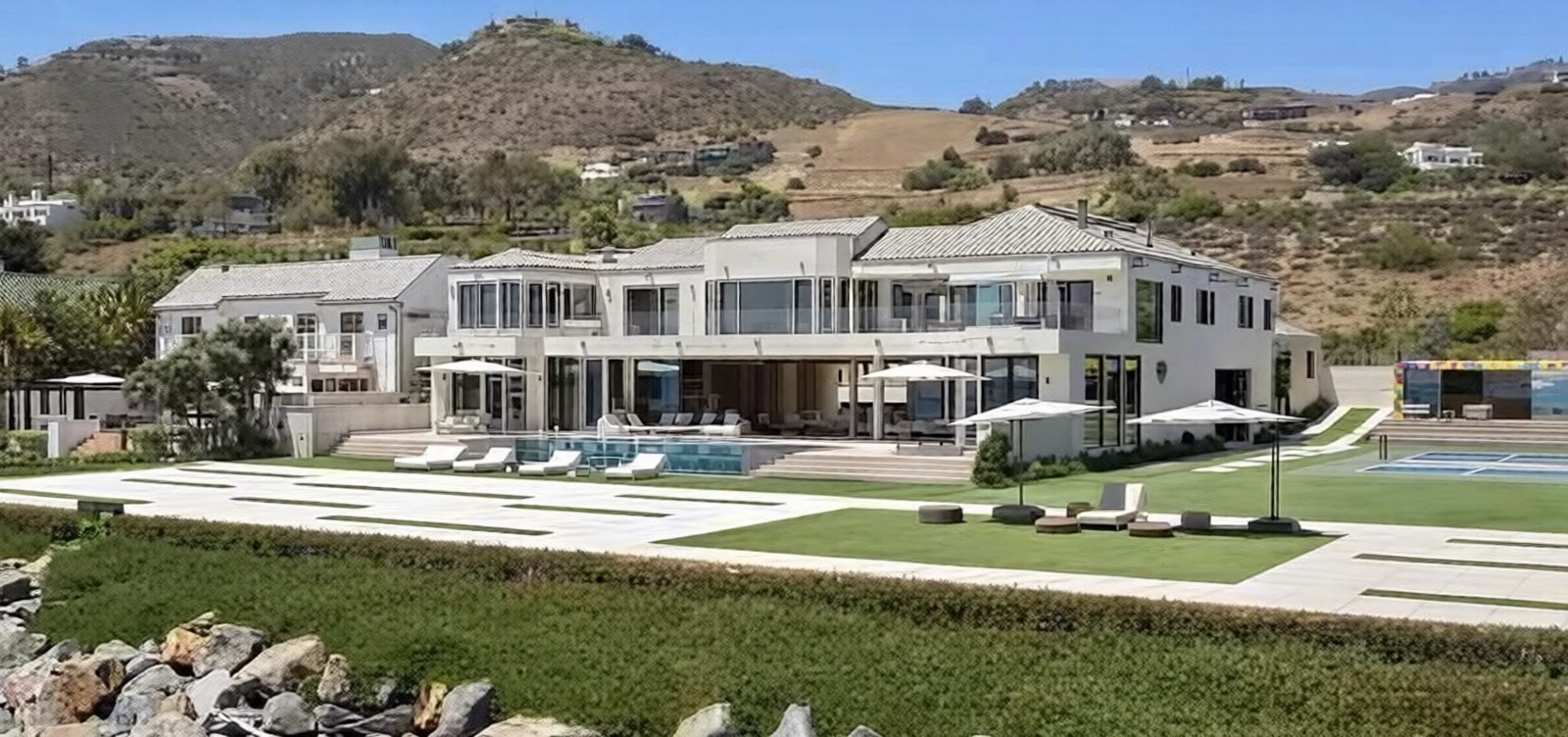
Architecturally, the estate is a study in restraint by the standards of ultra-luxury Malibu, where glass-walled Modernism tends to dominate the coastline. Designed by Ferguson & Shamamian Architects, the more than 15,000-square-foot main house draws on Palladian classicism — ornate columns, beamed ceilings, formal proportions — a deliberate departure from the area’s more common Richard Meier-indebted, white-cube aesthetic. Eight bedrooms and fourteen bathrooms are arranged around interiors handled by designer Michael S. Smith, whose past clients include the White House itself; his work at 33064 Pacific Coast Highway favors the same warm, tailored formality he brought to the Oval Office redesign, expressed here through steel-and-glass window walls that soften the classicism just enough to let the Pacific back in.
Outside, the property unfolds with the scale of a private resort rather than a single residence: a grand entry courtyard framed by manicured gardens gives way, at the rear, to a flat lawn and a pool positioned to look as though it drops straight into the ocean beyond. A gym and a pair of guesthouses round out the compound, all of it sitting atop a stretch of genuinely rare Malibu real estate — nearly ten acres, with 300 feet of ocean frontage, a combination that’s become almost impossible to find intact anywhere along this coastline.
An Off-Market Deal in a Very Public Arms Race
What makes the $210 million sale especially notable is the company it kept — and the way it was done. The deal quietly surpassed the previous state record of $200 million, set only a year earlier when Jay-Z and Beyoncé purchased a six-acre, roughly 40,000-square-foot concrete compound elsewhere in Malibu. Before that, the benchmark belonged to venture capitalist Marc Andreessen, who paid $177 million for a Paradise Cove estate in 2021. Taken together, the three sales effectively made Malibu the epicenter of the entire American housing market’s high end, with California’s three most expensive residential transactions ever recorded sitting within a few miles of one another.
Unlike those two prior record-setters, Jannard’s sale never touched the open market. Represented by Kurt Rappaport of Westside Estate Agency — one of the most prolific brokers in California’s ultra-luxury tier — the transaction was arranged privately and closed for $210,000,000 before most of the industry knew the property was even available. The buyer’s identity remains unknown; property records point only to an unidentified Delaware-based limited liability company, a structure commonly used at this price point specifically to keep a purchaser’s name out of public view.
The Same Month, a Very Different House
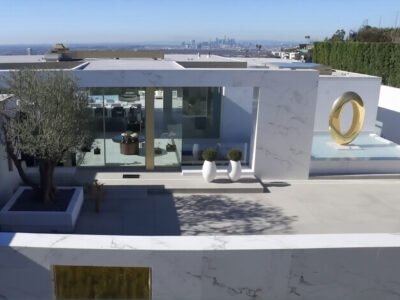
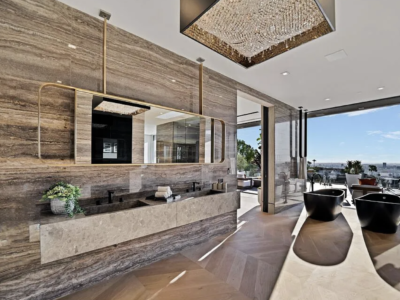
The timing of the sale adds an unexpected layer to Jannard’s own story. Barely weeks after quietly banking $210 million on a classical, Palladian-style compound, he turned around and listed an entirely different kind of house: the Brutalist, board-formed concrete fortress at 410 Trousdale Place in Beverly Hills, asking $68 million. The contrast is hard to overstate — one property built on formal columns and beamed ceilings, the other built to look, as more than one outlet put it, like the lair of a Bond villain. Seen side by side, the two sales sketch a portrait of a collector willing to move fluidly between architectural languages, provided each commands attention on its own terms.
A Record Built to Be Broken
If California real estate history has taught anything in the last several years, it’s that records like this one rarely stand for long. The $210 million paid for 33064 Pacific Coast Highway eclipsed a mark set just a year prior, which itself had eclipsed the one before it — a pattern that suggests the ceiling on Malibu’s ocean-facing acreage is less a fixed number than a moving target, reset every time a compound this size, with frontage this rare, quietly finds its way to a buyer willing to pay for both. For now, though, the deal stands as the most expensive residential sale in California history — a title earned not with a public bidding war, but with the kind of understated, LLC-shielded transaction that has become its own particular signature of how the truly rarefied end of the market actually does business.