listen to the audio of this article
Few properties on the French Riviera carry a history as tangled as Villa La Leopolda, perched above Villefranche-sur-Mer near Nice. At one point valued at roughly €500 million, it has long been cited as one of the most expensive private residences on Earth, even though it has, remarkably, never actually completed a sale at anywhere near that figure in the modern era. Its story runs through a Belgian king’s mistress, a Fiat dynasty, a demanding American architect, and a spectacularly failed billion-dollar deal that ended in a courtroom rather than a closing table.
The Royal Origins
The estate’s name and legacy trace back to King Leopold II of Belgium, who built the original property here as a gift for his mistress, Blanche Zelia Josephine Delacroix, also known as Caroline Lacroix. After Leopold’s death, Delacroix was evicted from the estate, and ownership passed to his nephew, King Albert I. During World War I, the property was pressed into service as a military hospital, a use that reflected both its scale and its strategic coastal location.
The Architect Who Built the Villa That Exists Today
In 1919, Therese Vitali, Comtesse de Beauchamp, acquired the property, but its defining transformation came a decade later. American architect Ogden Codman, Jr. purchased the dozen or so existing structures on the site, including a couple of old peasant cottages, and beginning in 1929 spent two years turning them into a unified architectural statement, completed by 1931.
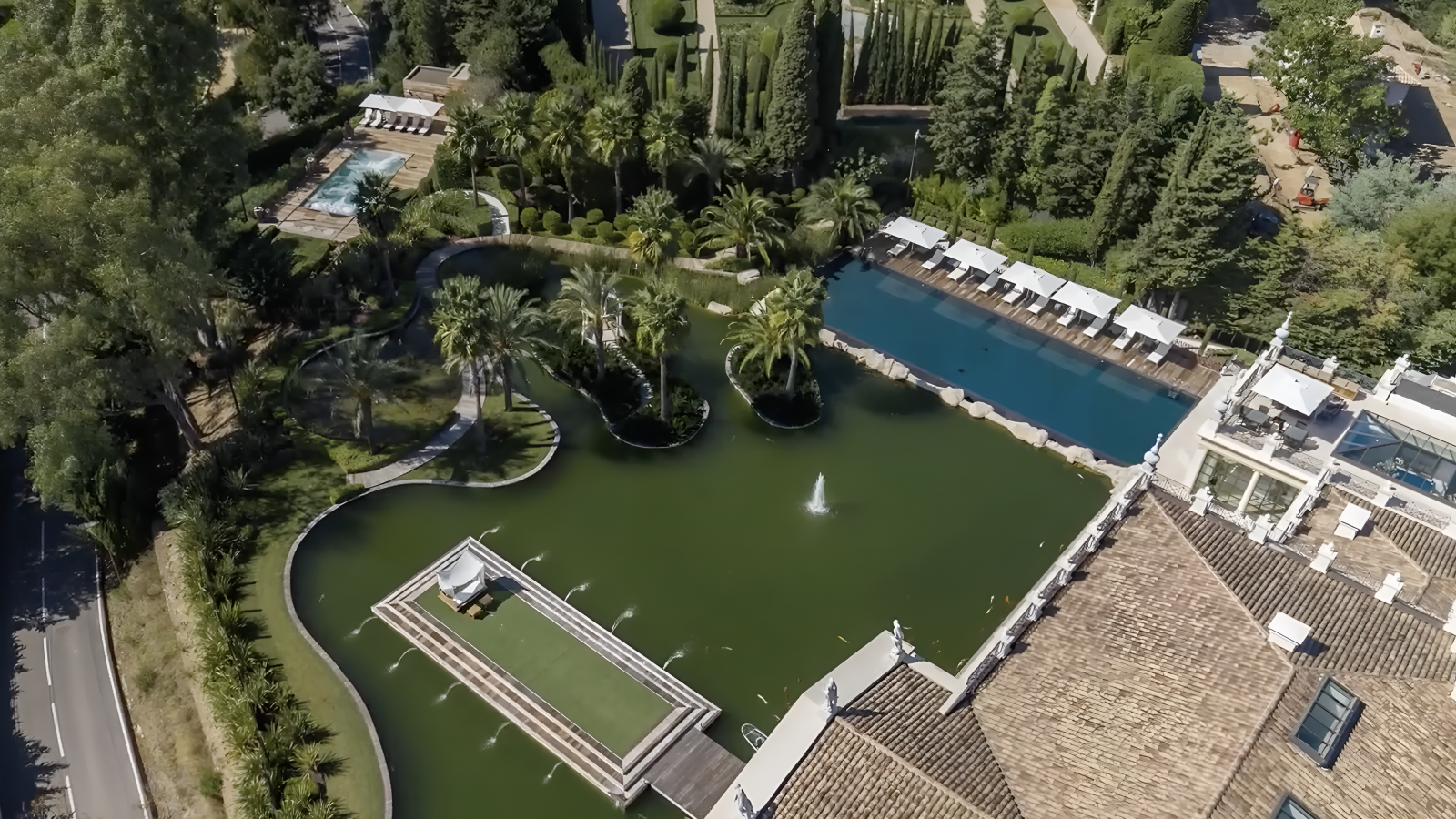
Codman was known for an exacting, sometimes combative aesthetic vision. He reportedly turned away one prospective English tenant couple who wanted to alter his designs. His neo-Palladian design, drawing heavily on historical precedent, gave the villa its extensive gardens and the grand, Belle Epoque-inflected appearance it retains today. The finished estate sits on roughly 7.3 hectares, about 18 acres, of landscaped grounds overlooking the Mediterranean.
A Chain of Extraordinary Owners
After Codman’s death in 1951, financial difficulties tied to his own lavish spending meant he had never actually lived in the villa himself, and the estate passed to Canadian financier Izaak Walton Killam. His wife, philanthropist Dorothy J. Killam, inherited the property after his death. In the late 1950s she sold it to Fiat president Gianni Agnelli and his wife Marella Agnelli, one of the most storied industrial families in postwar Europe. The arrangement didn’t last. Dorothy Killam bought the villa back from the Agnellis in 1963 and lived there until her own death in 1965, closing out one of the more unusual ownership loops in Riviera real estate history.
The Safra Era and Legendary Excess
In 1987, the villa was acquired by Lebanese-born banker Edmond Safra and his wife Lily Safra, the same couple later connected to Monaco’s La Belle Epoque penthouse, where Edmond would die in a 1999 fire. The Safras commissioned designer Renzo Mongiardino for the interiors, with Mica Ertegun handling the second-floor bedrooms, bringing a level of decorative ambition befitting the estate’s scale.
Their tenure produced some of the most legendarily excessive parties in Riviera history. A 1988 gathering was so oversubscribed that Safra split it across two separate nights, with tulips airlifted in from Holland, catering handled by celebrated chef Roger Verge of Moulin de Mougins, and live music from Brazilian bandleader Sergio Mendes, who flew his entire orchestra in from California, alongside a UK quartet led by pianist David Wood. Author John Fairchild, describing the event, called it the “ultimate in conspicuous consumption.” Security at the estate was handled by a team of former Israeli commando soldiers, and the Safras themselves lived roughly ten miles away, in their Monaco penthouse, treating La Leopolda more as a showpiece and entertaining venue than a primary residence.
This is really where the villa’s €500 million reputation comes from. Russian billionaire Mikhail Prokhorov pursued the property for years and finally struck a deal with Lily Safra in the summer of 2008 for €370 million, plus an additional €19.5 million for the villa’s furniture. It was a headline-making figure that made global news at the time, and initial reports even mistakenly credited fellow Russian oligarch Roman Abramovich as the buyer.
But the 2008 global financial crisis intervened almost immediately, and Prokhorov attempted to withdraw from the agreement. His spokesperson later claimed he had grown reluctant to do business in France following his 2007 detention by French police over allegations related to Courchevel, the French Alps ski resort, though no charges were ever filed against him in that separate matter. Whatever the underlying reason, his attempt to exit the villa deal triggered a legal battle over the 39 million euro deposit he had already paid.
A French court ultimately ruled against Prokhorov in November 2012, and Safra subsequently announced she would donate the forfeited deposit to a range of global charities rather than keep it herself. The sale never closed. Technically, the villa’s astronomical valuation has always rested more on a collapsed negotiation than a completed transaction, which makes it something of an outlier among the world’s most expensive homes, most of which earned that reputation through an actual closing.
Where Things Stand Today
Lily Safra retained ownership of Villa La Leopolda until her death in July 2022, and the estate has remained in Safra family hands since. Unlike Monaco’s La Belle Epoque penthouse or Cap d’Antibes’ Chateau de la Garoupe, both of which changed hands in high-profile modern sales, La Leopolda hasn’t traded in the contemporary ultra-luxury market at all. In a sense, it remains the Riviera’s most famous property that almost sold, rather than one that actually did — its reputation as a $500 million estate built entirely on a deal that fell apart in a courtroom rather than closed at a signing table.
A Riviera Landmark on Screen and in Heritage Records
Beyond its ownership history, La Leopolda has a substantial Hollywood pedigree of its own. It served as the filming location for Lermontov’s villa in the 1948 British classic The Red Shoes, in which the heroine climbs the estate’s grand staircase believing she has been invited to a simple dinner, only to be offered the starring role in a new ballet. The villa has also been associated, with some dispute among sources, with Alfred Hitchcock’s 1955 film To Catch a Thief, starring Cary Grant and Grace Kelly, though some accounts instead attribute that film’s villa scenes to Chateau de la Croix-des-Gardes in Cannes.
The estate’s architectural and historical significance has also been formally recognized within France: La Leopolda is listed in the general inventory of architectural heritage for the Provence-Alpes-Cote d’Azur region, a designation that reflects both Codman’s design work and the layered history of royal, industrial, and financial owners who have shaped the property over more than a century.