listen to the article
Tucked into a bowl-shaped canyon in the Santa Susana Mountains, less than an hour from downtown Los Angeles, sits one of Southern California’s most improbable estates: a 124-acre compound built as a private equestrian empire for one couple, later turned into a working event venue and one of Hollywood’s favorite filming backdrops. Its name, Hummingbird Nest Ranch, now shows up as often on wedding-venue listings and TV credits as it does in real estate coverage — but its origins are pure early-2000s Los Angeles excess.
From Chumash Land to Radio Fortune
The land itself has a long history, once inhabited by the Chumash people and later folded into the sprawling El Rancho Simi land grant before passing through a succession of owners. Its modern story begins in 1999 and 2000, when David Saperstein — the entrepreneur credited with pioneering the radio traffic report and founder of the broadcasting company Metro Networks — acquired roughly 124 acres in Simi Valley through his company, Five S Properties Ltd.
Saperstein’s original plan wasn’t Simi Valley at all. He and his wife, Suzanne, an accomplished equestrian and collector of haute couture, had hoped to build a private equestrian center in Coldwater Canyon, closer to their 45,000-square-foot mansion in Holmby Hills. Neighborhood opposition killed that plan, and a real estate agent instead pointed them toward a run-down ranch in the Santa Susana foothills. “I had never heard of Simi Valley before,” Saperstein later told the Los Angeles Times, adding that the property’s geography sold him instantly.
Building an Equestrian Empire
The Sapersteins commissioned architect Rick Robertson to design a 17,000-square-foot Spanish Colonial-style villa on a rise overlooking the property’s show rings, completed around 2004. Around it, they built out an equestrian operation on a genuinely industrial scale: three riding arenas, a regulation-size polo field, and a roughly 20,000-square-foot barn with stalls for more than 40 horses, along with a veterinary and breeding facility. Additional construction eventually included somewhere between 11 and 16 guesthouses and staff residences (reports vary by year), a helipad, a solar farm, multiple pools, and parking for several hundred vehicles. The historic “Sitting Bull Cottage,” a ranch house dating to the 1920s, was restored and preserved as part of the property rather than replaced.
By spring 2004, the center was finished in time to host the International Equestrian Federation’s Children’s International Jumping Final — exactly the kind of event Suzanne Saperstein had envisioned when the project began.
A Divorce, and a $75 Million Listing
The Sapersteins’ equestrian dream didn’t last long as a private retreat. In 2005, David Saperstein filed for divorce from Suzanne — according to a widely circulated W Magazine account, she learned of it via papers served during a refueling stopover on the couple’s private jet, after Saperstein had reportedly become involved with the family’s nanny. The ranch went up for sale two years later, in 2007, with an asking price of $75 million, positioning it as one of the most expensive residential listings in the country at the time.
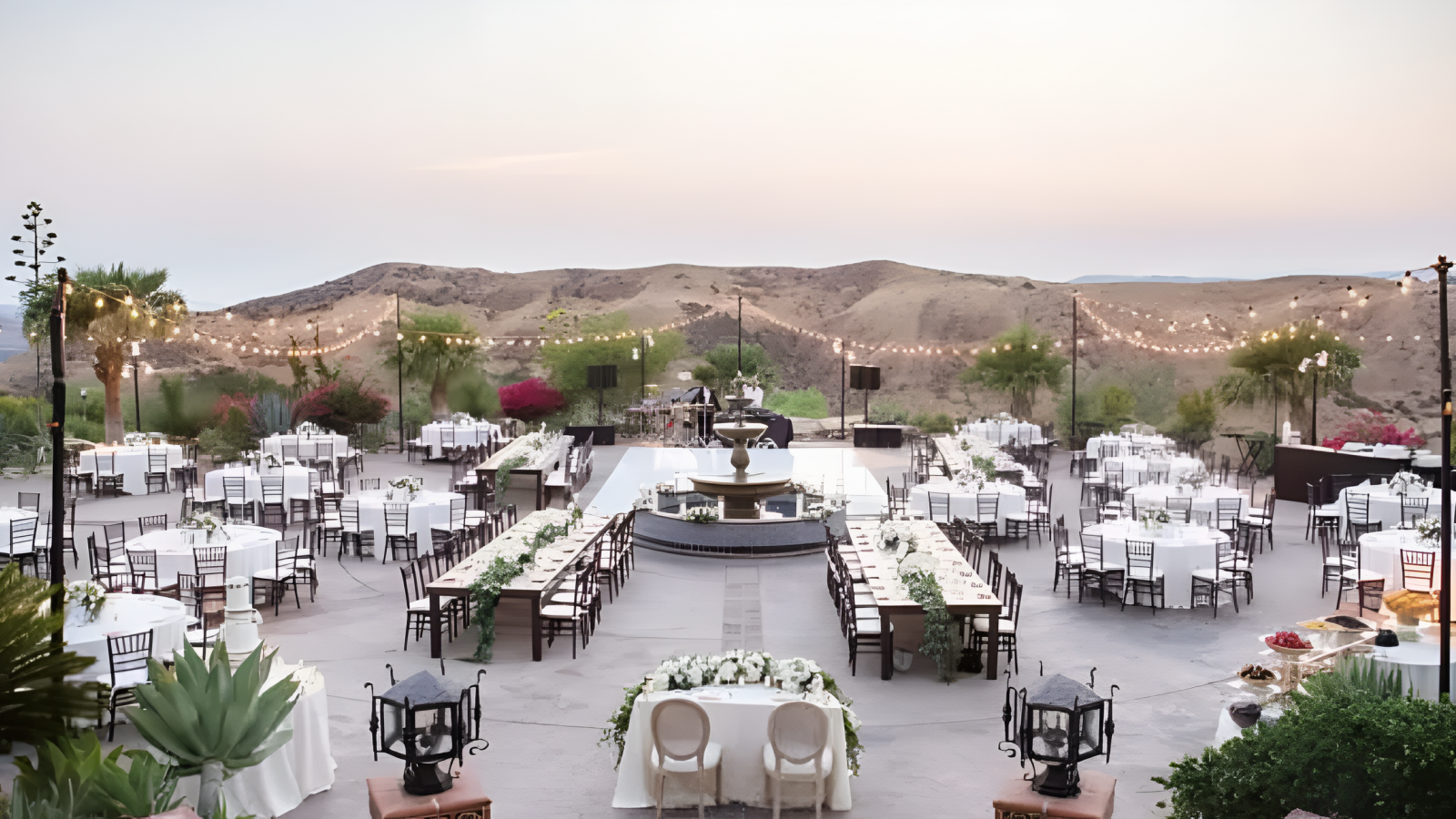
It would take eight more years to find a buyer. Hummingbird Nest Ranch finally sold in 2015 for $33 million — well below its original ask — to Kieu Hoang, a Vietnamese-born billionaire who made his fortune in the plasma and pharmaceutical industry. Rather than keeping the estate as a private residence, Hoang has operated it commercially ever since, as a venue for weddings, corporate functions, equestrian events, and film and television productions.
Hollywood’s Backlot in the Foothills
In its second act, Hummingbird Nest Ranch has become nearly as well known for what’s been filmed there as for its equestrian pedigree. The property served as the primary filming location for a season of ABC’s “The Bachelorette,” and its grounds and buildings have appeared in productions including “The Last Man on Earth” and “Sex and the City: The Movie.” In “Book Club,” the restored Sitting Bull Cottage stood in for a character’s Arizona home. Its combination of Spanish Colonial architecture, olive groves, vineyards, water features, and secluded canyon setting has made it a recurring choice for productions needing a location that reads as private-estate luxury without the complications of shooting at an actual celebrity home.
More recently, Hummingbird Nest Ranch has returned to the market, listed at roughly $78 million — more than double what Hoang paid in 2015. Current listings describe the estate, located at 2940 Kuehner Drive, as encompassing roughly 50,000 square feet of total living space across the main villa and guesthouses, with as many as 57 bedrooms and 40 bathrooms when every structure on the property is counted. The equestrian facilities, helipad, and solar array all remain, positioning the ranch simultaneously as a functioning events business and a trophy property for whoever buys it next.
Few estates capture the arc of a certain strain of Los Angeles ambition quite like Hummingbird Nest Ranch: built by one radio-industry fortune as a monument to a marriage, unwound by that marriage’s collapse, and reborn as a rental backdrop for other people’s weddings and reality-TV romances — all set against a mountain backdrop that, as its original owner discovered almost by accident, turned out to be the real asset all along.