listen to the audio of this article
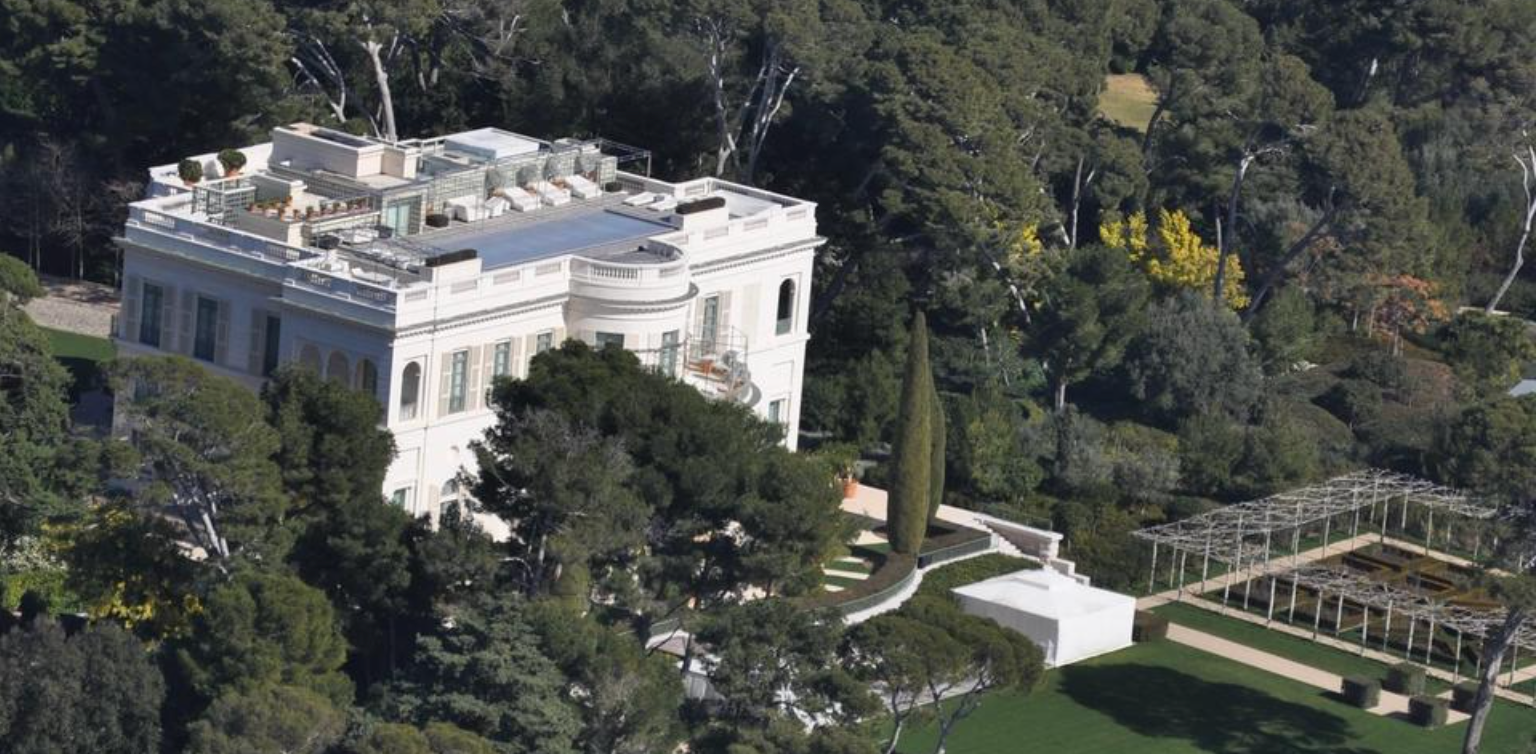
At the very tip of Cap d’Antibes, where manicured pine gardens give way to rock and open sea, sits a white villa that has spent nearly a hundred years changing hands between kings, tycoons, and oligarchs. The Château de la Croë doesn’t look like a battlefield. With its green shutters, red-tiled roof, and sweeping lawns running down to the Mediterranean, it looks instead like an oversized English country house that wandered south and decided to stay. But beneath that calm exterior is one of the most eventful ownership histories of any private residence in Europe — a story of abdication, scandal, fire, decay, and finally, government seizure.
A Newspaperman’s Folly
The château’s origin story is comparatively modest. It was built in 1927 for Sir William Pomeroy Burton, the general manager of Associated Newspapers, and designed by the French architect Armand-Albert Rateau, a decorator known for his work on the Palais de la Méditerranée and for the interiors of couturier Jeanne Lanvin. Rateau gave Burton’s house a classical, almost stately silhouette rather than the flashier Mediterranean style favored by many of the era’s Riviera villas, and set it within roughly seven to eight hectares of grounds stretching to the coastline. Cap d’Antibes was already, by the late 1920s, thick with the fortunes of Europe — it had earned a reputation as a playground for millionaires, dotted with estates like the neighboring Villa Eilenroc, once home to Belgian king Leopold II and Egyptian king Farouk. La Croë was built to compete in that company, and it did. Burton’s ownership, however, is now little more than a footnote. The house’s real fame began a decade later, with a fallen king.

A King in Exile
In 1936, Edward VIII abdicated the British throne to marry the American divorcée Wallis Simpson, an act that scandalized the establishment and ended his reign after less than a year. Stripped of the crown but not of taste, the newly minted Duke and Duchess of Windsor went looking for a home that could stand in, at least symbolically, for the palace they’d left behind. After a brief stay outside Versailles, they found it on Cap d’Antibes. In May 1938, the couple leased Château de la Croë in addition to their Paris mansion, signing on for what was, at the time, a substantial annual rent.
Wallis Simpson took to the house with the zeal of someone determined to prove a point. She redecorated extensively, chasing a kind of theatrical grandeur — light-flooded rooms, gilt detailing, and an almost obsessive use of mirrors. She had huge mirrors installed above the fireplaces so that light and movement bounced endlessly around the rooms; friends noted that she seemed to glance at her own reflection constantly while entertaining, murmuring in passing conversation even as her eyes drifted to the glass. It became something of a private joke among her circle, who nicknamed her “Wallis through the Looking Glass.”
The effort paid off, socially if not politically. La Croë became a genuine salon of European high society, hosting royalty, diplomats, and political heavyweights throughout the tense years leading up to the Second World War. Winston Churchill and his wife Clementine were among the notable guests, and the couple is said to have celebrated their fortieth wedding anniversary at the château — an odd, glittering footnote given that Churchill would soon be leading Britain through its most desperate hours, largely without the Duke’s help. The Windsors eventually decamped for Paris, and La Croë passed out of their hands, but the association stuck; even today, most write-ups of the château lead with Wallis Simpson rather than the newspaper executive who actually built it.
Shipping Dynasties and a Very Awkward Sale
The château’s next chapter reads like a soap opera scripted by Greek tragedy. In 1950, it was bought by Aristotle Onassis, the Greek shipping magnate who was, at the time, assembling one of the largest fortunes in the world. Onassis owned La Croë for seven years, using it as a stage for the kind of lavish entertaining that suited both his wealth and his appetite for spectacle. The sale, when it finally came in 1957, was driven by a domestic crisis: Onassis’s wife, Athina Livanos, discovered him in bed with a family friend, the socialite Jeanne Rhinelander, and the marriage — along with the family’s hold on the house — began to unravel.
What happened next is almost too neat to be true. The château was bought by Stavros Niarchos, Onassis’s own brother-in-law and, not incidentally, his fiercest rival in the shipping business. Niarchos purchased it for his wife, Eugenia Livanos — Athina’s own sister. The two shipping dynasties, locked for decades in a rivalry over fleets, deals, and social standing, ended up trading the same French villa between sisters married into opposing empires. Whether by design or coincidence, it kept La Croë squarely within the orbit of postwar Greek shipping wealth for years afterward.
Fire, Decay, and a Long Silence
By the 1970s, the château’s luck ran out. Around 1970, a major fire tore through the estate, damaging both the house and the surrounding gardens. What followed was nearly three decades of neglect. The once-glittering house that had hosted a king and two shipping barons was reduced to a near-derelict shell, at points occupied by squatters, its grand rooms stripped down to bare structure. For a property built to project permanence and status, it was a strikingly ordinary fate — the slow, quiet decay that eventually claims most unmaintained great houses, royal pedigree or not.
The Oligarch Era — and a Sudden Seizure
The turnaround came in 2001, when Russian businessman Roman Abramovich acquired the property. Over the following years, he poured an estimated £30 million into restoring it, with formal renovation permits granted in February 2004 and the work completed roughly four years later, ahead of schedule. Every piece of furniture and fitting inside was individually designed and made for the house, reportedly restoring it to something close to — or beyond — its original grandeur, while quietly slipping in modern additions like a rooftop pool, a private gym, and a basement cinema. In 2010, the restoration was even the subject of a public lecture and short film, treating the house’s rebirth almost as a case study in preservation.
That second golden era, too, came to an abrupt halt. In April 2022, following Russia’s invasion of Ukraine and the wave of Western sanctions that followed, French authorities seized Château de la Croë as part of asset freezes tied to Abramovich. The house that had survived abdication, scandal, family rivalry, and fire now found itself caught up in the machinery of international sanctions law — a very twenty-first-century plot twist for a very old story.
The château remains closed to the public and, for now, sits in a kind of legal limbo, its future ownership uncertain. But the building itself is still visible from the coast. Walkers along the Chemin des Douaniers, the coastal footpath that traces the edge of Cap d’Antibes, can catch clear views of the château and its grounds framed against the Mediterranean — a quiet, scenic postscript to a history that has been anything but quiet. Nearly a century after Sir William Pomeroy Burton built it as a private retreat, La Croë remains exactly what it always was: a house too grand, too visible, and too desirable to ever really belong to just one person for long.