In the summer of 1899, an engineer and a merchant walked into a courthouse in the small Westphalian town of Herzebrock and registered a company that would outlive both of them, their children, and most of the industry they were about to enter. Carl Miele and Reinhard Zinkann started with eleven employees, four lathes, one drilling machine, and a single product idea: a machine to separate cream from milk. More than a century later, their descendants still run the company, and the business they built—Miele & Cie. KG—stands as one of the last major kitchen and laundry brands on earth that has never answered to a shareholder.
That detail alone makes Miele an unusual case study in modern manufacturing. Most appliance brands people recognize today were built, sold, merged, or absorbed into conglomerates decades ago. Miele wasn’t. Understanding why requires going back to that courthouse in Herzebrock—and following the company through a founding, a war, several waves of expansion, and a commitment to engineering that few competitors have matched.
The Miele Founders: From Farm Equipment to Household Appliances
The Miele company history begins not in a kitchen, but in the agricultural economy of rural Germany. Miele’s first product was never meant for a home. A cream separator is farm equipment, and the butter churn that followed—sold under the Meteor name—was built for the same audience: rural households doing physically exhausting manual labor by hand.
The pivot that actually built the company came almost by accident, when Miele founders Carl Miele and Reinhard Zinkann noticed how much of that manual labor also went into washing clothes. Their answer was a wooden-tub washing machine with a hand-cranked agitator, introduced in the early 1900s—crude by modern standards, but enough to turn a small farm-equipment workshop into a genuine appliance manufacturer.
The company outgrew Herzebrock quickly. By 1907, Miele had relocated to Gütersloh to tap into better rail links for moving raw materials—a logistics decision that still defines the company’s headquarters today. Two decades later, in 1927, Miele introduced its first vacuum cleaner, the Melior. Just two years after that, in 1929, it launched what’s widely credited as Europe’s first electric domestic dishwasher—a genuinely early bet on a category most manufacturers wouldn’t take seriously for another generation.
The Miele Product Line: Every Category Traces to a Specific Bet
Nearly every category in the modern Miele product line traces back to a specific, datable decision somewhere in that timeline—not a modern product-strategy meeting, but an early-20th-century bet that happened to pay off.
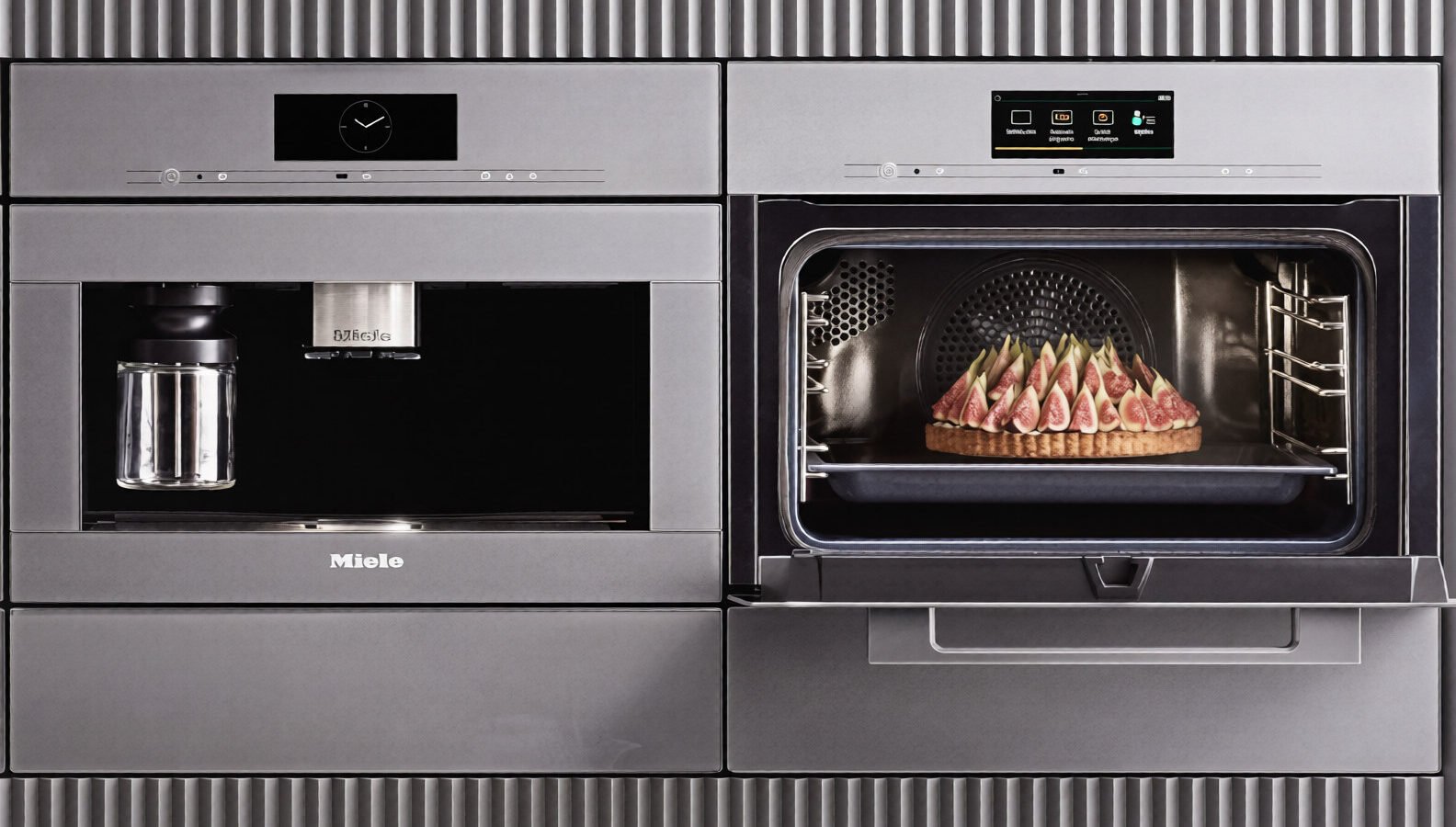
Laundry appliances represent the accidental pivot that turned a farm-equipment workshop into an appliance company. Dishwashers carry a lineage running back to that 1929 electric model, decades ahead of most competitors. Cooking appliances—including built-in ovens, induction cooktops, and steam-combination ovens—were added as the company diversified into full kitchens. Vacuum cleaners and floor care descend directly from the 1927 Melior. Finally, commercial and professional equipment—laundry, dishwashing, and sterilization machinery built for hospitals, labs, and hospitality—operates as a separate business from anything sold to households.
This breadth didn’t happen overnight. Postwar Miele had to rebuild trust in a devastated economy while figuring out how a mid-sized German manufacturer could compete once the rest of the world started buying appliances too. It did both by expanding outward in careful stages. Switzerland became home to Miele’s first foreign subsidiary; Australia followed as its first outside Europe; Singapore came later still. Along the way, the company folded in laundry specialist Cordes and appliance maker Imperial through acquisition, added built-in kitchen lines, and adopted computer-controlled appliance electronics as the technology matured.
The Bielefeld plant tells that expansion story in miniature. Built in 1916 as a branch facility barely a decade after the move to Gütersloh, it has grown into what Miele now describes as its second-largest factory—a hub for domestic dishwashers, vacuum cleaners, and commercial cleaning equipment.
Miele Family Owned: A Structure That Shaped the Brand
What distinguishes Miele from virtually every competitor is that it remains Miele family owned. Both founders died just before World War II reached Germany—Carl Miele in 1938, Reinhard Zinkann in 1939—leaving their sons, Carl Miele Jr. and Kurt Christian Zinkann, to run the company through the war years, with younger brothers Heinrich Miele and Erich Zinkann later joining them.
What happened next is not a footnote a family business gets to leave out of its own history. According to Miele’s own published corporate account, a substantial share of its manufacturing was converted to munitions production, and forced laborers were deployed at its Gütersloh and Bielefeld plants to build armaments. Miele has published this on its own official history pages as part of its account of the founding century—an unusually direct acknowledgment for a company that could easily have let the decades quietly bury it.
That transparency, and the family’s continued stewardship, has shaped a corporate culture that thinks in generations rather than quarters. By the time Miele marked its centenary in 1999, it was no longer a regional manufacturer. By its 125th anniversary in 2024, it employed more than 22,000 people across 49 countries, generating roughly €4.96 billion in revenue that year, with its own sales organizations in about 50 countries and importer relationships covering roughly 50 more.
Forever Better: The Engineering Behind the Promise
“Forever Better” is the kind of slogan that invites skepticism, so it’s worth looking at what actually stands behind it. Miele doesn’t just assert a 20-year lifespan; it tests toward one, using a specific, published methodology rather than a vague marketing claim.
For washing machines, that means running roughly 5,000 wash cycles across some 10,000 hours during development—the mathematical equivalent of five wash loads a week, fifty weeks a year, for two full decades—before a model series is cleared for production. Door mechanisms get their own separate torture test: Miele opens and closes washing machine doors 100,000 times in a controlled rig, and oven door hinges go through 24,000 open-close cycles of their own.
The rest of the lineup gets equivalent treatment. Ovens and combination steam ovens are run for roughly 4,000 operating hours, calculated against an assumption of about ten hours of use per week over 20 years. Enamel oven trays are scoured 100,000 times to check for surface wear. Vacuum cleaners are shipped through simulated transport conditions ranging from -20°C to 60°C for 336 straight hours to make sure a rough delivery doesn’t damage the unit before it’s even unboxed. Miele has had these protocols reviewed by outside engineering bodies, including a stability assessment from Germany’s Fraunhofer Institute, to back up the internal test data with outside sign-off.
It’s worth being precise about what this does and doesn’t prove. Miele’s own legal disclosures are explicit that the 20-year testing regime simulates average household use under laboratory conditions and “does not represent any assurance or guarantee” that any individual appliance will actually last two decades in someone’s home. Actual outcomes still depend on installation, maintenance, water quality, and ordinary bad luck.
Miele company is a manufacturer that has stayed private, stayed in Germany, and stayed committed to a single promise for 125 years. The Miele founders could not have imagined dishwashers with Wi-Fi or steam ovens with touchscreens, but they built a structure—long-term capital, engineering-first culture—that made those innovations possible. For consumers researching a premium appliance purchase, that history isn’t just trivia. It explains why Miele’s product line looks the way it does, why its prices sit where they do, and why the brand has survived when so many of its original competitors have disappeared into corporate portfolios.