listen to the audio of this article:
Casa Casuarina: The Versace Mansion on Miami Ocean
Nestled at 1116 Ocean Drive in the heart of Miami Beach’s South Beach, Casa Casuarina — more widely known as the Versace Mansion — stands as one of America’s most iconic residences. It is the third most photographed home in the country, after the White House and Graceland, and its story weaves together Standard Oil fortunes, Mediterranean grandeur, high fashion, and one of the most shocking crimes in modern history.
Origins: An Oil Heir’s Dream
Casa Casuarina was built in 1930 by Alden Freeman, an architect and philanthropist who inherited a vast fortune from his grandfather, a treasurer of the Standard Oil Trust. Freeman retired at just 27 years old and set out to construct the home he had always envisioned. During a world tour, he visited the Alcázar de Colón in Santo Domingo, Dominican Republic — the oldest viceregal residence in the Americas, built by Christopher Columbus’s son, Diego. So inspired was Freeman that he used it as the architectural blueprint for his Miami Beach estate, even bringing back two bricks from the original structure to incorporate into the mansion.
The name Casa Casuarina — “House of the Australian Pine” — is said to honor the sole tree that survived the devastating 1926 Miami hurricane on the property lot. Legend holds that Freeman was forced to cut it down to make room for construction, and named the house in its memory.
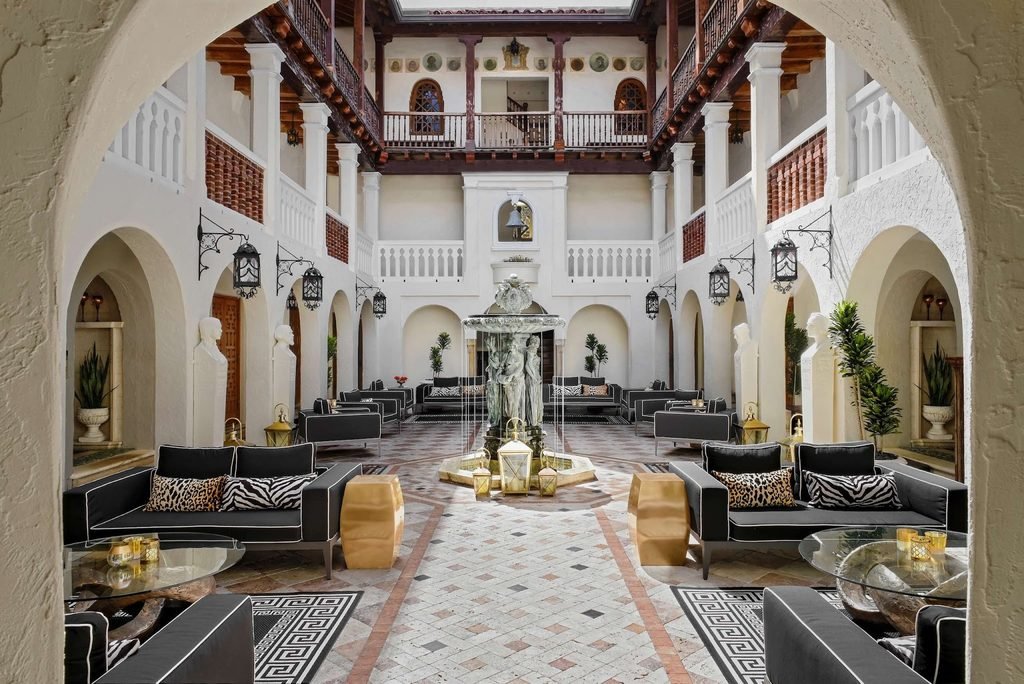
The mansion was designed in the Mediterranean Revival style, with original key lime coral flooring, an observatory, a small replica of the Homage Tower from the Fortaleza Ozama, and nearly 100 medallions of notable figures — from Gandhi and Rockefeller to Mussolini and Cleopatra — embedded in its walls. Freeman lived in a top-floor suite and rented the remaining 23 apartments to friends and guests until his death in the house in 1937. The property then passed through several owners, operating as the Amsterdam Palace and later the Christopher Columbus Apartments, gradually falling into disrepair over the decades.
Versace’s Arrival and Transformation
In 1992, Italian fashion designer Gianni Versace arrived in Miami Beach on what was meant to be a brief stopover. While walking down Ocean Drive, he was drawn to the property by the bronze Kneeling Aphrodite statue at its entrance. After touring the then-dilapidated mansion, he purchased it for $2.95 million and, in his own words, “instinctively” decided to make it his home.
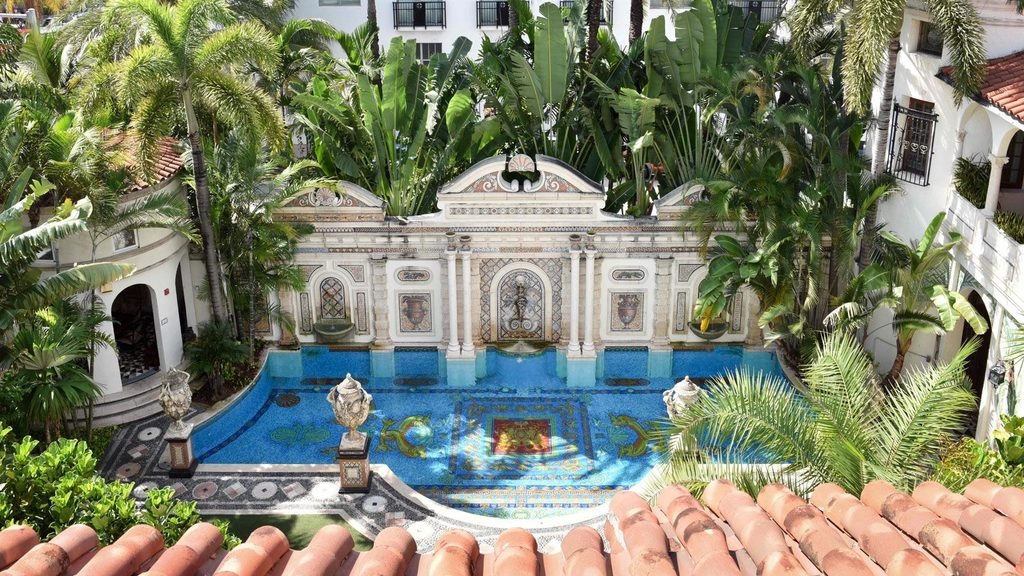
Versace’s vision was nothing short of transformative. He acquired the adjoining Revere Hotel for $3.7 million and demolished it to create a south wing, garden, and the legendary pool terrace. Over three years, he invested an additional $32 – $33 million in renovations, converting the 24 – apartment building into a single private residence with eight bedrooms, two kitchens, three sitting rooms, ten bathrooms, a bar, a library, and four living rooms.
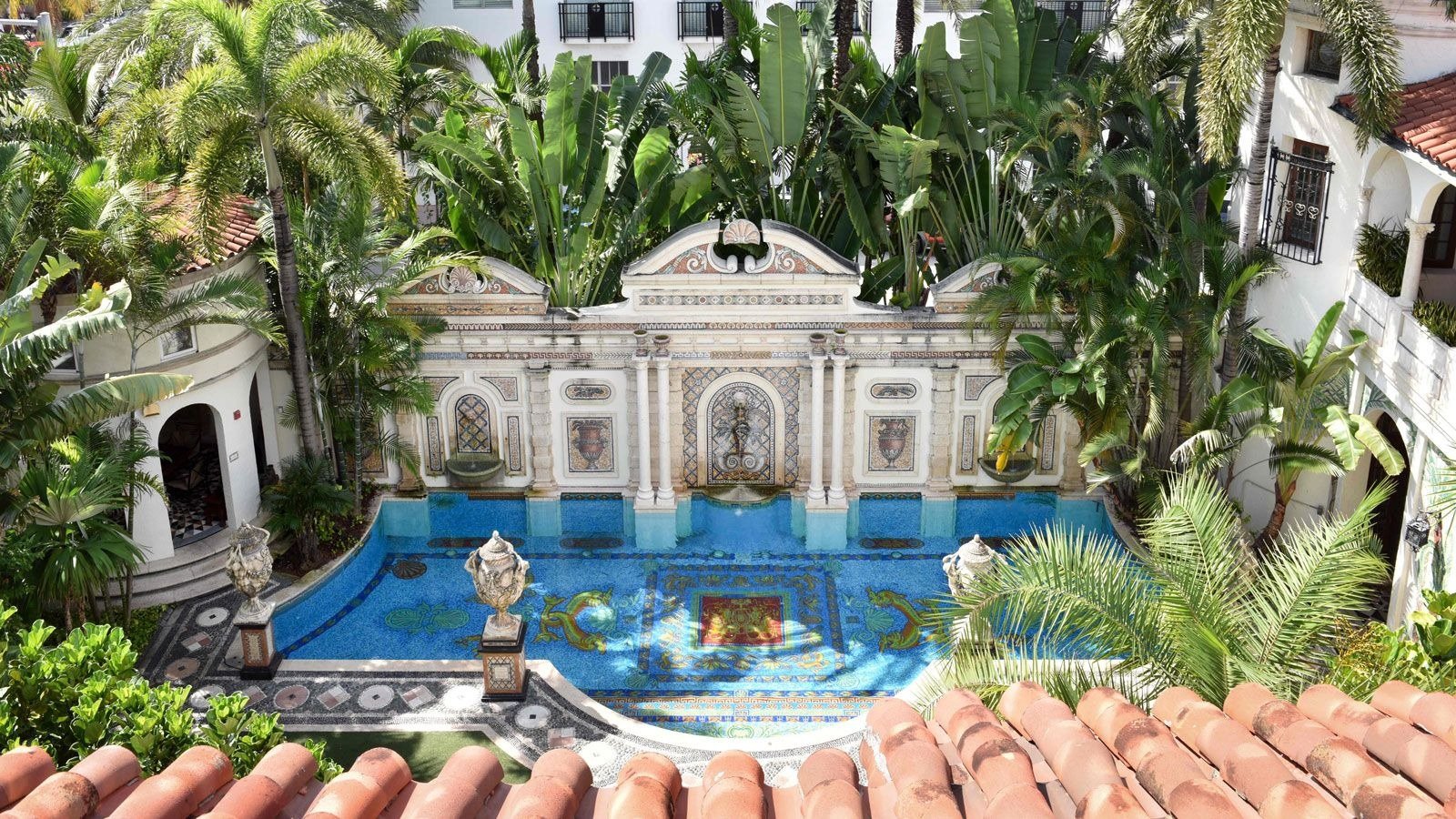
The mansion became a shrine to Versace’s maximalist aesthetic. Walls were covered in intricate mosaics — some made entirely of pebbles or seashells — frescoes adorned the ceilings, Picassos hung on the walls, and Versace fabrics upholstered the furniture throughout. The centerpiece of the outdoor space was the Thousand Mosaic Pool, a 54-foot-long masterpiece inlaid with thousands of 24-karat gold tiles imported from Italy. English art historian and landscape designer Sir Roy Strong was commissioned to design the gardens, which he had also done for Versace’s Villa Fontanelle on Lake Como.
The mansion quickly became a gathering place for the global elite. Elton John, Princess Diana, and Madonna were among the famous overnight guests during Versace’s residency.
Tragedy on the Steps
On the morning of July 15, 1997, Gianni Versace returned from his habitual breakfast at the nearby News Cafe. As he unlocked the front gate of Casa Casuarina, he was shot twice in the back of the head by Andrew Cunanan, a serial killer who had already murdered four other men across the country and was on the FBI’s Ten Most Wanted list. Versace collapsed on the coral steps of his own home and was pronounced dead at Jackson Memorial Hospital. Cunanan evaded capture for eight days before being found dead from suicide on a houseboat just 40 blocks away.
The murder sent shockwaves through the fashion world and cemented Casa Casuarina’s place in cultural history. The bloodstained steps became one of the most haunting images of the decade.
After Versace: From Private Residence to Boutique Hotel
Following Versace’s death, his sister Donatella sold the mansion in 2000 to telecommunications magnate Peter Loftin for $19 million. Loftin operated it as a private residence, boutique hotel, and members-only club. In 2009, restaurateur Barton G. Weiss took over the lease, rebranding it as The Villa by Barton G.
In September 2013, the mansion was sold at auction for $41.5 million to VM South Beach LLC, owned by the Nakash family of Jordache jeans fame. Since 2015, it has operated as The Villa Casa Casuarina, a luxury boutique hotel with ten uniquely designed suites, a restaurant called Gianni’s, and the Onyx Bar.
The current management has worked to preserve Versace’s original vision, reproducing furniture from archival photographs, touching up murals, and maintaining the lavish interiors that made the mansion famous. Secret passageways that once connected rooms have been sealed for guest privacy, but the Medusa mosaics, gold-tiled pool, and pebble-walled suites remain intact.
Legacy
Today, Casa Casuarina remains a symbol of unapologetic opulence — a Mediterranean palace on Ocean Drive that has witnessed the heights of glamour and the depths of tragedy. Whether viewed through the lens of architecture, fashion history, or true crime, it endures as one of Miami’s most compelling landmarks, its gates still drawing crowds of tourists, fashion pilgrims, and the simply curious, all hoping to catch a glimpse of the world Gianni Versace built.