In a market crowded with luxury SUVs, the Alfa Romeo Stelvio stands apart. It is a vehicle that refuses to compromise on the brand’s DNA—a tradition of driving passion, race-bred engineering, and unmistakable Italian style. For 2026, now in its ninth model year on essentially unchanged architecture, the Stelvio continues to offer a compelling proposition for driving enthusiasts who need SUV practicality, even as a full redesign looms on the horizon.
A Powertrain with a Racing Heart
At its core, the Stelvio is defined by its spirited performance. The standard powertrain is a 2.0-liter turbocharged four-cylinder engine, producing 280 horsepower and 306 lb-ft of torque. This engine, paired with an eight-speed automatic transmission and standard Q4 all-wheel drive, delivers a 0-60 mph time reported at either 5.4 or 5.5 seconds depending on the source—Alfa Romeo’s own materials cite 5.5—and a top speed exceeding 144 mph.
This performance is aided by a class-exclusive carbon-fiber driveshaft—a component more common in exotic sports cars that reduces weight, improves throttle response, and contributes to the Stelvio’s near-perfect 53/47 front-rear weight balance. The Stelvio is also available with a Veloce package, which adds a limited-slip differential, a front strut tower brace, Brembo brakes with red calipers, sport seats, and 20-inch wheels for enhanced handling and a more dynamic driving experience.
A Surprising Comeback: The Quadrifoglio
One of the most significant stories for the 2026 model year is the return of the legendary Quadrifoglio performance variant. While the potent V6-powered Stelvio Quadrifoglio was withdrawn from the US market in 2024, and European production of the model was itself paused in September 2025, Alfa Romeo announced at the Brussels Motor Show in early 2026 that it would reopen order books for both the Giulia and Stelvio Quadrifoglio in Europe, with production resuming in Cassino, Italy from April 2026.
The Quadrifoglio is powered by a 2.9-liter twin-turbocharged V6 engine producing 520 horsepower, allowing the Stelvio version to sprint from 0-100 km/h in roughly 3.8 to 3.9 seconds depending on the source. This decision was driven by strong enthusiast demand and a delay in the development of the Stelvio’s fully electric successor. Alfa Romeo CEO Santo Ficili explained the move as an effort “to keep to a promise made to customers of ours who pay the most attention to the extreme performance and pure emotions inherent in Alfa Romeo’s DNA,” adding that “the Quadrifoglio is the most authentic expression of Alfa Romeo sportiness and of our cars, designed for real fans of driving, with the focus always on the driver.” Production of the current-generation Stelvio, including the V6 variant, is now extended through 2027 in Europe.
Italian Design and Modern Technology
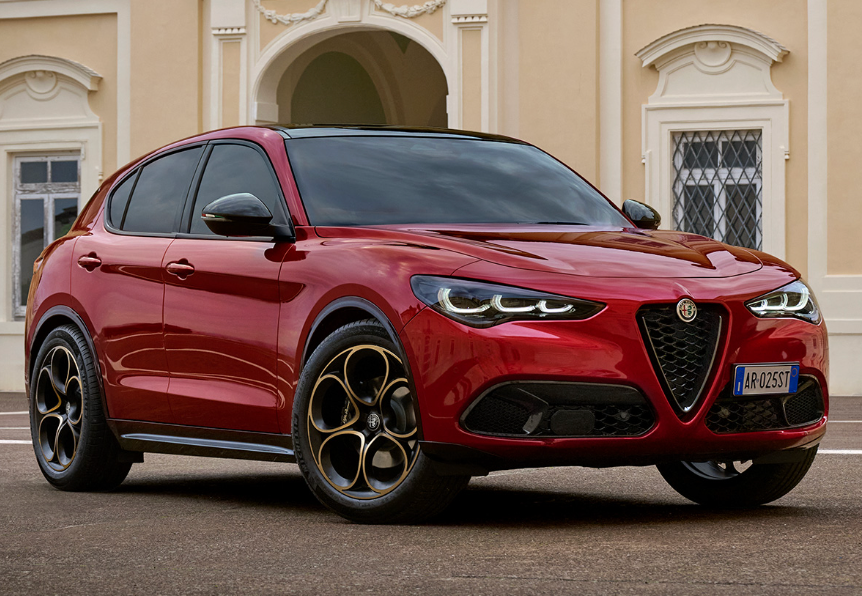
The Stelvio’s exterior is a masterclass in Italian styling. Its curvaceous body and distinctive inverted-triangle “Scudetto” grille make it one of the most eye-catching vehicles in its class. For 2026, the model carries over with its timeless design, available in a palette of striking colors including Alfa Rosso, Misano Blue Metallic, and Verde Fangio Metallic, alongside more traditional options like Milano White and Vulcano Black.
Inside, the focus remains on the driver. The cabin features a 12.3-inch digital instrument cluster with selectable layouts and an 8.8-inch central touchscreen—modest by the standards of some 2026 German and American rivals, but paired with an analogue, driver-centric character that many reviewers find refreshing rather than dated. Standard and available features include leather-trimmed sport seats, an available 14-speaker Harman Kardon premium audio system, wireless charging, and a comprehensive suite of driver-assistance technologies, including adaptive cruise control, lane-keep assist, and automatic emergency braking.
The Road Ahead
The Alfa Romeo Stelvio finds itself in a unique position. It is an established model being kept on sale longer than initially planned, a testament to its enduring appeal in a market where, according to Alfa Romeo’s own UK leadership, roughly 80 percent of buyers in that market still choose internal combustion engines over electrified alternatives. Its blend of Italian flair, thrilling performance, and everyday practicality positions it firmly against rivals like the BMW X3, Audi Q5, and Porsche Macan.
While an all-new Stelvio is in development, its launch has been pushed back to 2028—a delay driven by Alfa Romeo’s decision to abandon an original electric-only plan for the next generation in favor of a more flexible approach spanning combustion, hybrid, plug-in hybrid, and fully electric powertrains, all built on Stellantis’s STLA Large platform. That platform, which also underpins the Dodge Charger and the electric Jeep Wagoneer S, gives Alfa Romeo room to potentially offer a high-output inline-six—possibly derived from the Charger’s available 550-hp Hurricane straight-six—in a future Quadrifoglio, alongside electrified options for markets not yet ready to go fully electric.
This means the current Stelvio remains the purest expression of Alfa Romeo’s sports car soul wrapped in an SUV body for the foreseeable future. It is a reminder that even in a segment defined by utility, the joy of driving can be the priority—and that sometimes the smartest product decision a struggling manufacturer can make is simply keeping a beloved, enthusiast-favorite model on sale a little longer than the original plan called for.
A Brand Betting on Patience
The broader context here matters. Alfa Romeo has had a difficult run in North America in particular, with U.S. sales falling sharply in recent years even as the brand’s smaller Junior and Tonale crossovers have found more traction in Europe. Against that backdrop, extending the current Stelvio’s life rather than rushing an underdeveloped electric replacement to market is a notably conservative, almost old-fashioned strategy for an industry that has spent the last several years racing toward electrification on fixed timelines regardless of demand signals. Alfa Romeo’s leadership has been candid that the shift reflects a broader recalibration: EV adoption has simply not moved as fast as many manufacturers, including Alfa’s own parent company Stellantis, once assumed it would, and reworking a platform designed primarily for electric power to properly accommodate combustion and hybrid drivetrains—with all the cooling and packaging challenges that involves—has proven more complex than anticipated.
For buyers in the meantime, that hesitation is arguably good news: it means one more generation to buy a Stelvio, or a reborn Quadrifoglio, in something close to its original, unfiltered form—razor-edged four-cylinder or howling V6 included—before Alfa Romeo’s next chapter, whatever combination of batteries and pistons it ultimately settles on, finally arrives in 2028.
How the Stelvio Stacks Up Against Its Rivals
Positioned against the BMW X3, Audi Q5, and Porsche Macan, the Stelvio doesn’t try to win on outright technology or interior spaciousness—its 8.8-inch touchscreen looks modest next to the sweeping curved displays now common in German rivals, and its cabin, while handsome, leans on tactile controls and analogue instruments rather than chasing the latest infotainment trends. What it offers instead is a genuinely different character behind the wheel: quicker, more direct steering, a chassis tuned more for cornering agility than outright ride comfort, and an engine note and throttle response that several reviewers have described as more engaging than anything else in the segment, particularly once the drive mode is switched out of its default comfort-oriented setting and into something sportier.
That tradeoff—fewer screens, more soul—is precisely the case Alfa Romeo has built its identity around for decades, and it’s a big part of why the Stelvio has managed to remain relevant even as its underlying architecture has gone unchanged for the better part of a decade. Reviewers consistently note that the Stelvio’s basic bones, however dated some of its interior tech may look on paper, still deliver one of the more genuinely rewarding driving experiences in the compact luxury SUV class, in a way that pure spec-sheet comparisons don’t always capture.
What Comes Next for the Quadrifoglio
The Quadrifoglio’s return isn’t without complications for Alfa Romeo’s parent company. European emissions regulations penalize high-CO2 vehicles heavily, and the Stelvio Quadrifoglio’s roughly 267 g/km of CO2 output reportedly triggers a meaningful per-vehicle penalty under current EU rules—a cost Stellantis is apparently willing to absorb in order to keep faith with a loyal enthusiast customer base and preserve the Quadrifoglio badge’s prestige heading into the next generation. It’s a notable business decision: keeping a low-volume, emissions-penalized performance model on sale purely to satisfy a passionate subset of buyers, at a moment when most of the industry is trying to reduce exactly that kind of vehicle from their lineups.
Looking further ahead, reports suggest the next-generation Quadrifoglio—whenever it eventually arrives alongside the broader 2028 Stelvio redesign—could take a very different form. Some reporting has floated the possibility of a high-output electric or hybrid powertrain producing as much as 1,000 horsepower from a tri-motor setup, a dramatic departure from today’s twin-turbo V6, though none of these figures have been officially confirmed by Alfa Romeo and should be treated as speculative at this stage. Whatever direction the badge ultimately takes, Alfa Romeo’s leadership has been explicit that maintaining some connection to the Quadrifoglio’s performance-first identity remains a priority, even as the underlying technology shifts dramatically over the next several years.