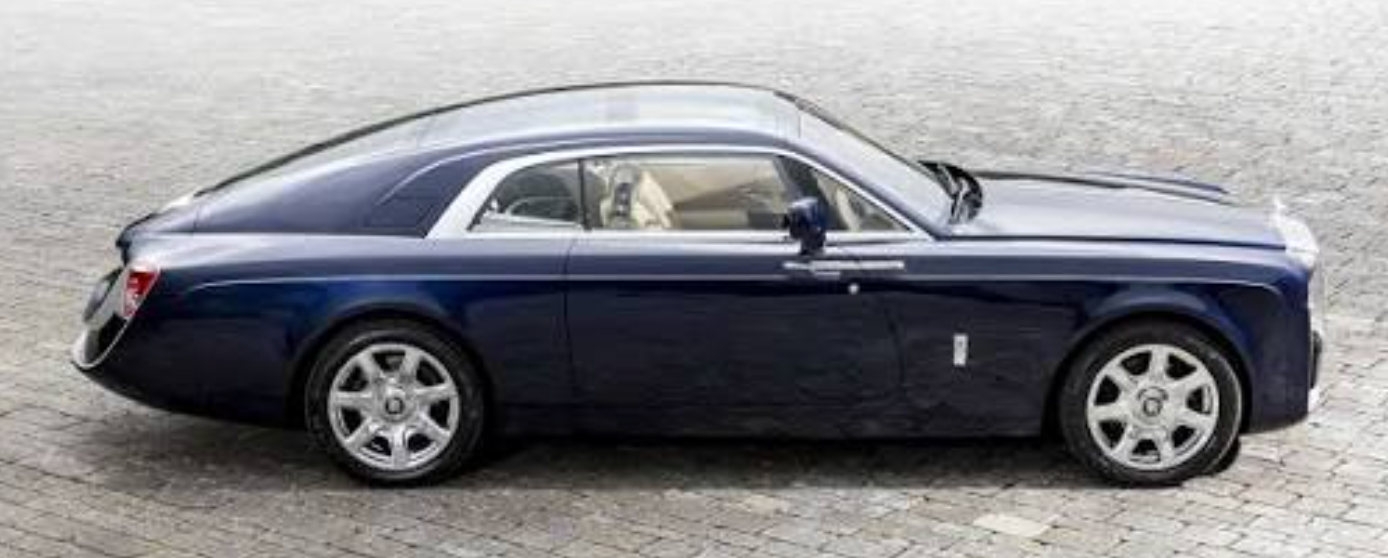
On a spring morning in May 2017, a car rolled onto the lawn at the Concorso d’Eleganza Villa d’Este on the shores of Italy’s Lake Como — one of the world’s most exclusive automotive events — and quietly rewrote the record books. There was no production run behind it, no dealership network, and no price list. There was only one of it, and it existed because a single, anonymous client had asked Rolls-Royce to build him a car that didn’t exist anywhere else in the world.
Its name was Sweptail.
Four Years in the Making
The Sweptail was commissioned in 2013 by a client Rolls-Royce has described only as a super-yacht and aircraft specialist, and it took roughly four years of design and hand-construction before it was finally revealed to the public. The customer worked closely with Rolls-Royce’s Bespoke division over those four years to bring his own idea for a two-seat, one-of-a-kind Rolls-Royce into being.
Mechanically, the car is based on the Rolls-Royce Phantom Coupé, sharing its 6.75-liter V12 engine and eight-speed automatic transmission, but almost everything visible on the body was reimagined from scratch. Rolls-Royce described the unnamed client as someone who approached the marque with his own concept for a two-seat car he wanted brought to life in the present day, inspired by the swept-tail silhouette of certain Rolls-Royces built in the 1920s.
Design Born of Yachts and Coachbuilding
What set the Sweptail apart from any other modern Rolls-Royce was its design language, which reached back to an era before mass production, when wealthy clients would commission a rolling chassis from a manufacturer and then send it to an independent coachbuilder to have a completely bespoke body built on top. The Sweptail’s design draws inspiration both from classic Rolls-Royce models and from the client’s own personal passion for yachts, giving the car’s tapering rear end a distinctly nautical, boat-tail profile rather than a conventional automotive one.
That boat-tail was hand-formed from aluminum, paired with a curved panoramic glass hatchback, and the car’s number plates — both front and rear — were themselves integral to the bodywork, formed and hand-polished from solid aluminum rather than bolted on as an afterthought. Rolls-Royce’s own design leadership framed the project in the language of fashion rather than engineering. Design director Giles Taylor called it the automotive equivalent of haute couture, saying it was a Rolls-Royce designed and hand-tailored to fit one specific customer.
Inside, the car leaned just as hard into personalization. A full set of bespoke luggage was fitted to match the trunk, set among wood cladding and polished aluminum rails, and hidden compartments in the doors held custom attaché cases in carbon fiber and leather. The single most talked-about detail, though, was tucked into the center console: a push-button mechanism that deploys a chilled bottle of vintage champagne from the year of the owner’s birth, along with two crystal flutes positioned for the car’s occupants to reach.
The Most Expensive New Car in the World
Rolls-Royce never confirmed an exact price, and to this day the true figure remains a matter of informed speculation rather than official record. Some sources have put the cost at $12.8 million, though Rolls-Royce chief executive Torsten Müller-Ötvös has disputed the accuracy of that specific figure while still describing the car as potentially the most expensive new vehicle ever built. At its unveiling, most estimates converged on a price of roughly £10 million, and for a period afterward it stood unchallenged as the most expensive new car in the world.
That title didn’t last forever. In 2019, the Sweptail was overtaken as the priciest new car on record by the Bugatti La Voiture Noire. Even so, the Sweptail remains a landmark in the industry — not simply for its price tag, but for what it represented: a major manufacturer agreeing to build a single, fully bespoke automobile for one customer, essentially reviving the coachbuilding tradition of the early twentieth century on a modern chassis.
A One-Off That Changed the Conversation
The Sweptail was never meant to be anything but singular — Rolls-Royce built it once, for one person, and there will not be another. But its influence on the brand didn’t end when the champagne chiller closed for the last time at Lake Como. The project marked the effective launch of Rolls-Royce’s modern Coachbuild program, a standing invitation to its most valued clients to commission fully individualized, one-off vehicles built to their own specifications rather than simply an especially loaded version of an existing model.
In that sense, the Sweptail wasn’t just an extravagant curiosity — it was a proof of concept. It showed that in an era of shared platforms and modular manufacturing, there is still a market, however small, for a car that exists exactly once, built for exactly one person, down to the year of vintage in the champagne bottle hidden in the console.