listen to the article
A Speaker That Looks Like a Sculpture
Walk into any showroom, design hotel, or well-curated living room and you will recognize a Bang & Olufsen product before you can name it. That recognition is the entire point. While other audio brands design objects that disappear into cabinets and closets, B&O designs objects that are meant to be seen — sculptural, quiet, and unashamedly luxurious. The company’s design director puts it simply: “We don’t work from technology. We always work from the idea,” meaning human experience, not engineering specs, guides every development.
Three Pillars: Sound, Design, Craft
Since 1925, Bang & Olufsen has built its reputation on three inseparable pillars: sound, design, and craft. The aesthetic language is unmistakably Scandinavian: clean lines, minimalist geometry, muted natural color palettes, and an interior-friendliness that allows a speaker or television to sit in a room like furniture rather than equipment. The principle is what the company calls the honesty of materials — if it looks like aluminium, it is aluminium; if it appears to be solid oak, it is solid oak, treated with natural oils so the grain stays warm to the touch.
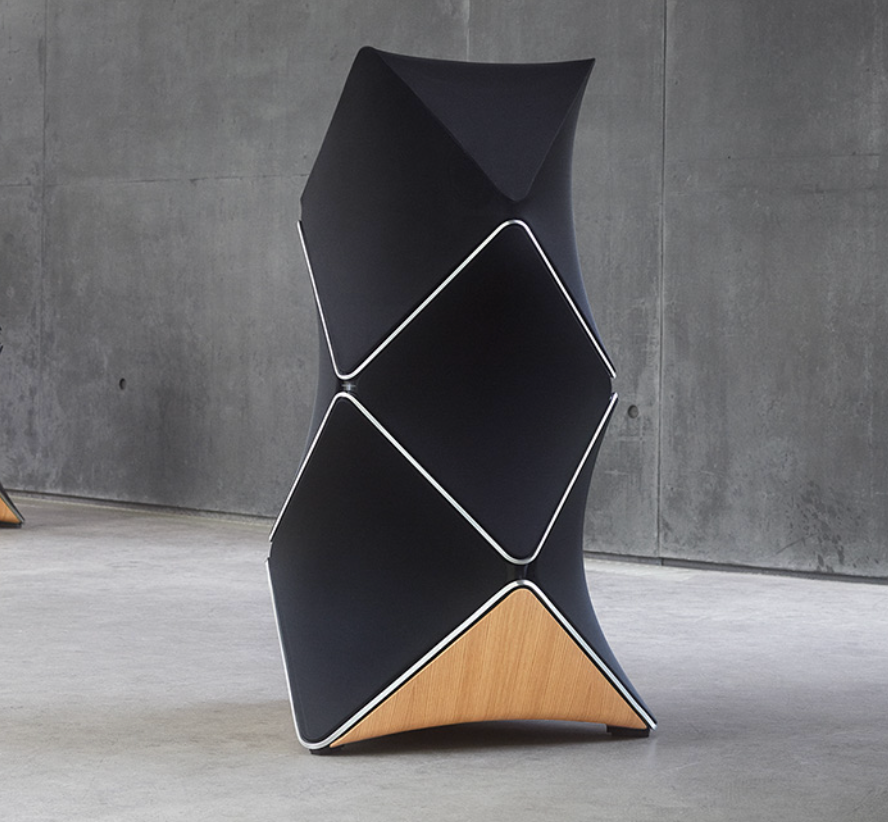
Form, at B&O, is never decoration bolted onto function — the two are developed together. The Beolab 90 flagship speaker is the clearest example: its faceted, almost crystalline shape was dictated entirely by acoustics, housing eighteen drivers arranged in multiple directions, each with its own amplifier and digital processing. The result is an object that reads as avant-garde sculpture yet behaves as one of the most advanced loudspeaker systems ever built.
Each speaker is essentially an entire audio system: four woofers, seven midrange drivers, and seven tweeters — all premium Danish-made Scan-Speak units — with a custom amplifier and digital signal processor for every single driver, so all eighteen operate independently. The speakers run beam-steering software that adapts their sound to the acoustics of your specific room, and every unit is tested for thousands of hours — including overnight sessions of full-volume techno to stress the electronics — before leaving the factory in Struer, Denmark. Compare that with a conventional hi-fi setup, where the buyer assembles amplifiers, DACs, and speakers from different brands and pays separately for each.
Design as Cultural Capital
The fame rests on a century of objects that transcended their category. By 1978, the Museum of Modern Art in New York had already placed eleven B&O products in its permanent collection, and pieces like Jacob Jensen’s Beogram 6000 turntable from 1974 are still described as looking “like a record player from the next century.” The company holds a Royal Warrant as official purveyor to the Danish Royal Family, cementing its status as a national institution.
Critically, B&O understood before almost anyone else that audio was becoming a lifestyle product. Its televisions were designed to hang like artwork; its speakers to be placed like furniture; its headphones finished with anodized aluminium grilles and deliberately positioned screw heads because “even the inner surfaces are smoothly sculpted.”
The Honest Answer
Is a $211,800 pair of speakers worth it on pure acoustic measurements? Audiophile forums debate this endlessly, and many argue that equivalent or better sound can be assembled for a fraction of the price. But you are paying for a century of design thinking, Danish manufacturing, materials chosen for honesty rather than cost, decades of serviceability, and an object that elevates a room the way a painting does. The company’s own philosophy says it best: B&O products are “destined to be kept, not put aside when something new comes along.”