Listen to the article
Most legendary châteaux carry centuries of royal history behind their stone façades. Château Louis XIV carries none of that — and that’s precisely what makes it remarkable. Rather than a restoration of an existing estate, the property was constructed entirely new between 2008 and 2011, on land in Louveciennes that developer Emad Khashoggi acquired in 2008 and promptly cleared, including the demolition of an unremarkable earlier house known as the Château du Camp.
The project was the vision of Khashoggi, a property developer with a track record of building and restoring opulent French-style estates, including the Palais Rose in Le Vésinet and the Château du Verduron in Marly-le-Roi. Through his company COGEMAD, Khashoggi set out to recreate the grandeur of a genuine 17th-century French royal residence — the kind of architecture associated with the reign of Louis XIV — but without the compromises that come with restoring a genuinely old building.
To pull this off, COGEMAD employed an average of 120 workers a day across roughly 200 people over three years, drawing on traditional artisan trades — stonemasons, bronze casters, roofers, carpenters, and coppersmiths — using centuries-old techniques and materials rather than modern shortcuts. The result is a building that, from the gates, could pass for a survivor of the ancien régime, with symmetrical stone façades, mansard roofs, and manicured formal gardens reminiscent of Versailles itself.
What’s Inside
The finished château offers roughly 5,000 square meters (about 54,000 square feet) of living space across some 7,000 square meters of total constructed area, set within a walled estate of 23 hectares — approximately 57 acres. (COGEMAD’s own marketing materials list the site as “23 hectares / 69 acres,” an internal inconsistency that various reports have repeated without resolution.) Whatever the exact figure, the scale is enormous by any residential standard.
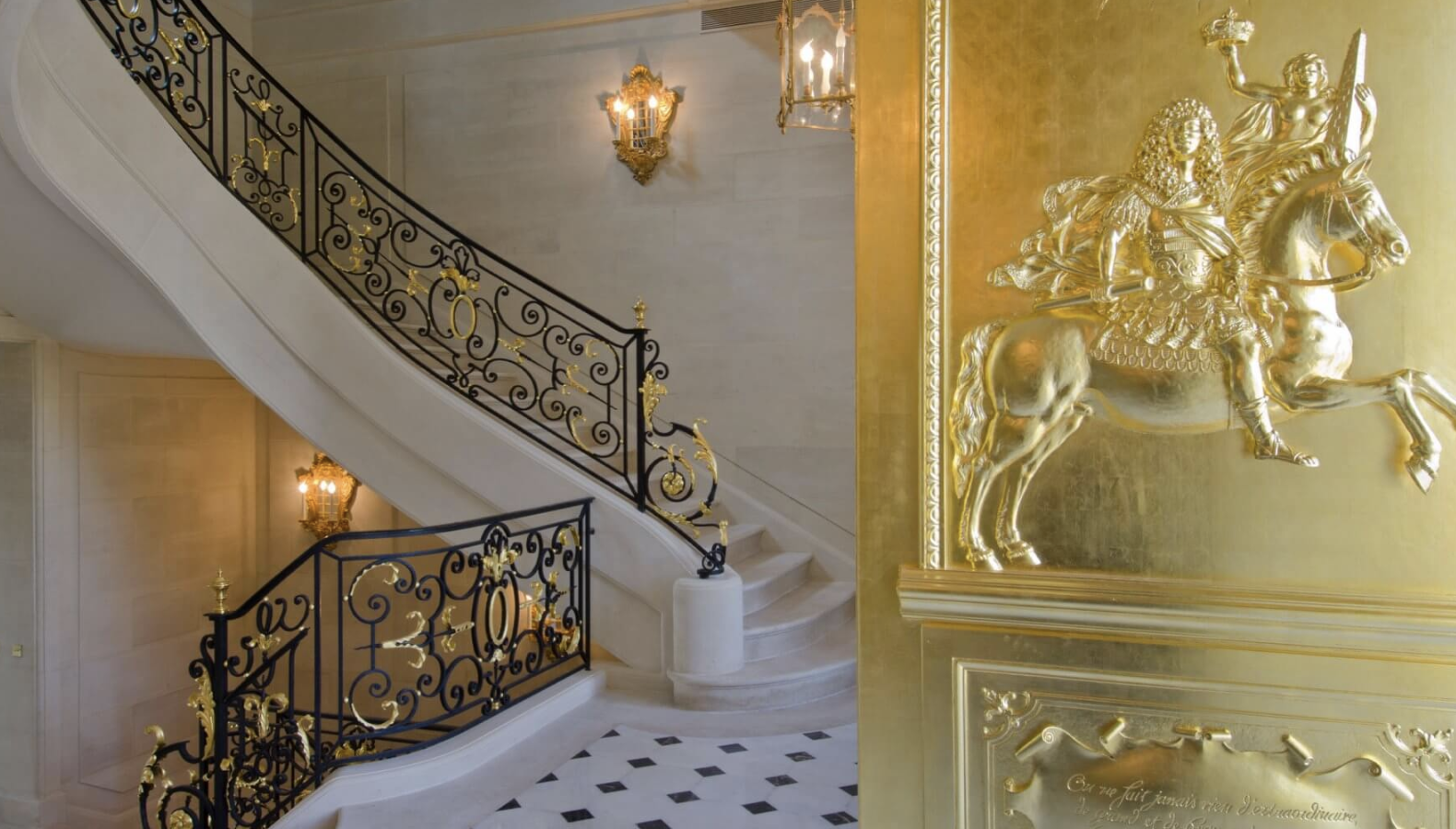
The interior design leans heavily into Baroque and classical French motifs. The entrance hall and grand reception rooms feature elaborate trompe l’oeil ceiling frescoes, painted in a dedicated workshop and inspired by the work of Charles Le Brun — most directly by his celebrated fresco at Vaux-le-Vicomte, the château that helped inspire Versailles itself, though Le Brun also decorated much of the actual Palace of Versailles. One reception room is crowned by a frescoed dome more than 50 feet high, and ceilings in the main reception areas rise more than five meters — behind which hides a fully modern, near-silent climate-control system.
The château includes bedroom suites, a grand reception room, a library, a home cinema with leather seating for about a dozen guests, both an indoor and an outdoor swimming pool, a squash court, and — perhaps the most incongruous feature for a building modeled on 17th-century France — an underground nightclub. Beneath the entrance hall sits a wine cellar capable of holding around 3,000 bottles, positioned near a professional kitchen built for large-scale entertaining. Beneath the moat, a glass-walled meditation room furnished with white leather sofas resembles a giant aquarium.
Elsewhere on the property, there’s a safe room, garage space, and outbuildings that evoke the self-sufficient estates of the aristocracy the château is designed to imitate.
Outside, the grounds mirror the formal French garden style popularized at Versailles: sculpted topiaries, geometric flowerbeds, and a large ornamental basin — a three-quarter-scale reproduction of Versailles’ Bassin d’Apollon, its statuary finished in gold leaf. A hedged labyrinth reportedly stretches about 1.2 miles.
Old World Looks, New World Technology
What separates Château Louis XIV from a genuine period estate is what’s hidden behind the historical detailing. The entire property was built with integrated smart-home technology, allowing an owner to control lighting, fountains, sound systems, and climate settings from a smartphone app. It’s a deliberate contrast: a building engineered to look untouched by time, wired throughout with the conveniences of contemporary luxury living.
The $301 Million Sale
The château was formally completed in 2011, but it wasn’t until 2015 that it made international headlines. That year, the property sold for approximately $301 million — roughly €275 million at the exchange rates of the time — shattering the previous residential record of about $221 million, set by a London penthouse. The sale instantly made it the most expensive private home ever recorded at that time.
At the time of the sale, the buyer’s identity was concealed behind a web of shell companies, a common practice in ultra-high-end real estate transactions. It later emerged, through reporting by The New York Times in December 2017, that the purchase was traced back to Mohammed bin Salman — then Saudi Arabia’s Deputy Crown Prince and defense minister, who became Crown Prince in June 2017. Saudi Arabia’s government has never officially confirmed his ownership of the estate, but the connection has been widely reported and repeated across international outlets in the years since.
The Record, and What Came After
For years, Château Louis XIV was cited as the benchmark for the most expensive home ever sold. That distinction no longer stands unchallenged. Pan Sutong’s Hong Kong mansion reportedly changed hands for around $322 million in 2017, Providence House in London was reported sold for roughly $350 million in 2026, and in 2026 it emerged that Ukrainian-born billionaire Rinat Akhmetov had paid €471 million — some $552 million — in 2024 for a palatial apartment in Monaco’s Mareterra development, the most expensive apartment purchase ever recorded. By most current rankings, the French château now sits around fourth on the list of priciest homes ever sold.
What the château retains is arguably more specific and more durable: it remains the most expensive château ever sold, the most expensive private home ever sold in France, and the only recorded sale of this particular estate.
Part of what keeps the story alive is the sheer contrast at the heart of the property: a building constructed to erase all evidence of its true age, built with the specific goal of looking like it has stood since the age of the Sun King, now known instead as a symbol of 21st-century wealth. Between the frescoed ceilings inspired by Vaux-le-Vicomte and the smartphone-controlled fountains, between the hand-crafted stonework and the underwater meditation room, Château Louis XIV occupies an unusual space — a monument to French classical architecture, built purely to look as though it always had been.
Château Louis XIV remains one of the more unusual entries in the story of the world’s most expensive homes — purchased for a record-breaking price by one of the most powerful men in the modern world.