listen to the audio of this article
The story of Fleur de Lys begins not in Los Angeles but in Houston, where David I. Saperstein built Metro Networks and later sold for $1.25 billion , instantly vaulting him into billionaire status. With that fortune freshly minted, David Saperstein and his wife, Suzanne, set out to build something equally outsized: a private residence that would rival the palaces of European royalty. They commissioned architect Richardson Robertson III in 1996, and the two would spend the next six years constructing what became one of the largest and most opulent private homes ever built in Los Angeles County.
Building a Palace: Vaux-le-Vicomte Comes to Holmby Hills
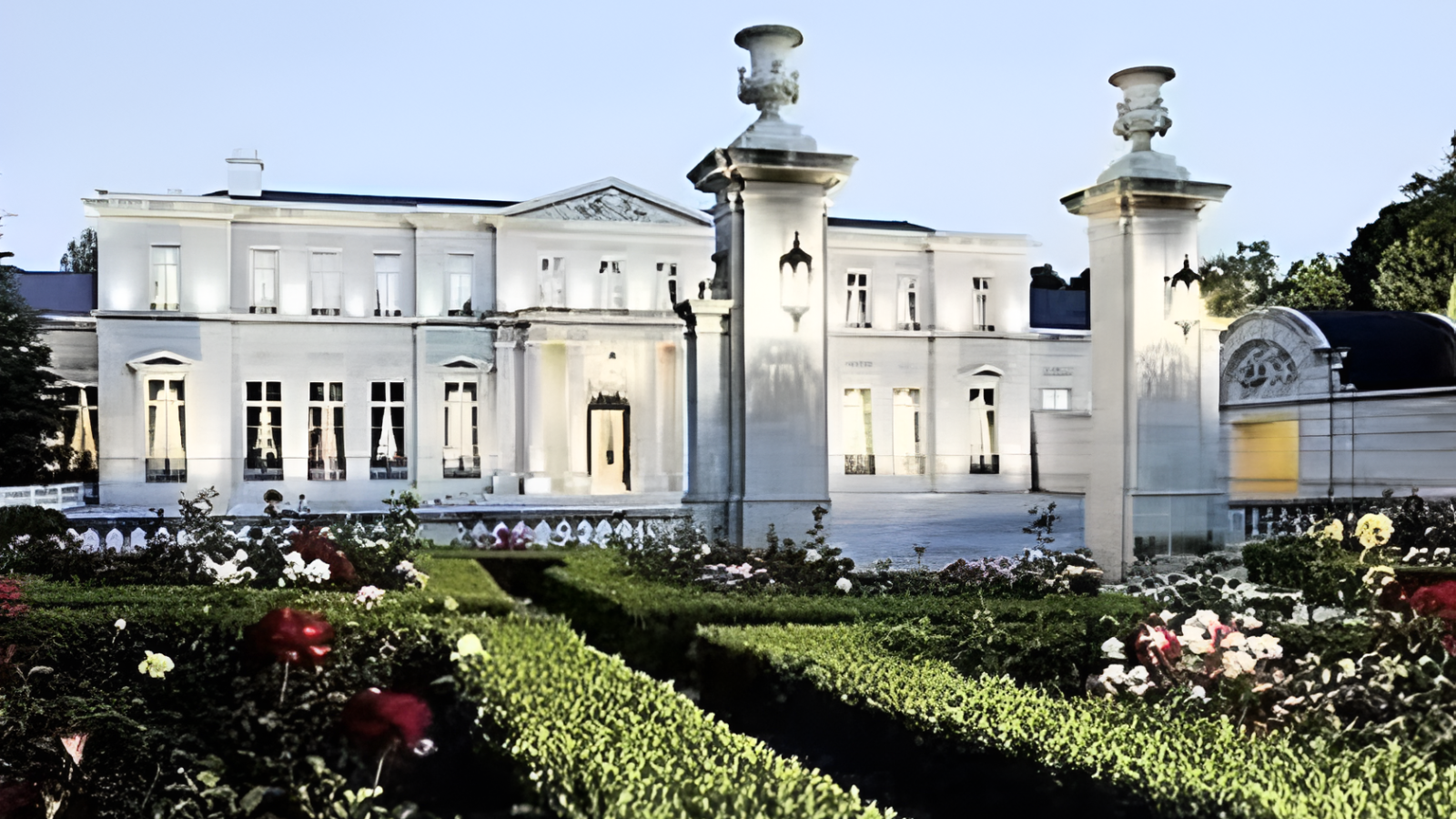
The inspiration for Fleur de Lys was explicit and unapologetic: France’s 17th-century Vaux-le-Vicomte, the château whose extravagance so alarmed King Louis XIV that he had its creator arrested and then built Versailles in response, determined to outdo it. The Sapersteins wanted their Los Angeles home to carry that same unmistakable air of French royal grandeur, and Robertson was tasked with making sure every detail — down to the moldings and rooflines — matched the aesthetic vocabulary of a grand French chateau rather than anything resembling a typical Beverly Hills mansion.
The final result, completed in 2002, sprawled across roughly 45,000 square feet of living space on five acres of manicured grounds, though some accounts of the finished property put the total closer to 50,000 square feet once every wing, outbuilding, and covered space is counted. Reaching the front door required traversing a 200-yard driveway lined with mature trees, passing through not one but two separate motor courts before arriving at a marble-floored, two-story entry hall crowned with gold-paneled ceilings — an entrance built explicitly to announce, before a guest ever reached the living areas, that this was not an ordinary home.
Inside, the numbers alone tell a story of scale bordering on the absurd. Twelve to fifteen bedrooms. Fifteen or sixteen bathrooms, depending on the account. A fifty-seat private movie theater, finished in the glamorous style of a 1940s Hollywood picture palace. A ballroom capable of holding as many as 650 people, decorated in the same ornate French style as the rest of the house. A wine cellar sized for roughly 4,000 to 5,000 bottles. A dedicated music room, a private conference room, a massage room, and even a full beauty salon — amenities that suggested the home was designed less as a place to relax and more as a private compound capable of running like a small institution.
The outdoor grounds matched the interior’s ambitions. A seventy-foot swimming pool with its own pavilion. A championship-caliber tennis court. A 1,200-foot running track. A separate guest house and pool house, the latter outfitted with its own exercise room, dance floor, and kitchen. Ornamental gardens, flat manicured lawns, and a garden folly rounded out grounds designed to be experienced as a self-contained estate rather than a backyard.

A Marriage That Didn’t Outlast the Construction Schedule
Perhaps the most striking detail of the Fleur de Lys story is its timing. The mansion took roughly six years to build, a construction schedule long enough to span a significant portion of the Sapersteins’ marriage. Yet the couple divorced within just a few years of the home’s completion — some accounts put it as little as eighteen months, others closer to three years. Whatever the exact interval, the house that was meant to be a generational family seat instead became, almost immediately, a divorce asset. As part of the settlement, Suzanne Saperstein retained ownership of the estate.
It is a familiar irony in the world of ultra-luxury real estate: some of the most extravagant homes in America are less monuments to lasting family legacies than snapshots of a specific, often fleeting, moment of wealth and ambition. Fleur de Lys, despite its centuries-old architectural references, ended up embodying a distinctly modern and transient kind of American fortune — built fast, enjoyed briefly, and then repurposed as a financial chip in a legal settlement.
Nine Years on the Market, One Price
Suzanne Saperstein first listed Fleur de Lys in 2007 with an asking price of $125 million — an eye-watering figure for the time, reflecting both the scale of the house and its unusual architectural pedigree. What followed was one of the more unusual sagas in luxury real estate: for seven years, through a recession, a housing market collapse, and a slow recovery, the price never moved. Buyers came and went, offers were reportedly floated and rejected, and at one point pop star Mariah Carey was said to have made a bid on the property. None of it dislodged Suzanne Saperstein from her number.
The standoff eventually ended in the spring of 2014, when three billionaires were reportedly competing in a final bidding war for the estate. The winner was Michael Milken — the former “junk bond king” whose name remains synonymous with the high-yield debt markets of the 1980s and who had, by 2014, spent decades rebuilding his public reputation through philanthropy and medical research funding. Milken’s winning bid came in at $102 million, notably below the original $125 million ask but paid entirely in cash, a detail that made headlines almost as much as the sale itself. At the time, the transaction became the most expensive single-family home sale in the history of Los Angeles County, a record that briefly eclipsed even the $94 million Gary Winnick had paid for a Bel Air estate and the $85 million Petra Ecclestone paid for The Manor in 2011.
A House That Became a Landmark of Excess
More than two decades after ground was broken, Fleur de Lys endures less as a family home and more as a case study — cited repeatedly in discussions of American mega-mansions, celebrity real estate, and the psychology of ultra-wealthy home-building. It represents a particular species of trophy property: commissioned not simply for shelter or even comfort, but as an architectural statement modeled explicitly on European royal precedent, built by new money in direct homage to old power.
Its afterlife has proven just as compelling as its construction. A marriage that didn’t survive its own construction timeline. A record-setting cash sale to one of finance’s most notorious names. A near-decade of market limbo at a single stubborn price. Few houses manage to accumulate so many chapters of a distinctly American story — ambition, excess, divorce, and finally, a staggering payday — inside their own walls. Fleur de Lys did it all before its first owners even finished unpacking.