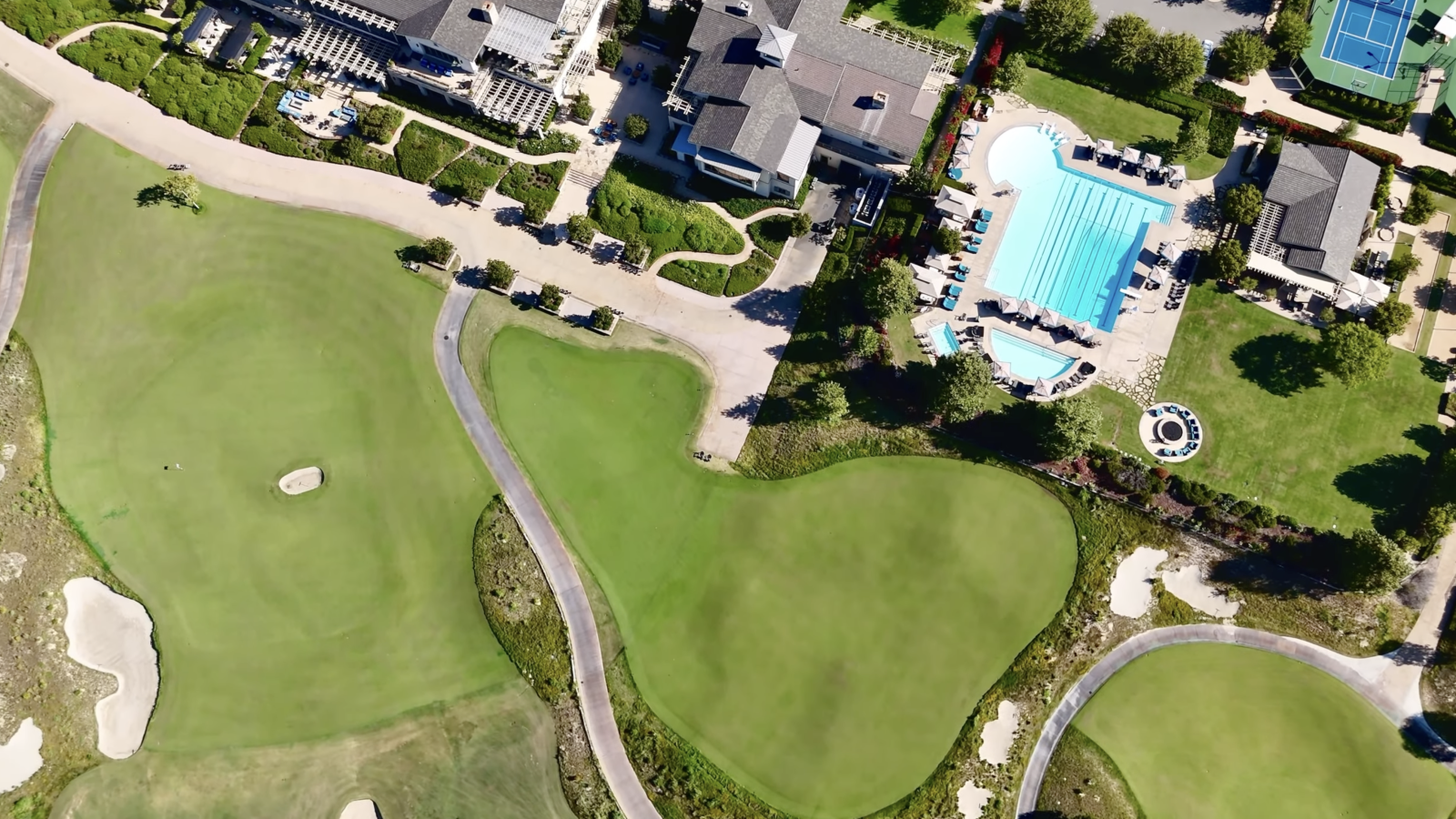
Located on the Palos Verdes Peninsula, Rolling Hills Country Club has solidified its reputation as one of Southern California’s most exclusive havens. Established in 1965, the club underwent a massive transformation culminating in a 2018 reopening, unveiling a brand-new 70,000-square-foot luxury clubhouse and a premier championship 18-hole golf course designed by world-renowned architect David McLay Kidd.
What makes Rolling Hills remarkable isn’t just its price tag or its pedigree — it’s the sheer audacity of the project that created it. This is a club that was rebuilt, almost literally, from the ground up: an industrial sand-and-gravel quarry transformed into one of the most scenic and strategically ambitious golf courses in the region.
The Club Profile
The Course: A par-72 layout stretching 7,090 yards from the tips, built over a filled, former 240-foot-deep sand and gravel quarry, with sweeping views across the LA Basin.
Family Amenities: Unlike golf-only facilities, Rolling Hills features an extensive fitness center, athletic facilities, a swimming pool, and tennis and pickleball courts — positioning it as a full lifestyle destination rather than a purely golf-centric retreat.
Vibe & Culture: The club is known for a modern, energetic, and highly social atmosphere, popular with younger families throughout the South Bay.
Exclusivity: With full equity golf initiation fees starting at roughly $200,000, the club maintains highly restricted access and demands a serious financial commitment from prospective members.
A Daring Gamble: Rebuilding From an Industrial Quarry
The staggering valuation of a Rolling Hills membership stems directly from the club’s $75 million radical reinvention — a project whose origins reach back decades.
For close to fifty years, the club operated on a tight, compromised footprint squeezed alongside the active Chandler’s Palos Verdes Sand & Gravel quarry. The original course, laid out by architect Ted Robinson in the 1960s and expanded onto leased quarry-adjacent land in the early 1970s, was hemmed in by houses and constrained property lines — leaving little room for the kind of expansive, strategic design that modern championship golf demands.
Everything changed when the club and a development partner moved to acquire the quarry itself in 2008, with an eye toward eventually combining the two properties into a dramatically reimagined course alongside new residential development. The plan stalled almost immediately: the 2008 financial crisis froze financing and development plans industry-wide, putting Rolling Hills’ ambitions on hold for years.
It wasn’t until local developer Chuck Lande stepped in, years later, to revive the stalled project that momentum returned. Lande succeeded in bringing acclaimed Scottish golf course architect David McLay Kidd on board to design the new course — a designer whose credits include the celebrated Bandon Dunes resort in Oregon. The club formally retained architect Robert Altevers to design the new clubhouse and supporting athletic facilities as early as 2004, but between the recession-driven delays and the extensive approvals required for a project of this scale, the full arc from initial planning to grand reopening spanned roughly a decade and a half.
An Engineering Marvel
Once construction resumed in earnest, the scale of the undertaking became clear. Crews shifted an estimated 6 to 6.5 million cubic yards of earth to level the site’s namesake hills, cap the new fairways, and fill the quarry’s 240-foot-deep pit — an almost unfathomable volume of material moved to reshape the landscape into a golf course.
The sand deposit beneath the old quarry turned out to be the project’s defining asset. Kidd has spoken about the site in near-reverential terms, noting that Rolling Hills is “blessed with the magic ingredient shared by almost all truly great golf courses” — sand, which provides the ideal drainage medium for firm, fast, links-style playing surfaces rarely found in Southern California.
The course closed to members in early 2015 to allow construction to begin in earnest. After more than three years of building, grading, and finish work, member play resumed in September 2017, with the club’s official grand reopening celebration following in January 2018.
A Championship Course Reborn
Today, the par-72, 7,090-yard championship course features wide, rolling fairways that loop seamlessly over the old quarry pit, rewarding players with unobstructed, cinematic views across the Los Angeles Basin and, on clear days, out toward the San Gabriel Mountains.
Kidd’s design philosophy leans heavily on his background in traditional Scottish links golf: generous, contoured fairway corridors that invite aggressive driving lines, paired with large, dramatic green complexes that offer a wide variety of pin placements and demand precision on approach. Course-ranking panels have praised the layout’s changing wind angles, elevation shifts, and the way its bunkering and tee placements create multiple strategic options on nearly every hole — golf writers have singled out the course’s opening stretch on the back nine, routed along the highest point of the reshaped property, as among the strongest sequences in the entire design.
The course has since earned recognition on Golf Digest’s rankings of the best courses in California, a notable achievement for a club that spent decades as a modest, tightly-squeezed layout with limited strategic ambition.
Redefining the Private Club Experience
While traditional $200,000-initiation clubs often lean toward stuffy formal dining rooms and quiet, golf-only environments, Rolling Hills has deliberately positioned itself differently — targeting younger South Bay families in search of high-end, resort-style amenities alongside serious golf.
The centerpiece of that social experience is the club’s 70,000-square-foot clubhouse, designed by noted Southern California clubhouse architect Robert Altevers and built to function less like a traditional country club and more like a five-star resort hotel. Amenities include:
- A state-of-the-art fitness and aquatic center
- A dedicated tennis and pickleball complex
- Family-oriented programming and activities for younger members
- Elevated dining and event spaces designed to host both formal and casual social gatherings
This emphasis on lifestyle amenities — well beyond the golf course itself — has become central to the club’s identity and appeal, attracting younger executives, entrepreneurs, and multi-generational families drawn to the expansive athletic facilities, resort-caliber pool deck, and an active weekend social calendar that keeps the clubhouse buzzing well beyond tee times.
A Model for Modern Private Clubs
Rolling Hills Country Club’s transformation offers a compelling case study in what’s possible when a private club is willing to bet big on reinvention. Few clubs would attempt — let alone successfully execute — a project requiring the acquisition and complete regrading of an active industrial quarry, all while navigating a recession-driven, decade-plus approvals process. That the result is now ranked among California’s premier golf destinations, while simultaneously functioning as a magnet for younger South Bay families seeking a full-service lifestyle club, speaks to just how deliberately the project was designed from the ground up — literally and figuratively.
For members willing to meet its steep entry requirements, Rolling Hills now offers something increasingly rare in Southern California private golf: a genuinely modern, championship-caliber course paired with the kind of resort-style family amenities that have redefined what a “country club” can be.