listen to the audio of this article
In September 2010, La Belle Epoque sold for approximately €240 million. At the time, this instantly made it the most expensive residential real estate transaction ever recorded anywhere in the world. Coverage at the time framed it as a watershed moment for the ultra-luxury property market, with the transaction reportedly working out to roughly $17,600 per square foot — a figure that stunned even seasoned observers of the world’s priciest real estate markets.
The buyer’s identity was never officially confirmed, but reports at the time pointed to either an Arab sheikh or a Greek billionaire, with later sourcing more specifically naming Sheikh Mohammed bin Rashid Al-Maktoum of the Dubai Royal Family — though this attribution should be treated as widely reported rather than definitively confirmed, since Monaco’s ultra-luxury market is notoriously private about buyer identities.
The apartment’s path to that record sale began under difficult circumstances: its previous occupant, billionaire banker Edmond Safra, died there in a 1999 fire, after which his widow, Lily Safra, sold the property to British developers Nick and Christian Candy for a reported £10-15 million, or roughly $16-25 million — a fraction of what it would eventually fetch.
The Transformation
What the Candy brothers did next is really the heart of this story. Over roughly 18 months and at a cost of approximately $40-50 million, they gut-renovated the penthouse into what Architectural Digest and much of the luxury press at the time called arguably the most spectacular private residence in Europe. Nick Candy later told Architectural Digest: “Chris and I were already living quite contentedly in Monte Carlo when this penthouse came up for sale, but once we’d seen the space and the location, we realized it had the makings of the best apartment in the world.”
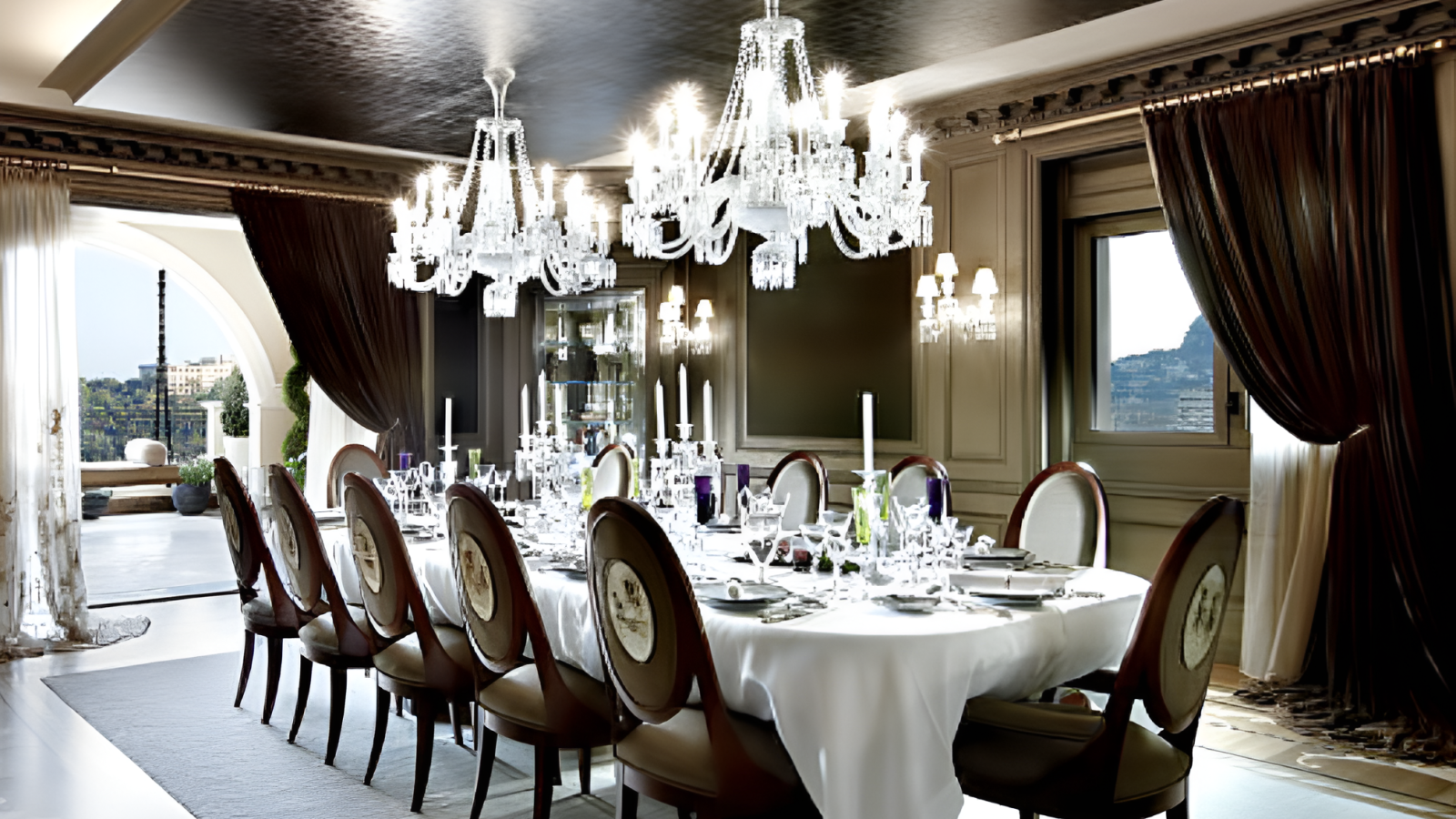
The finished result was a three-bedroom duplex spanning roughly 1,625 square meters, about 17,500 square feet, sitting atop the top two floors of the building with sweeping views over Port Hercules and Monte Carlo’s marina. Standout features included a platinum-leaf ceiling in the formal dining room, a double-height library, two suites each with its own bedroom, bathroom, dressing room, cinema, and kitchen, an oval-shaped office where the Candy brothers themselves worked while living in the apartment, and vast roof terraces featuring mature 15-foot trees and a rooftop infinity pool. The apartment was featured in Architectural Digest in November 2009, showcasing the double-height library and the brothers’ oval office to an international design audience just months before the record sale would make headlines around the world.
The design ethos, per the Candy & Candy team, was deliberately patterned after the golden-age aesthetic implied by the apartment’s name — La Belle Epoque, meaning “the beautiful era,” a nod to the ornate, art-and-culture-driven period of European high society in the decades before World War I. The interiors leaned into an almost palatial visual language, with the property frequently described in press coverage as a modern equivalent of a residence fit for the Medici or Versailles.
Why It Mattered Beyond the Price Tag
The sale wasn’t just a personal transaction — it became a landmark moment in the broader story of Monaco’s real estate market, long recognized as one of the most expensive and tightly constrained property markets in the world, similar in spirit to Hong Kong’s Peak district. Monaco’s Avenue Princess Grace, in the same period, was separately reported as the most expensive street in the world to buy property, with per-square-meter prices reaching roughly €85,000. La Belle Epoque’s sale reinforced that reputation on a global stage, and for several years it held the record as the most expensive home sale ever completed — a title that would later be surpassed but that cemented Monaco’s status in the same rarefied tier as Hong Kong’s Peak, London’s most exclusive postcodes, and the French Riviera’s grand estates.
The Bigger Picture on Monaco’s Ultra-Luxury Market
La Belle Epoque’s sale sits within a long lineage of headline Monaco transactions that continue to this day. Monaco has long compensated for its minuscule footprint — just over two square kilometers, making it the second-smallest country in the world — by building relentlessly upward and, more recently, outward into the sea. More recently, the 2024 inauguration of Mareterra, Monaco’s ambitious land-extension development, produced a fresh wave of record-setting sales, including a set of ten private villas built within the new district, each conceived as a singular architectural statement in its own right. That newer generation of trophy properties shows how Monaco has continued to reinvent the physical boundaries of its own tiny territory, literally extending into the Mediterranean, in order to keep producing the kind of ultra-scarce, ultra-desirable addresses that buyers like the eventual purchaser of La Belle Epoque were willing to pay record sums for.
La Belle Epoque’s journey from the scene of a billionaire’s death to the world’s most expensive apartment sale captures, in miniature, exactly what makes markets like Monaco’s so singular: an almost total absence of available inventory, combined with a global class of buyers for whom price is rarely the deciding factor, so long as the address is right. For the Candy brothers, the sale marked a defining moment in their own careers, cementing Candy & Candy’s reputation as one of the preeminent names in ultra-high-end residential development and design. And for Monaco itself, the transaction served as a kind of permanent marker in the principality’s ongoing story — proof that even in a market defined by extraordinary scarcity, there will always be a buyer willing to pay for the right address, the right history, and the right view of Port Hercules.