listen to the audio of this article:
Tucked into Paradise Cove, one of Malibu’s most exclusive stretches of sand, sits a property with a name as romantic as its price tag is enormous. Mar de Amor — Spanish for “sea of love” — is the 2.6-acre oceanfront compound built by broadcasting billionaire David Saperstein, and when it hit the market in January 2020 asking $115 million, it briefly stood as one of the most expensive listings in California history. The listing capped off a run of headline-grabbing Malibu megadeals in the late 2010s, and offered a rare look inside a property its owner had spent decades treating as a genuinely private retreat rather than a trophy asset built for the market.
The Man Behind the Traffic Reports
Saperstein’s fortune traces back to an idea that sounds almost quaint by today’s standards: real-time traffic and weather reports for radio stations. He founded Metro Networks, the company that pioneered using helicopters to relay up-to-the-minute drive-time conditions to local broadcasters across the country, turning a simple service into a business empire. Public accounts of his exit vary somewhat on timing and structure, but Saperstein ultimately sold the company — later folded into Westwood One — in a deal reportedly worth well over a billion dollars, cementing his status as one of the wealthier, lower-profile figures in American media. Before Metro Networks, by some accounts, Saperstein had worked as a car salesman, a detail that occasionally surfaces in profiles of him as a reminder of just how far his eventual fortune traveled from its starting point. Since selling the company, he’s diversified into tree farming, with substantial land holdings in Texas and Florida, a business about as far removed from helicopter traffic reports as one could imagine.
Real estate has been a recurring theme throughout Saperstein’s post-Metro Networks life, and rarely on a modest scale. He and his ex-wife Suzanne built Fleur de Lys, a Palace of Versailles-inspired mega-mansion in Beverly Hills’ Holmby Hills neighborhood that became one of the most photographed trophy homes in Los Angeles; after their 2014 divorce, Suzanne sold it for $102 million. In 2018, Saperstein separately sold Hummingbird Nest Ranch, his 123-acre equestrian property in Simi Valley — a filming location used for movies, weddings, and music festivals — for $33 million. Mar de Amor represents the third leg of that real estate legacy, and by most measures, the most personal: a home he built himself, from the ground up, rather than one he acquired.
A House Shaped Like a “V”
Built in the late 1990s, the 10,600-square-foot compound earned an unofficial nickname almost as memorable as its Spanish moniker: the “Triangle House.” Viewed from above, the home’s footprint forms a distinct V-shape, with the point of that V converging at an infinity-edge pool positioned to make the ocean feel as though it’s spilling directly into the house. It’s an architectural choice that turns an aerial photograph into the property’s calling card, and one that real estate agents touring the home have specifically called out as a defining, almost sculptural feature.
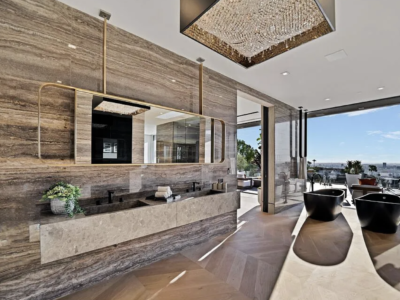
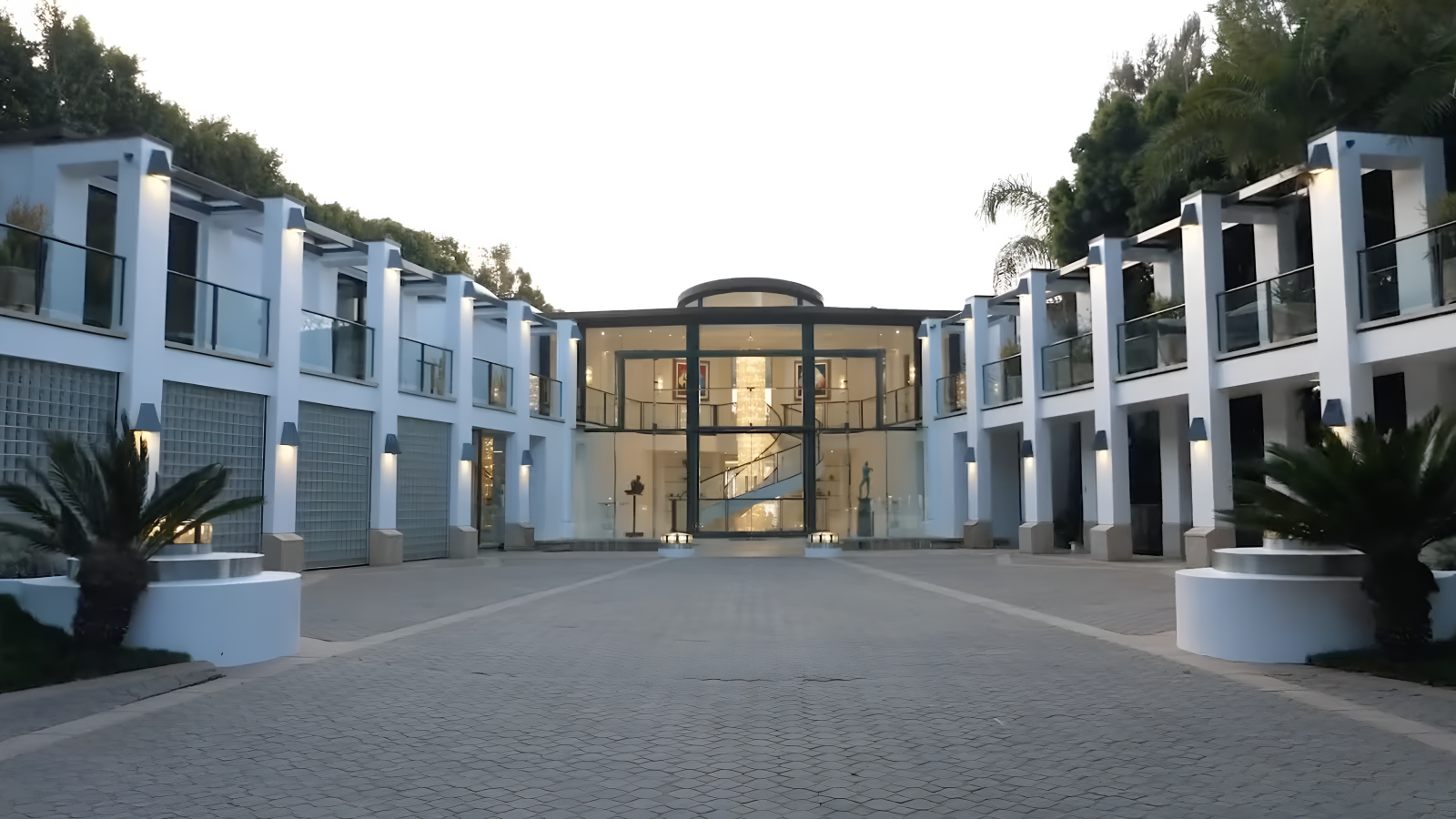
The home spans 12 bedrooms and 14 bathrooms across three stories, arranged around a two-story entry anchored by an 18-foot crystal chandelier suspended above a sweeping circular staircase clad in Bianco Carolina marble — a deliberately theatrical first impression before a visitor even reaches the main living spaces. Beyond the entry, the layout opens into vast, open-plan rooms wrapped in floor-to-ceiling glass, engineered to keep the Pacific in constant view. The primary suite continues that theme, finished in white tile and stark white walls specifically to avoid competing with its own 180-degree ocean views — one agent touring the home compared the sensation to standing on the bow of a ship.
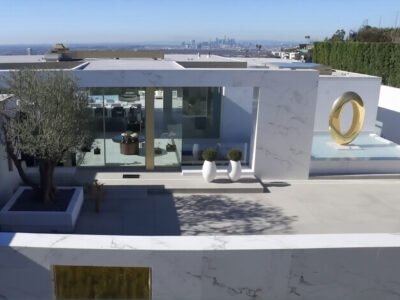
Amenities run deep even by Malibu’s demanding standards: a 20-seat private screening room, a lighted tennis court, an eight-car subterranean garage, a chef’s kitchen finished in industrial-grade stainless steel with its own dedicated elevator down to the lower-level entertaining spaces, and a primary bathroom built around a freestanding copper soaking tub. A games room on one of the lower levels adds a pool table and additional casual entertaining space, while a walk-in wardrobe off the primary suite has been singled out by touring agents as among the largest they’ve encountered in any home, Malibu or otherwise. Outside, extensive decks, patios, and Zen-inspired walkways cascade down the property toward private beach access on the sand at Paradise Cove — one of the more tightly held, celebrity-heavy enclaves anywhere on the California coastline. The gated entry itself sets the tone for the rest of the property, with a long paved driveway passing a pair of custom-built children’s treehouses on one side and the lit tennis court on the other before opening into a grand motor courtyard. Saperstein’s neighbors have reportedly included Walmart heiress Ann Walton Kroenke next door, along with nearby residents Leonardo DiCaprio, Courteney Cox, John McEnroe, and former Paramount Pictures chief Frank Mancuso Sr.

A Listing That Took Its Time
Getting Mar de Amor sold proved to be a multi-year effort. Saperstein first listed the property in January 2020 at $115 million, a price that — had it been achieved — would have ranked among the ten most expensive home sales in California history at the time, trailing benchmark deals like Serge Azria’s $177 million Paradise Cove sale and Lachlan Murdoch’s $150 million purchase of the Chartwell Estate. The pricing was pitched in the same range as other recent Malibu megadeals, including NBCUniversal executive Ron Meyer’s $100 million oceanfront sale in 2019 and Peter Morton’s $110 million Carbon Beach sale in 2018.
The property didn’t move at that price. Saperstein pulled the listing that September, then relisted it roughly fifteen months after its original debut, still asking $115 million, with Drew Mandile of Sotheby’s International Realty handling the listing. By January 2022, after two years without a buyer, Saperstein cut the price substantially, relisting through Compass agent Chris Cortazzo at $85 million — a $30 million reduction from the original ask. Later reporting on the home’s continued marketing referenced an even steeper cumulative markdown, with some coverage describing a $40 million total price cut from the original $115 million figure.
Public property records indicate the home ultimately changed hands in April 2024, with available data pointing to a sale price in the neighborhood of $75 million — a substantial discount to the original $115 million ask, though still a significant sum for a coastal compound of this scale. That figure should be treated with some caution: it stems from public-record and aggregator sources rather than confirmed reporting from a major real estate outlet naming a specific buyer, and details of the final transaction haven’t been as widely covered in the press as the original listing was.
Even short of its original asking price, Mar de Amor’s eventual sale is a reminder of how quickly ultra-luxury pricing can compress once a property spends years on the market. What was pitched in 2020 as a potential top-ten sale in California real estate history closed, by most available accounts, at roughly two-thirds of that original number — a pattern that has played out across a number of nine-figure Malibu listings that debuted with headline-grabbing prices only to find their eventual buyers well below the initial ask.
Whatever it ultimately sold for, Mar de Amor’s real legacy may be architectural rather than financial. Few homes on the California coast are quite so literally built around their own signature view: a V-shaped footprint converging on an infinity pool, engineered so that the entire structure seems to funnel toward the Pacific itself. For a broadcasting mogul whose original fortune was built on telling people, in real time, exactly what conditions lay ahead of them, there’s a certain symmetry in building a home whose entire architecture points toward the same horizon.