listen to the audio of this article:
In a city that didn’t exist as a major metropolis forty years ago, one address has come to function as shorthand for arrival itself. Locals call it, simply, “深圳第一豪宅” — Shenzhen’s No. 1 mansion. In English it’s known as Shenzhen Bay One (深圳湾壹号), and for more than a decade it has stood, unrivaled, at the top of the city’s luxury property pyramid — a title it has held since long before Shenzhen Bay’s skyline had much competition to offer at all.
Built on Reclaimed Land, Aimed at the Sky
Shenzhen Bay One occupies a site that could hardly be more symbolic of the district around it: the Houhai area of Shenzhen Bay, a stretch of the city built almost entirely from scratch on reclaimed coastal land, now home to some of the highest property values in mainland China. The complex sits directly beside Shenzhen Talent Park, with uninterrupted views across the bay itself — the kind of permanent, unobstructable sightline that luxury buyers in a rapidly vertical city are willing to pay enormous premiums to secure.
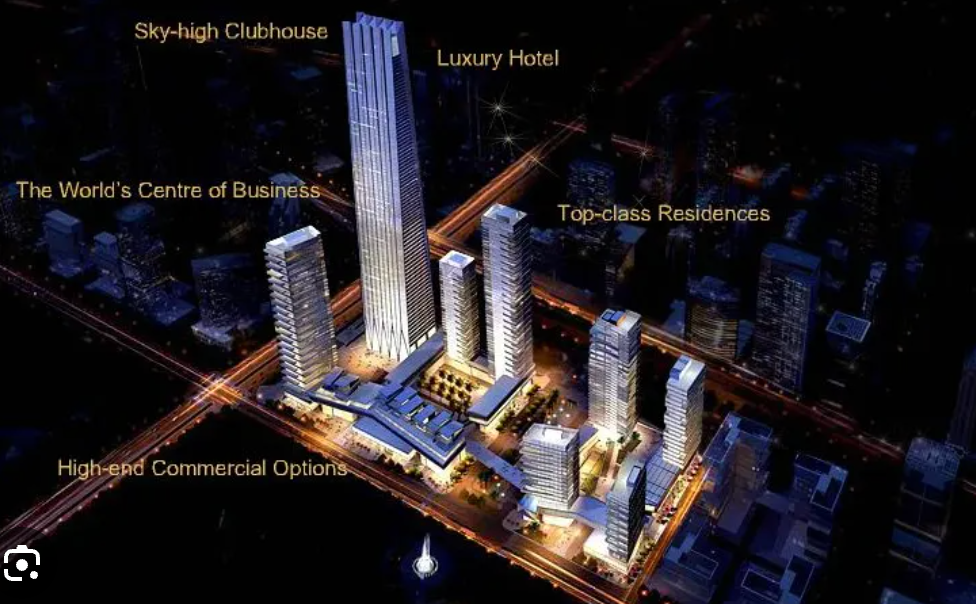
The development is substantial in scale: eight towers ranging from 70 to 338 metres in height, together forming a combined floor area of roughly 475,000 square metres, blending ultra-high-end residences with global business space, a luxury hotel, and high-end retail — less a single building than an entire vertical neighbourhood engineered around one address. The project was developed by Shenzhen Pengrui Real Estate Development Co., a locally rooted developer that staked its reputation on building not just Shenzhen’s most expensive residence, but a genuine architectural landmark for the city.
A Design Team Assembled Like a Supergroup
Few residential developments anywhere have assembled quite so many internationally recognized names under one roof. Shenzhen Bay One’s design drew on more than twenty leading global design firms, including the American architecture practice Kohn Pedersen Fox and the Canadian interior design house Yabu Pushelberg, in an effort to give the complex what its developer has called a landmark quality meant to outlast any single design trend. The project won the International Property Award — often described locally as real estate’s answer to the Oscars — as early as 2013, the same year its first phase went on sale.
The building’s exterior reflects that same ambition for permanence. Its facade uses a 2.4-metre-wide, beamless, panoramic glass curtain wall combined with high-grade metal detailing, achieving a light transmission rate of roughly 91.7 percent — engineered so that, from nearly any unit, the boundary between interior and bay seems to all but disappear, day or night.

Amenities Built for a Different Kind of Owner
What separates Shenzhen Bay One from ordinary luxury housing isn’t simply the apartments themselves, but the ecosystem built around them. The complex houses the Cloud Concert Hall, promoted as the world’s highest-altitude concert venue, which regularly hosts international performances for residents and guests. It also includes a helicopter landing pad positioned roughly 350 metres above ground level, offering owners a private point of arrival and departure that bypasses the city’s traffic entirely.
Day-to-day property management is handled by JLL, the global real estate services firm, which provides what is marketed locally as seven-star butler service — a tier of concierge attention more commonly associated with ultra-luxury hospitality than residential property management. That service comes with a service more typical of a five-star hotel than an apartment block.
A Decade of Record Prices
Since its 2013 launch, Shenzhen Bay One has repeatedly reset expectations for what property in the city could command. Units in the first phase launched at between 60,000 and 170,000 yuan per square metre, a figure that shattered Shenzhen’s price ceiling at the time. By 2020, resale transactions in the building had reached as high as 300,000 yuan per square metre, cementing its reputation as the city’s most expensive residential address by a wide margin.
That premium has proven remarkably durable. Even as Shenzhen’s broader property market cooled through 2024 and 2025 — new home prices citywide fell somewhere between a quarter and a third over that period, and many developers were forced into steep discounts to move inventory — ultra-luxury addresses in the Shenzhen Bay corridor continued attracting buyers largely undeterred by the wider slowdown, with sales of homes priced above 30 million yuan actually accelerating even as the mass market struggled. Shenzhen Bay One has functioned throughout as something closer to a benchmark asset than an ordinary home: a piece of real estate whose scarcity — a coastline that, once built out, cannot be replicated — has made it comparatively resistant to the cyclical swings affecting the rest of the market.
More Than a Home
Local commentary on the building consistently frames ownership there as something beyond shelter altogether — a signal of arrival within Shenzhen’s wealthiest social tier, and, for many buyers, a belief that the site’s position on the water carries genuine feng shui significance, an idea that shapes not just where buyers choose to live in the city but how developers design, orient, and even name their projects along the bay.