In the rarefied world of business aviation, a handful of names command instant recognition. But only one has become synonymous with the very concept of private jet travel itself: Gulfstream. From its beginnings with a Grumman-built turboprop to its current status as the flagship of General Dynamics, Gulfstream has spent over six decades not just building aircraft, but shaping an industry. Today, its fleet of advanced, ultra-long-range jets represents the pinnacle of performance, comfort, and innovation—a legacy of excellence forged in the skies over Savannah, Georgia.
The story of Gulfstream is not merely one of technical achievement, but of a singular, unwavering vision. It is the story of a company that, from its very first flight in 1958, sought to create an aerial canvas for the world’s most discerning travelers. The Gulfstream I wasn’t just a new plane; Gulfstream itself describes it as the world’s first aircraft designed from the ground up for the specific demands of business travel. This pioneering spirit has propelled the company forward, leading it to consistently push the boundaries of what’s possible in aviation, culminating in the recent entry into service of the G800, now the world’s longest-range business jet.
The Modern Fleet: A Spectrum of Excellence
Gulfstream’s modern line-up is a carefully curated portfolio designed to meet the diverse needs of a global clientele. From the agile and efficient G400 to the flagship G800, each model represents a specific expression of the company’s core values: performance, innovation, and uncompromising luxury.
Gulfstream G400: The Agile Newcomer
The G400, which completed its first flight in August 2024, is the newest member of the family. Positioned as a highly efficient and capable long-range jet, it leverages the advanced, high-speed wing and winglet design first introduced on the larger G500 and G600. This technology, combined with its twin Pratt & Whitney Canada PW812GA engines, allows the G400 to achieve a range of 4,200 nautical miles at Mach 0.85. With a launch price of around $34.5 million, it fills a vital niche in the market, offering a compelling blend of speed, efficiency, and Gulfstream’s renowned cabin comfort in a more accessible package. The G400’s potential was quickly recognized: the first sale for dedicated charter operations in Europe, to Germany’s DC Aviation Group, was announced in September 2024, signaling strong market demand for the new platform.
Gulfstream G500 & G600: The Proven Performers
The G500 and G600 form the bedrock of the modern Gulfstream fleet. These aircraft, which first flew in 2015 and 2016 respectively, have amassed a robust track record of reliability and performance. They are the workhorses of the Gulfstream lineup, offering the exceptional cabin comfort, advanced avionics, and long-range capabilities that define the brand.
Gulfstream G650ER: The Legendary Workhorse
The G650ER is a legend in its own right. An extended-range variant of the revolutionary G650, this aircraft redefined the ultra-long-range category. Together with the standard G650, the family now numbers more than 595 aircraft in service across 55 countries, making it a familiar and highly respected sight at airports around the globe. The G650ER can connect city pairs like New York and Hong Kong with its extraordinary 7,500-nautical-mile range, carrying up to 19 passengers in a cabin renowned for its comfort and quiet. Powered by two Rolls-Royce BR725 A1-12 engines, it has a high-speed cruise of Mach 0.90 and a maximum operating speed of Mach 0.925, making it one of the fastest and most capable business jets ever built. The G650ER’s proven performance and spacious interior have made it a favorite for both corporate flight departments and charter operators worldwide.
Gulfstream G700: The Ultimate Cabin Experience
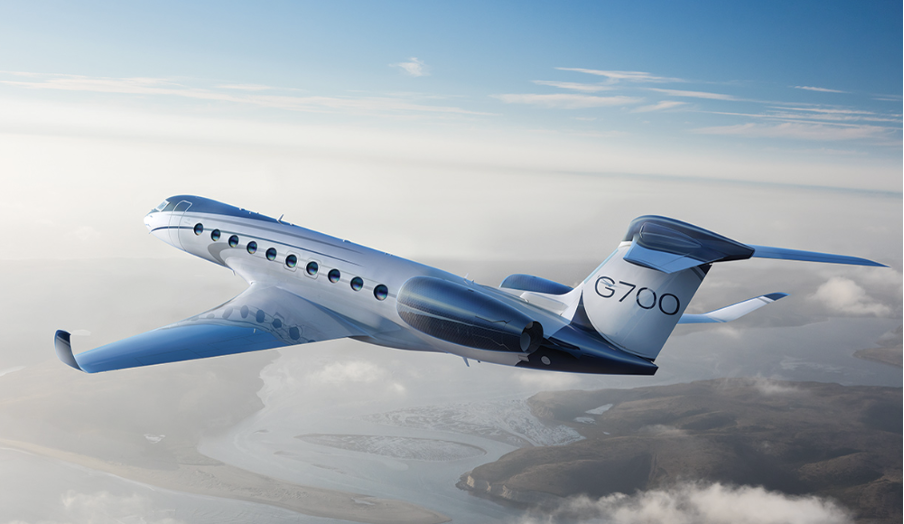
The G700 represents the pinnacle of Gulfstream’s interior design philosophy. It is the aircraft that brings a truly residential feel to the sky, offering what Gulfstream calls business aviation’s most spacious and flexible interior. The cabin can be configured with up to five living areas, sleeping up to 13 passengers. The highlight is the optional grand suite, a private stateroom featuring a full-size bed and a bathroom with a shower—an onboard sanctuary that rivals a five-star hotel.
This cabin experience is further enhanced by 20 Gulfstream Panoramic Oval Windows, among the largest in business aviation, which bathe the interior in natural light and provide sweeping views. The G700 also features a whisper-quiet cabin, 100% fresh, plasma-ionized air replenished every two to three minutes, and a cabin altitude of just 2,840 feet at 41,000 feet—all contributing to a sense of wellness designed to reduce the effects of jet lag. The G700 is not just a mode of transport; it is an aerial residence.
Gulfstream G800: The New Flagship
The G800, certified in April 2025 and delivered to its first customer that August, is the new crown jewel of the Gulfstream fleet. It represents the culmination of decades of engineering expertise, designed to be the ultimate global connector. Its claim to fame is an unmatched range of 8,200 nautical miles at a long-range cruise speed of Mach 0.85, making it the longest-range business jet in the world. This capability, combined with a high-speed cruise of 7,000 nautical miles at Mach 0.90 and a maximum operating speed of Mach 0.935, means the G800 can link virtually any two cities on the planet with speed and efficiency.
The G800 inherits many of the G700’s best features, including its award-winning interior design and the industry’s lowest cabin altitude. It can be configured with up to four living areas and features 16 Gulfstream Panoramic Oval Windows. The G800’s blend of peerless range, cutting-edge technology, and luxurious comfort sets a new standard for what a business jet can achieve, solidifying Gulfstream’s position at the forefront of the industry.
Engineering a Legacy of Performance and Innovation
For over six decades, Gulfstream has woven a legacy of safety, technical expertise, performance, and comfort. This legacy is not just about the past; it is actively being built upon every day.
A History of Firsts
The company’s story is a series of firsts. The Gulfstream I, first flown in 1958, was the aircraft the company describes as the first designed specifically for business travel. The G-II, a jet-powered successor, further established Gulfstream as a serious player in the corporate aviation market. Each subsequent model—the G-III, G-IV, G-V, the revolutionary G650—pushed the envelope further, setting new standards for speed, range, and cabin comfort. This relentless pursuit of improvement is embedded in the company’s DNA.
A Commitment to Sustainability
Today, that legacy is being channeled into a new frontier: sustainable flight. As part of General Dynamics, Gulfstream is investing in new aircraft technologies aimed at more sustainable aviation. This commitment shows up in the efficiency of the latest models. The G400, for example, leverages advanced wing design to achieve strong fuel economy. The G800, despite its massive range, also carries impressive short-field credentials, reflecting a broader approach to performance and efficiency rather than range alone.
The Power of the Gulfstream Customer Support Network
The aircraft themselves are only half the story. The other, equally critical component of the Gulfstream experience is its Customer Support network. With well over 3,000 Gulfstream aircraft in operation worldwide, providing reliable, near-instantaneous service is a genuine logistical challenge—one that Gulfstream has worked to turn into a competitive advantage.
The company’s commitment is backed by a spare parts inventory that has been reported at well over $1.6 billion, positioned across a global network of factory-owned and authorized distribution and maintenance sites. This ensures that critical components are rarely far from where they’re needed. Support goes beyond parts, too: Gulfstream’s Field and Airborne Support Teams (FAST) have historically numbered over 150 dedicated technicians and field service representatives, backed by a broader customer support organization now numbering in the thousands worldwide.
This dedication is delivered through a suite of programs:
Gulfstream FAST™: The command system that coordinates rapid response from the worldwide support teams.
24/7 Tech Ops: Immediate telephone assistance from a team of engineers and technical specialists.
Repair and Overhaul: Gulfstream has taken more control of its own supply chain by opening dedicated facilities, including a 2025 repair and overhaul center in the Dallas-Fort Worth area initially focused on wheels, brakes, and landing gear, helping ensure the long-term availability of key parts.
Predictive Analytics: The Reliability and Performance Analytics system forecasts the services and parts an aircraft will need before it needs them, helping customers stay on schedule.
Flexible Aircraft Ownership Service: A customizable program that allows owners to select the services they need and prioritize maintenance at preferred labor rates.
This comprehensive, white-glove approach to support gives Gulfstream owners the confidence to fly anywhere in the world, knowing the company’s global network is ready to assist.
Gulfstream Aerospace stands as a testament to the power of a visionary idea, executed with relentless precision. From the first flight of the Gulfstream I in 1958 to the entry into service of the record-breaking G800, the company has consistently redefined the art and science of business aviation. With a fleet that spans from the efficient new G400 to the unparalleled luxury of the G700 and the global reach of the G800, Gulfstream offers a comprehensive lineup for the world’s most demanding travelers.
But the company’s true strength lies not just in its products, but in its people. With more than 20,000 employees globally and a culture of continuous improvement, Gulfstream is positioned to lead the industry for years to come. It is a company where excellence takes flight, and where the future of aviation is being shaped today. The art of flight, as Gulfstream defines it, is about more than just getting from point A to point B. It is about creating an experience that is as extraordinary as the destinations themselves.