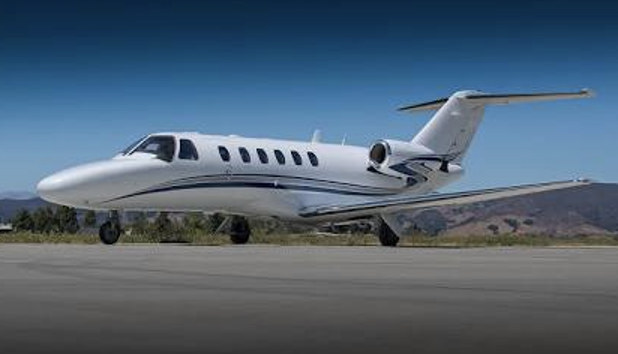
Since the first Citation flew in 1969, the Cessna Citation family has become one of the most recognized names in business aviation. With more than 8,500 aircraft delivered to date, the line represents a significant share of the private jet market. The Citation brand is often associated with practical, mid-range business jets, though the lineup has expanded over the decades to include everything from light jets to transcontinental aircraft. The name has become so widely known that it’s frequently used as shorthand for business jets in general—a reflection of the model line’s market penetration and longevity. For corporate flight departments, charter operators, and individual owners, the Citation family spans from accessible entry-level aircraft to high-performance intercontinental jets, making it one of the most comprehensive product lines in business aviation.
Development History
The Citation program began with the Fanjet 500, which first flew on September 15, 1969, and received FAA certification on September 9, 1971. The initial production model, the Citation I, was designed to be simpler to operate and more cost-effective than existing light jets, with the ability to use shorter runways. This focus on practicality and ease of operation established the foundational philosophy that would guide the Citation line for decades to come.
The Citation I was followed by the stretched Citation II, which offered increased cabin space and range, and the midsize Citation III, which marked Cessna’s entry into a larger segment of the market. Later additions included the CitationJet series, which evolved into today’s CJ line, the Excel/XLS family that combined midsize cabin space with light-jet operating costs, the high-speed Citation X that pushed the boundaries of business jet performance, and the very light Citation Mustang that broadened access to private jet ownership. Each new model built on lessons learned from its predecessors, keeping the Citation family relevant across changing market conditions and evolving customer expectations.
Current and Upcoming Production Models
The Citation family today spans several models, each aimed at a different market segment and mission profile. It’s worth noting up front that Textron Aviation, the Cessna parent company, is in the middle of rolling out a next-generation “Gen3” refresh across its light-jet lineup, and not every Gen3 model has actually entered service yet—a distinction that matters for anyone shopping the current catalog rather than a future one.
The Citation CJ4 Gen3 is the furthest along of the new generation, expected to enter service in 2026 as the largest of the single-pilot CJ series. It carries a maximum range of 2,165 nautical miles and seats up to ten passengers, giving operators genuine nonstop reach between major business hubs on a single-pilot-certified airframe. It introduces the Garmin G3000 PRIME cockpit, a touchscreen interface designed to reduce pilot workload, along with CoolView skylights and upgraded seating. Pricing is expected to land around $11.3–$11.5 million, with custom configurations running higher for owners who want bespoke interiors and additional equipment.
The Citation M2 Gen3 and Citation CJ3 Gen3, by contrast, are still in development and certification, with entry into service targeted for 2027 rather than already on ramps today. The M2 Gen3 is positioned as the entry-level model in the lineup, with an expected range of around 1,550 nautical miles and seating for roughly six to eight passengers depending on configuration; it’s slated to carry forward the Garmin G3000 avionics suite with autothrottles and the Garmin Emergency Autoland system, a safety feature that can bring the aircraft down automatically if a pilot becomes incapacitated. The CJ3 Gen3 will share that same Garmin G3000 avionics suite and is expected to offer a range of about 2,040 nautical miles with seating for around nine to ten passengers. Because both aircraft are still working through flight test and certification, any pricing attached to them at this stage should be read as an estimate rather than a confirmed factory figure.
The Citation Ascend, which did enter service in 2025, bridges the light and midsize categories. Textron lists her maximum range at 2,100 nautical miles, with a four-passenger high-speed-cruise range of roughly 1,900–1,940 nautical miles—a distinction worth keeping straight, since the shorter figure sometimes gets quoted as if it were the aircraft’s outer limit rather than its four-passenger cruise number. She seats up to twelve passengers and features a flat cabin floor that provides consistent headroom throughout, along with wireless charging at each seat. The factory list price is $16.725 million.
The Citation Latitude has been marketed by Textron as the best-selling midsize business jet for several years running. She carries a range of 2,700 nautical miles and, despite the seating figures sometimes attached to her, is consistently described by Textron itself as a nine-passenger aircraft—the twelve-passenger figure occasionally seen in circulation appears to belong to her larger sibling, the Longitude, rather than the Latitude. The cabin offers a six-foot stand-up height and class-leading baggage capacity, and the cockpit uses Garmin G5000 avionics. A new Latitude starts at approximately $19–$19.5 million; pre-owned examples trade anywhere from roughly $14.5 million for older models up to $20 million for recent ones, depending on age and equipment.
The Citation Longitude is the largest Citation currently in production. She carries a transatlantic range of 3,500 nautical miles and seats up to twelve passengers in a double-club configuration, allowing nonstop flights between New York and London with a light passenger load. The cabin is noted for its soundproofing and offers roughly 30 inches of legroom. Textron’s own published direct operating cost figure is $2,874 per flight hour—relatively low for the super-midsize category, though independent cost estimates that factor in crew, insurance, and other ownership costs typically run higher. The factory price is approximately $29.9–$30 million.
Older Models and the Used Market
Several older Citation models remain available on the used market, providing options for buyers at various price points. The Citation Excel/XLS/XLS+ series continues to be used by corporate flight departments and charter operators, valued for its combination of midsize cabin space and light-jet operating costs. The Citation Sovereign and Sovereign+ offer a genuine 3,200-nautical-mile range with a larger fuselage and more powerful engines, capabilities that remain competitive with newer aircraft even years after the line ended production. Older models like the Citation II, Bravo, and Ultra are also available on the pre-owned market, typically at a fraction of new-aircraft prices, giving buyers an accessible entry point in exchange for older technology.
Operational Considerations
The Citation family is generally known for relatively low operating costs compared to competitors in similar size categories, and maintenance intervals that tend to run longer than average, reducing downtime. The sheer number of Citations in service means parts and service are available at locations around the world. As with any aircraft, though, actual operating costs vary significantly depending on usage patterns, maintenance history, and the specific model—fuel, hangarage, crew salaries, insurance, and unscheduled maintenance all factor into total cost of ownership, and can differ substantially between individual aircraft.
The size of the fleet also supports reasonable resale values for most models, though depreciation differs across the lineup. Entry-level models tend to hold value relatively well thanks to steady demand from first-time buyers and charter operators, while larger models can see steeper depreciation in their early years. Broader market conditions—the health of the economy, the availability of financing—also influence resale values and are worth factoring in for any prospective buyer.
The Cessna Citation family has maintained a significant presence in business aviation for over five decades, with new-model prices spanning from roughly $11 million to $30 million once the currently-shipping models are considered on their own, and stretching lower still once the pre-owned market and older airframes are factored in. The widespread fleet and established support network remain practical considerations for buyers. The line continues to be updated with new models and technology, though it faces steady competition from manufacturers such as Embraer, Gulfstream, and Bombardier across various market segments. Whether considering a new purchase or a used aircraft, the Citation family offers a range of options refined over decades of production experience—along with a support infrastructure that newer entrants to the market are still working to match.