listen to the article
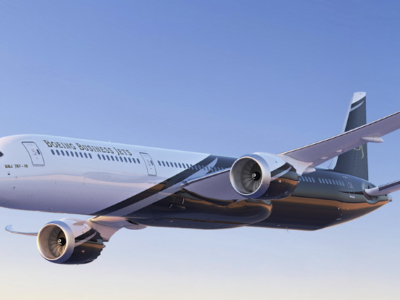
The Boeing 747 Business Jet is not merely an aircraft. It is the largest, most opulent, and one of the most exclusive private jet ever conceived—a flying palace built on the bones of the most iconic airliner in history. Derived from the 747-8 Intercontinental, the final and most advanced iteration of the “Queen of the Skies,” the BBJ 747 represents the apex of what money, imagination, and engineering can achieve when the usual constraints of commercial aviation are stripped away.
The Architecture of Ambition
To understand the BBJ 747, one must first appreciate the sheer audacity of its scale. The aircraft stretches 250 feet from nose to tail, with a cabin width of more than 20 feet—twice the width of two Gulfstream G650 cabins placed side by side. Its total interior volume encompasses roughly 5,200 square feet across both the main and upper decks, a space that would constitute a respectable mansion in most cities. This is not a jet for the merely wealthy. It is a jet for those who measure wealth not in millions, but in the ability to reimagine physical space itself.
Boeing delivers these aircraft as “green” airframes—essentially blank canvases. There are no standard interior configurations, no catalog of pre-approved layouts. Instead, owners collaborate with one of roughly 15 Boeing-licensed completion centers to design environments limited only by physics and, occasionally, taste.
Inside the Flying Palace
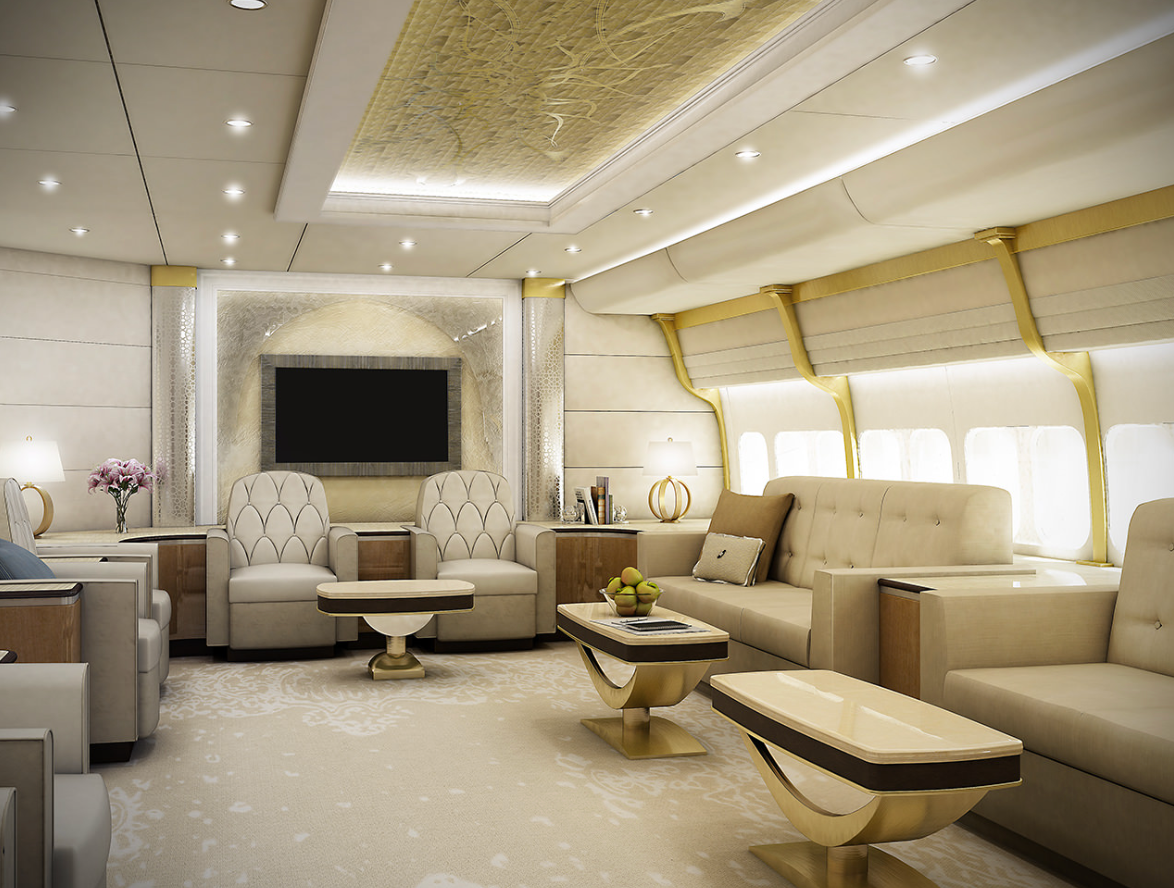
The results are as varied as the imaginations that conceive them: grand salons with full-size sofas and hand-woven carpets; boardrooms where billion-dollar deals are signed above the clouds; master bedrooms with en-suite bathrooms and rainfall showers; private cinemas; spas; even dedicated prayer rooms and majlis-style seating areas for Middle Eastern royalty.
Some configurations include an Aerolift—a specialized elevator system that transports VIPs directly from the tarmac to the upper deck, bypassing the main cabin entirely. Others feature spiral staircases clad in marble and brass, connecting the two decks like the grand staircases of ocean liners past. The upper deck, that distinctive hump that has defined the 747’s silhouette for over half a century, becomes a private sanctuary—an owner’s suite removed from the activity below, accessible only to those with the right invitation.
Famed French interior design firm Cabinet Alberto Pinto was tasked with creating the interior of one multi-million dollar BBJ 747-8i, purchased for private use by a Middle Eastern businessman. The master bedroom sits in the nose of the aircraft, directly under the cockpit—the quietest, most private section. It features a normal-size bed, walk-in shower, and full vanity. The upper deck houses a living room with bookshelves and high-definition screens, while the main salon serves as the centerpiece with vaulted ceilings and space for hosting, working, or simply reclining above the Atlantic.
Performance Without Compromise
The performance figures are equally staggering. Four General Electric GEnx-2B67 turbofans, each producing 66,500 pounds of thrust, propel the aircraft to a maximum cruise speed of Mach 0.855. But it is the range that truly sets the BBJ 747 apart: up to 8,875 nautical miles with a VIP payload. This is enough to connect virtually any two cities on Earth nonstop—New York to Bangkok, Dubai to Los Angeles, London to Adelaide. For a head of state or global business magnate, this means the world shrinks to the dimensions of a single, uninterrupted journey. There are no layovers, no connections, no surrendering to the schedules of commercial airlines. Only departure and arrival, with everything in between belonging entirely to the passenger.
Yet for all its magnificence, the BBJ 747 is not without its compromises. The aircraft’s maximum takeoff weight of 987,000 pounds and its substantial runway requirements—typically 7,500 to 9,500 feet—render it incompatible with many of the private aviation world’s most convenient airports. Teterboro, the favored gateway to New York for private jets, cannot accommodate it. Van Nuys, the bustling general aviation hub of Los Angeles, is off-limits. Operators must instead use major commercial airports, trading convenience for capability. It is, in a sense, the ultimate trade-off: you sacrifice the flexibility of smaller jets for the singular experience of possessing the sky’s largest private domain.
The Economics of Excess
The economics of owning such a machine are as eye-watering as its specifications. The airframe alone carries a list price of approximately $367 million. A standard VIP interior adds another $25 to $50 million, while the most elaborate, palace-grade completions can push the total investment well beyond $500 million. Operating costs are equally formidable. Variable costs alone run between $23,000 and $40,000 per flight hour, and when fixed costs—crew salaries, insurance, hangarage, maintenance reserves, and depreciation—are factored in, the total hourly cost for a low-utilization VIP frame can exceed $200,000 per hour. To put this in perspective, a single transatlantic crossing costs more than many people earn in a decade.
This exclusivity has ensured that only a handful of BBJ 747-8 aircraft exist. Just nine were built for private use, making them among the rarest aircraft in the sky. Known operators include the Qatar Amiri Flight, whose VIP-configured 747-8 has been valued at approximately $400 million, and the Saudi Royal Flight, which operates the aircraft as part of the Royal Saudi Air Force’s VIP division. The United States government, too, has embraced the platform—the next-generation Air Force One, designated VC-25B, is based on the 747-8, though hardened communications, defensive systems, and military infrastructure push that program’s costs into the billions.
Boeing has attempted to streamline the acquisition process through its 747-8 VIP Turnkey Program, offering a concierge service that covers aircraft acquisition, customized cabin design and build, delivery, and comprehensive in-service support under a single contract. It is an acknowledgment that buyers of such aircraft expect white-glove treatment at every stage—from the first consultation to the final delivery and beyond.
On January 31, 2023, the last Boeing 747 rolled off the production line in Everett, Washington, ending a 54-year production run that changed aviation forever. The final aircraft was a freighter, delivered to Atlas Air, but its departure marked the close of an era for the passenger variant as well. No new 747 airframes will ever be built.
Boeing has already begun steering future ultra-VIP buyers toward alternatives. The BBJ 777X, expected to enter service around 2027, promises even greater range—up to 11,835 nautical miles—and advanced technology. The BBJ 787 Dreamliner offers fuel efficiency and modern composite construction. Neither, however, possesses the 747’s iconic silhouette, its double-deck grandeur, or the cultural weight of an aircraft that has carried presidents, monarchs, and millions of ordinary travelers across the globe for generations.
As the remaining BBJ 747s continue to crisscross the skies, each flight becomes a little more precious, a little more historic. They are not merely transporting their passengers from one city to another. They are carrying forward the legacy of an aircraft that defined the Jet Age, now transformed into the ultimate expression of private ambition.