listen to the article
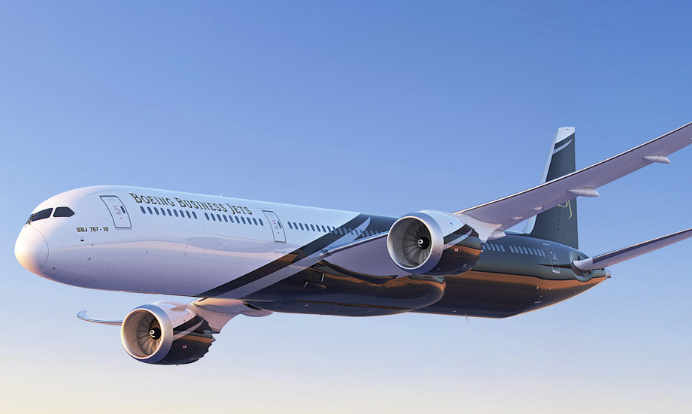
In December 2018, at the Middle East Business Aviation Association Show in Dubai, Boeing unveiled something that would reset the boundaries of private aviation. Nearly eight years later, the BBJ 777X remains one of the most anticipated aircraft in the upper stratosphere of private travel. It has not yet entered service—its commercial sibling, the 777-9, has faced repeated certification delays, with entry into service now expected in 2027. But for those who have placed their orders, and for the aviation world watching from the sidelines, the wait only heightens the expectation. When it finally arrives, the BBJ 777X will be the largest, longest-range business jet on the market, and the undisputed flagship of Boeing Business Jets.
Two Variants, One Vision
The BBJ 777X comes in two distinct flavors, each tailored to a different kind of mission. The BBJ 777-8 is the long-range specialist. With a cabin area of 3,256 square feet and a staggering range of 11,645 nautical miles, it is the longest-range business jet ever announced—capable of connecting virtually any two cities on Earth without stopping. The BBJ 777-9 trades some of that range for sheer volume. At 3,689 square feet, its cabin is the largest in modern business aviation, offering more than 3,600 square feet of customizable space while still delivering an 11,000-nautical-mile range.
To put those numbers in perspective, the BBJ 777-9’s cabin is larger than many suburban homes. The price of admission is commensurate with the ambition. The BBJ 777-8 carries a list price of $442.8 million, while the 777-9 commands $453.6 million—and that is before a single piece of leather is stitched or a marble slab is installed. By the time a completion center finishes its work, total investment can easily exceed half a billion dollars.
Engineering the Impossible
What makes the BBJ 777X possible is a suite of technologies borrowed from Boeing’s commercial and military portfolios, combined into a platform that redefines what a twin-engine aircraft can do.
At the heart of the aircraft are two General Electric GE9X engines, the largest and most powerful turbofans ever built for a commercial aircraft. Each produces approximately 110,000 pounds of thrust, and together they enable the 777X to achieve a maximum cruise speed of Mach 0.85 while burning significantly less fuel than the four-engine platforms it is designed to replace.
Then there are the wings. The BBJ 777X features composite wings with folding wingtips—a first in commercial aviation. Extended, the wingspan reaches 235 feet, providing extraordinary lift and efficiency. Inside, Boeing has equipped the BBJ 777X with a low cabin altitude system that reduces the effective altitude to 6,000 feet at maximum cruise—meaning passengers arrive less fatigued, even after 18-hour flights. Smooth Ride Technology uses sensors to detect turbulence and automatically actuates flight control surfaces to counteract it. The windows are electronically dimmable, eliminating the need for shades and giving passengers granular control over their environment.
The Blank Canvas
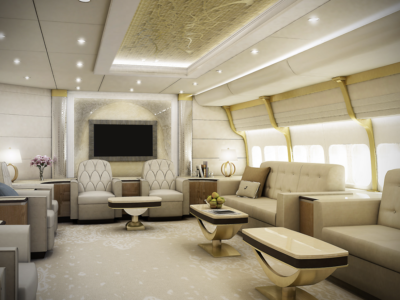
Like all Boeing Business Jets, the 777X is delivered as a “green” airframe—an empty shell ready for transformation. Boeing has commissioned concept designs from some of the world’s most prestigious completion houses to demonstrate what is possible. Greenpoint Technologies, Jet Aviation, and Unique Aircraft Design have each produced visions that range from minimalist modernism to classical opulence.
One standout concept, designed by Jet Aviation Design Studio and visualized by ACA, features transparent OLED screens integrated into the window panels, illuminated table inlays, and flexible mood lighting that shifts with the time of day. Another concept by Greenpoint shows a grand lounge with sweeping sofas, a private cinema, and a master stateroom that rivals a five-star hotel suite. Unique Aircraft Design’s vision includes a Turkish-style steam bath, a dedicated game room, and a bar area that would not look out of place in a Mayfair nightclub.
The cabin’s dimensions make these fantasies achievable. At 19 feet 7 inches wide and 8 feet 4 inches high, the interior can accommodate full-size rooms with proper walls and doors, not the curtained partitions common on smaller jets. Owners can configure multiple master suites, conference rooms, prayer rooms, staff quarters, and galleys capable of preparing restaurant-quality meals for dozens of guests.
The Long Wait
For all its promise, the BBJ 777X has been a study in patience. The base 777X program, launched in 2013, has endured a cascade of delays. The 777-9 first flew in January 2020, but certification has been repeatedly pushed back due to technical issues, regulatory scrutiny, and supply chain disruptions. As of mid-2026, the aircraft is in the final stages of FAA Type Inspection Authorization, with first deliveries to airlines expected in 2027.
The Promise
When the first BBJ 777X finally takes to the skies with a VIP interior complete, it will mark more than the arrival of a new aircraft. It will signal the dawn of a new era in ultra-long-range private aviation—one where the world is not merely within reach, but within a single, uninterrupted flight.