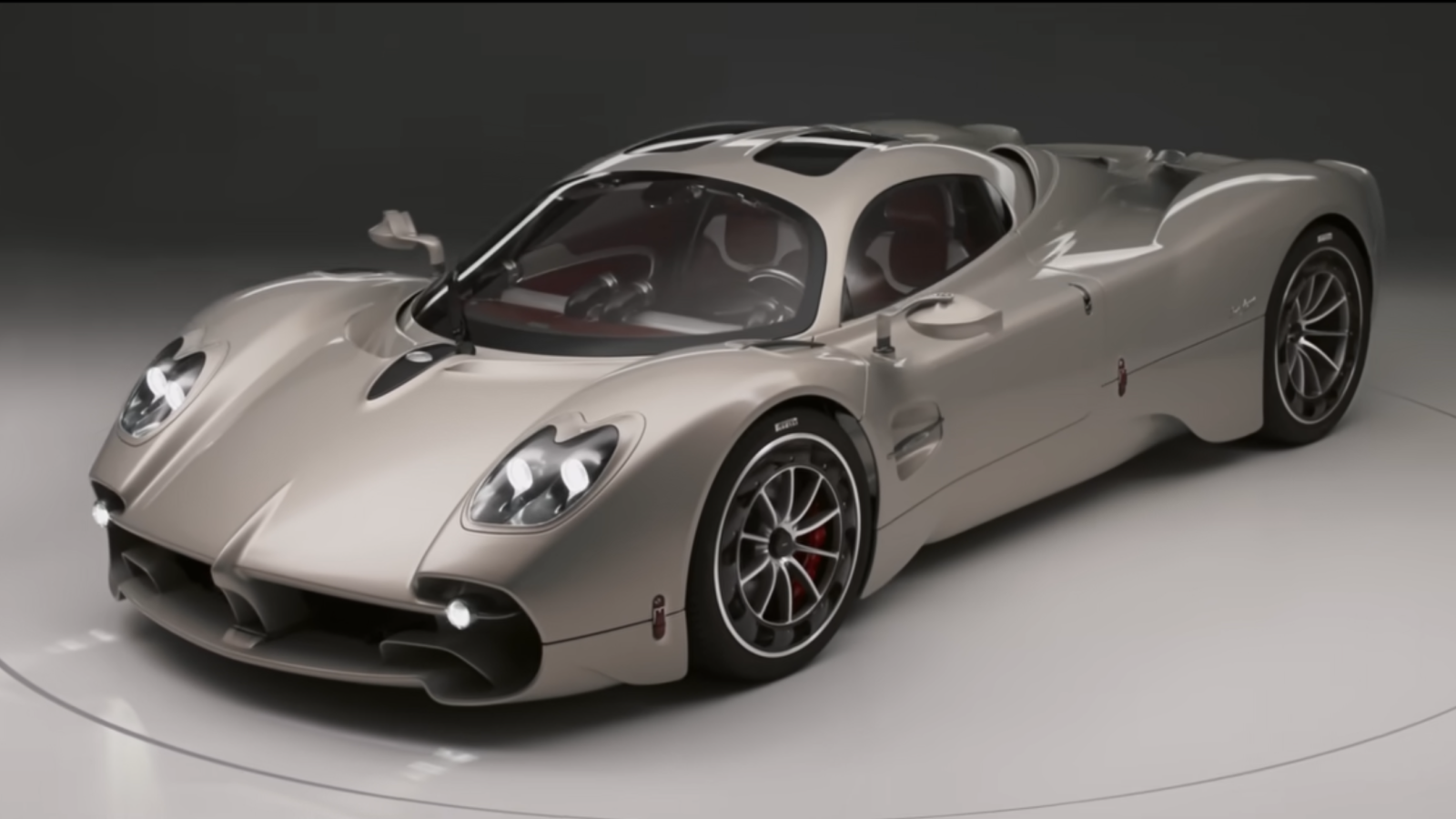
In September 2022, in a Milanese museum surrounded by original drawings by Leonardo da Vinci, Horacio Pagani unveiled a car named after a place that doesn’t exist. The Utopia — Pagani’s third model in three decades, following the Zonda and the Huayra — arrived at a moment when nearly every hypercar maker on earth was racing toward electrification, touchscreens, and turbo-hybrid powertrains. Pagani went the other way. No hybrid system. No massive central display. And, most strikingly, a genuine manual gearbox with a gated shifter and a third pedal, offered on a car making more than 850 horsepower. In an industry obsessed with the future, the Utopia is a car built almost entirely around the pleasures of the past — and it may be one of the most quietly radical hypercars of its generation precisely because of that.
The Name and the Idea Behind It
Pagani chose the name Utopia deliberately: a place, as the founder liked to point out at the car’s unveiling, that doesn’t exist anywhere except in the mind. That was the point. Horacio Pagani has said the car represents his idea of an ideal, uncompromised sports car — one built the way he believes cars ought to be built, regardless of where the rest of the industry happened to be heading. The Utopia was developed under the internal code name C10 (the Zonda was C8, the Huayra was C9), and its debut took place across two connected events in Milan in September 2022: a private reveal at the Teatro Lirico, and a public unveiling at Italy’s National Science and Technology Museum, staged inside the Sala del Cenacolo refectory hall alongside genuine da Vinci sketches. The pairing wasn’t incidental. Pagani has spent his career insisting that art and engineering are the same discipline seen from two angles, an idea he traces directly to da Vinci, and the Utopia was framed from day one as the fullest expression of that philosophy yet.
Development took more than six years and ran through eight complete prototypes, three of which were dedicated purely to engine testing over roughly two years. Pagani’s engineers built twelve scale models along the way — ten at 1:5 scale and two full-size 1:1 models — before the design was finalized, an unusually deliberate process for a company that builds only about fifty cars a year in total.
What’s Under the Skin
The Utopia is powered by a 6.0-liter twin-turbocharged V12, internally designated the M158 and built exclusively for Pagani by Mercedes-AMG’s engine facility in Affalterbach. It produces 864 metric horsepower (852 hp in SAE terms) and 811 lb-ft (1,100 Nm) of torque — enough to push the car from 0 to 60 mph in roughly 2.8 seconds and on to a top speed north of 220 mph. None of that is remarkable by modern hypercar standards; several rivals with hybrid assistance now exceed 1,000 horsepower. What is remarkable is how that power reaches the road: through a rear-mounted, rear-wheel-drive layout with no electric motors, no all-wheel drive, and no dual-clutch gearbox pretending to be something sportier. Buyers can choose a seven-speed automated single-clutch transmission, or — for the first time on a Pagani road car in this form — a genuine seven-speed manual with a traditional H-pattern gate, developed with the transmission specialist Xtrac specifically to handle the V12’s torque without a conventional dual-plate clutch overheating under abuse.
The chassis is built around a carbon-titanium monocoque using materials Pagani calls Carbo-Titanium HP62 G2 and Carbo-Triax HP62, the latest evolution of composite technology the company has been refining since Horacio Pagani first bought his own carbon-fiber autoclave with borrowed money back in 1987. The result is a dry weight of just 1,280 kg (2,822 lb) — roughly 70 kg lighter than the outgoing Huayra, despite the Utopia being, if anything, a more thoroughly engineered car. Horacio Pagani has said he set himself three explicit priorities when designing the Utopia: simplicity, lightness, and the pleasure of driving. The manual gearbox, more than any spec figure, is the clearest expression of that third goal — and it quickly won over skeptics who doubted a stick shift could survive that much torque without breaking or feeling like a compromise.
An Interior With No Screen to Hide Behind
Step inside and the Utopia makes its argument even more forcefully. Where most modern hypercars greet a driver with a wraparound digital cockpit, the Utopia has almost no screen at all — just a small, minimal display tucked in front of the driver. Every other instrument is purely analog: mechanical dials for oil temperature, oil pressure, water temperature, and turbocharger boost, arranged so that part of each gauge’s inner mechanism is visible, like the exposed movement of a fine skeleton watch. Pagani has described the decision as a deliberate one; a large central touchscreen would have been easier to design around and would have saved enormous engineering effort, but it would also have flattened much of what makes the cabin feel handmade.
Nearly everything the driver’s hand touches is machined aluminum rather than molded plastic or carbon-fiber composite — a shift from the Zonda’s wooden steering wheel and the Huayra’s carbon-rimmed wheel to a solid aluminum wheel that alone takes roughly 30 hours to carve on Pagani’s five-axis machines. In total, the automaker says the Utopia’s interior uses 777 individually machined parts on the manual-gearbox car (782 on the automated version), finished by hand and, in many cases, anodized or polished to a jewelry-like sheen. The doors open with small pivoting finger latches rather than conventional handles, swinging up and out silently. And in a detail that says everything about how Pagani thinks about the ownership experience, shutting the Utopia off triggers a short violin passage through the cabin speakers — a piece of music composed by Horacio Pagani himself, who studied piano before he ever picked up a welding torch.
Numbers, Rarity, and What It Costs
The Utopia coupe is limited to 99 units, all of which were reportedly spoken for well before customer deliveries began in 2023. Pricing started at roughly €2.18 million (around $2.2–2.5 million depending on market and exchange rate at the time), before the inevitable customer-specific options that push most real-world builds considerably higher through Pagani’s Unico personalization program. In July 2024, Pagani unveiled an open-top Utopia Roadster, sharing the coupe’s monocoque, weight, and drivetrain but adding a removable carbon-fiber hardtop and a stowable soft top, with production capped at 130 units and a starting price around €3.1 million ($3.4 million). That the Roadster weighs exactly the same as the fixed-roof coupe, despite the usual structural penalty that comes with cutting the roof off a car, is itself a small engineering flex — achieved by designing both body styles simultaneously around the same reinforced monocoque rather than adapting a roadster after the fact.
Why the Utopia Matters
It would be easy to read the Utopia as nostalgia — a wealthy company indulging its founder’s fondness for gated shifters and analog dials at a moment when the rest of the industry has moved on. But that undersells what Pagani is actually doing. The Utopia isn’t pretending electrification doesn’t exist; it’s making a deliberate argument that a hypercar’s job is to maximize the pleasure and craft of driving, not simply to maximize a spec sheet, and that a manual gearbox and a fully mechanical instrument cluster serve that goal better than another few tenths off a 0-60 time. Whether that argument continues to hold as global emissions rules tighten around even the smallest manufacturers is an open question — Pagani has acknowledged that some form of electrification is likely inevitable for whatever eventually replaces the Utopia. For now, though, the car stands as one of the last unapologetically analog hypercars being built anywhere in the world, a machine that treats the act of driving itself, gear change by gear change, as the whole point of owning one. In a segment increasingly defined by silence, screens, and hybrid assistance, the Utopia is Pagani’s argument that the old way was never actually a compromise — it was simply a different, and perhaps better, idea of what a hypercar is for.