For over a quarter of a century, one car redefined what a tiny, independent boutique supercar builder could accomplish against the entrenched giants of Maranello and Sant’Agata. The Pagani Zonda debuted at the 1999 Geneva Motor Show as an underdog with almost no broad name recognition. By the time the final custom chassis rolled out of the San Cesario sul Panaro atelier, it had become one of the most revered, collectible, and acoustically mesmerizing automobiles in history.
From its humble beginnings as a passion project of an Argentine composite specialist to wild, one-off iterations exceeding $15 million in valuation, the story of the Zonda is not just about raw horsepower—it is about composite engineering, obsessive craftsmanship, and an uncompromising artistic philosophy.
A Seven-Year Gestation, Named for a Mountain Wind
The Zonda was the inaugural production masterpiece of Pagani Automobili, founded in 1992 by Horacio Pagani. Horacio, an Argentine engineer, had previously served as the head of Lamborghini’s composites department, where he pioneered early structural carbon-fiber applications on models like the Countach Evoluzione. When Lamborghini famously declined to purchase an autoclave to expand carbon-fiber production, Pagani took out a loan to buy his own—a pivotal moment that established his technical autonomy.
The development of Pagani’s dream machine began under the moniker Fangio F1, named as a direct tribute to Horacio’s close friend, mentor, and five-time Formula One World Champion Juan Manuel Fangio. Fangio was instrumental in opening doors for Pagani, even introducing him to senior executives at Mercedes-Benz to secure supply agreements for their legendary engines. However, following Fangio’s passing in 1995, Horacio decided out of deep respect to rename the vehicle. When the production prototype arrived at the 1999 Geneva Motor Show, it bore a new title: Zonda, named after the fierce, hot wind that sweeps down the eastern slopes of the Andes in Argentina.
Visually, the Zonda C12 looked like nothing else on earth. Drawing geometric inspiration from jet fighter canopies and the sleek, endurance racing Sauber-Mercedes C9 and Group C Silver Arrows of the late 1980s, its proportions were dramatic yet organic. The design established signatures that define the brand to this day: quad headlights, cab-forward architecture, and a central four-pipe exhaust cluster housed inside a circular ring at the tail. Beneath its carbon-fiber skin lay a naturally aspirated 6.0-liter M120 AMG V12 engine producing 389 horsepower, mated to a 5-speed manual transmission. While modest by modern standards, its weight distribution and lightweight carbon-composite tub yielded startling agility.
Evolving in Public: From C12 to the Wild 760 Series
Unlike traditional automakers that launch a vehicle, run a production cycle, and retire the badge, Pagani treated the Zonda as a living, continuously evolving canvas.
- The Early Years (C12 to C12-S): The original 6.0-liter C12 quickly gave way in 2000 to the C12-S, which scaled displacement to a 7.0-liter AMG V12 producing 542 horsepower. By 2002, Pagani upgraded the engine again to a mammoth 7.3-liter unit. This 7.3-liter displacement became the defining mechanical heart for the remainder of the Zonda’s natural-breathing lifecycle.
- The Zonda F (2005): Dedicated again to Juan Manuel Fangio (“F”), this iteration brought major aerodynamic upgrades, redesigned side mirrors, and power bumps up to 643 horsepower in Clubsport trim. It demonstrated that Pagani could run neck-and-neck on track with established hypercars like the Porsche Carrera GT and Ferrari Enzo.
- The Zonda Cinque (2009): Requested by a Hong Kong dealer, the Cinque (meaning “Five,” as only five coupes and five roadsters were crafted) served as a bridge between race-car tech and street legality. It introduced Carbo-Titanium—a revolutionary weave of carbon fiber with titanium threads to enhance structural ductility—along with a roof scoop and aggressive rear winglets.
- The Track Masterpiece – Zonda R (2010): Unshackled by road regulations or racing homologation constraints, the Zonda R featured an extended wheelbase and a high-revving 6.0-liter racing V12 derived from the Mercedes CLK GTR. In July 2010, the Zonda R recorded a mind-boggling Nürburgring Nordschleife lap time of 6 minutes, 47.5 seconds, shattering the previous track-only record held by the Ferrari 599XX by roughly eleven seconds.
The HP Barchetta: The $17.5 Million Birthday Gift
Though Pagani officially introduced the twin-turbocharged Huayra in 2011 as the Zonda’s successor, wealthy clientele refused to let the atmospheric Zonda die. Demands for bespoke commissions led to the creation of the Zonda 760 Series and specialized one-offs.
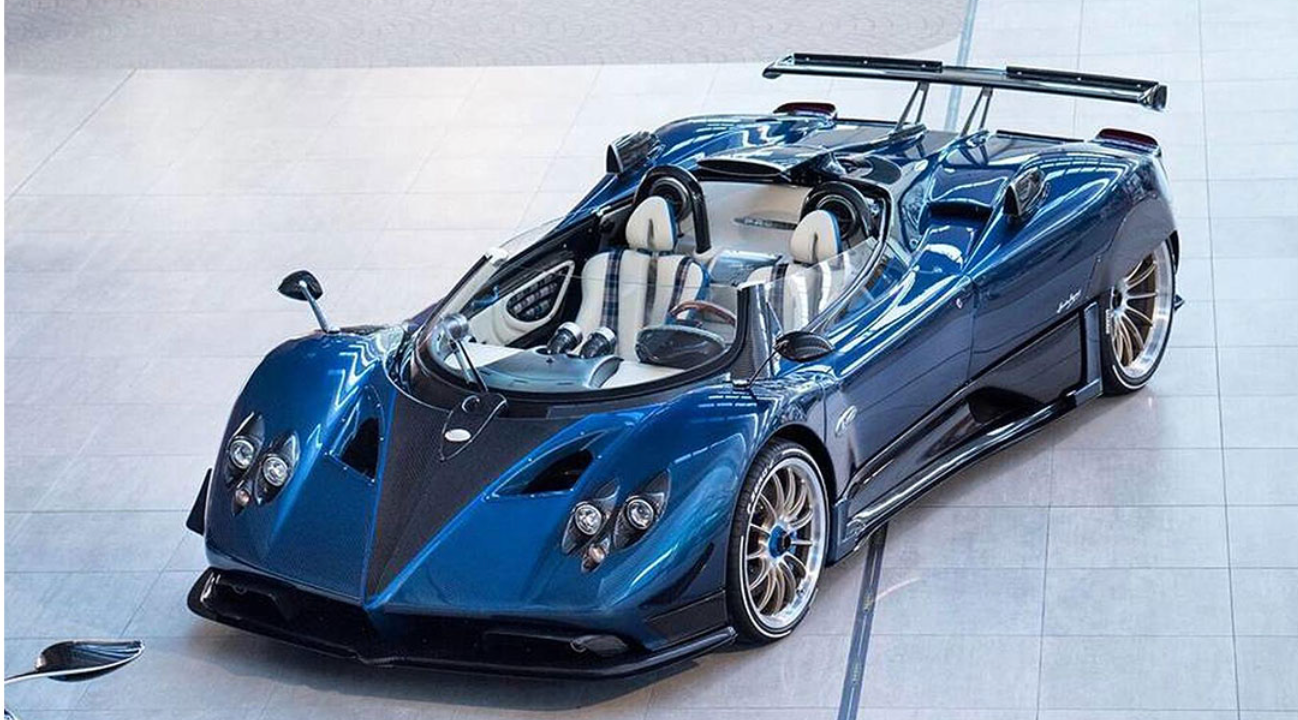
To celebrate Horacio Pagani’s 60th birthday, the company created one of its most radical creations: the Zonda HP Barchetta. Unveiled in August 2017 at the Pebble Beach Concours d’Elegance, “HP” stood for Horacio’s initials, while “Barchetta” (“little boat”) referred to its chopped, roofless body.
“I wanted to create a car that was a personal tribute—a synthesis of our history, modern technology, and purest driving emotion without a roof between the driver and the atmosphere.”
— Horacio Pagani
The HP Barchetta discarded the traditional windshield frame in favor of a low, wraparound glass visor and a central roof-mounted carbon-fiber air scoop feeding the naturally aspirated 7.3-liter AMG V12. Delivering 789 horsepower paired with a traditional 6-speed manual gearbox, it featured rear wheel fairings made of carbon fiber—a nostalgic design callback to 1980s endurance racers.
Only three units were constructed: one retained by Horacio Pagani himself, and two sold to private collectors. With valuations widely cited around €15 million (approximately $17.5 million USD at the time), it briefly held the crown as the world’s most valuable new car.
The Real Finale: Zonda Arrivederci
While the article noted the HP Barchetta as the end of the line, Pagani’s workshop continued updating older chassis and even constructing final custom orders for devout collectors. The absolute final newly produced Zonda chassis—Chassis No. 140—was officially revealed at Monterey Car Week in August 2024, named the Pagani Zonda Arrivederci (“Goodbye”).
Commissioned by renowned car collector Kris Singh, the Arrivederci features an unpainted Argento carbon-fiber finish with custom blue and red striping, bespoke six-spoke wheels inspired by the Huayra BC, a custom double-layer rear wing, and a full 760-spec 7.3-liter AMG V12 delivering 760 PS through a manual transmission. It represents the definitive end of a 25-year structural production timeline.
Why the Zonda Legacy Endures
The Pagani Zonda’s legacy rests on several factors:
- Analogue Purity: In an era dominated by dual-clutch paddle shifters, heavy hybrid batteries, and quiet turbochargers, the Zonda remained true to high-revving naturally aspirated V12 engines and manual gearboxes.
- Mastery of Materials: Horacio Pagani’s pioneering work with carbon-titanium and carbon-triax changed hypercar chassis design, proving that lightweight structural rigidity could rival massive automotive conglomerates.
- Artistic Tailoring: Every switch, gauge, and titanium bolt inside a Zonda is designed like a fine mechanical watch. It established the hypercar market as a realm of bespoke art rather than mere transportation.
The Zonda proved that passion, composite art, and absolute devotion to sound and speed could build a world-class automotive brand from scratch.