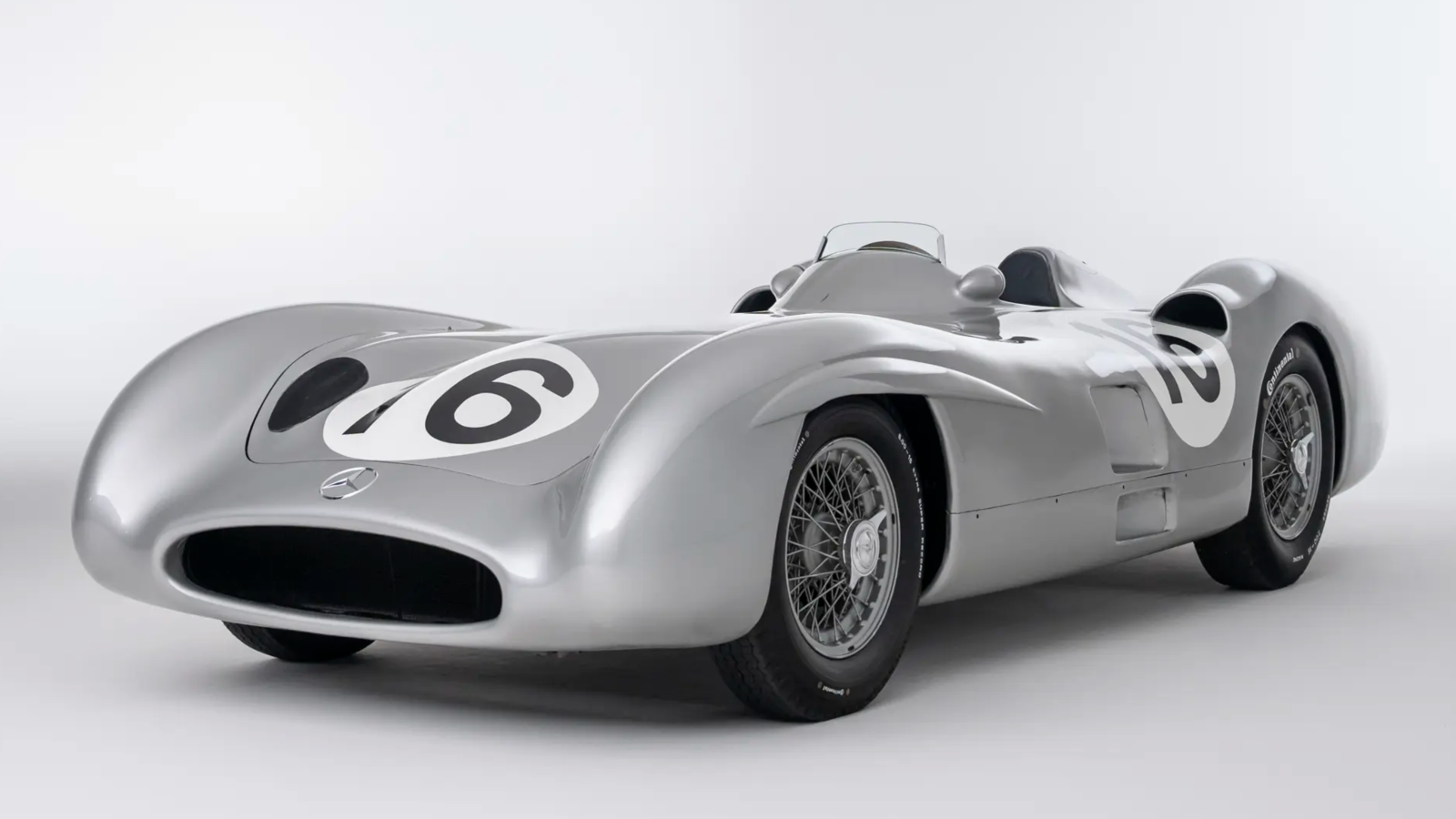
Picture this: a low, silver shape, sleek as a torpedo, crouched on four wheels like a predator ready to spring. Its body gleams under the museum lights, curving in ways that seem to cheat the wind itself. This is not just any old racing car. This is the 1954 Mercedes-Benz W 196 R Stromlinienwagen — and it just became the most expensive Grand Prix car ever sold.
The price? A cool $53.9 million. When the auctioneer’s gavel came down at the Mercedes-Benz Museum in Stuttgart on February 1, 2025, the room held its breath. The final figure — €51,155,000, or $53,917,370 — echoed through the halls where automotive history is written.
For nearly six decades, this magnificent machine had called the Indianapolis Motor Speedway Museum home. Mercedes-Benz had donated it back in 1965, and there it sat, a silent sentinel of a bygone era, before recently being shipped back to Germany for sale. This was the first time a streamliner-bodied W 196 R had ever been offered for private ownership — and now, for the first time, it has passed from an institutional collection into private hands.
The Men Behind the Wheel
Close your eyes and imagine the roar. The date is January 30, 1955. The place is Buenos Aires, Argentina. The air is thick with exhaust fumes and anticipation. Behind the wheel of this very car, chassis number 00009/54, sits Juan Manuel Fangio — the greatest racing driver of his age, a man with ice in his veins and fire in his heart.
The race was the Buenos Aires Grand Prix, a non-championship Formula Libre event run as two 30-lap heats — distinct from the World Championship-counting Argentine Grand Prix held two weeks earlier at the same circuit. For this outing the car wore its open-wheel body, and Mercedes used the race as a testbed for an experimental three-litre engine borrowed from the still-unreleased 300 SLR sports car. Fangio took pole position but finished second in both individual heats, behind teammate Stirling Moss in one and Ferrari’s Nino Farina in the other. It was his combined aggregate time across both heats that handed him the overall win — a technical victory rather than a checkered-flag one, but a victory all the same, and it made this chassis a winner at its very first outing.
Later that same year, at the high-speed temple of Monza in Italy, the car reappeared — this time fitted with the enclosed, streamlined bodywork it wears today — for the season-ending Italian Grand Prix, a genuine World Championship round. Sir Stirling Moss took the wheel, qualifying second behind Fangio’s sister car. The British ace briefly took the lead on the ninth lap before a damaged piston forced him to retire, finishing seventh. He did, however, set the fastest lap of the race in the process, at an average of 215.7 km/h — a mark that helped cement the car’s place in history even in a race it didn’t finish. Two titans, one chassis, history made twice over.
The Heart of the Beast
Under that elegant silver skin, in its Grand Prix specification, beat an engine that was decades ahead of its time. The purpose-built M 196 was a 2.5-litre straight-eight, fed by direct Bosch-derived fuel injection adapted from Messerschmitt fighter-plane technology — no supercharger, unusual for a Mercedes racing engine of the era. In 1954, it produced a robust 257 horsepower; through continued development across the 1954 and 1955 seasons, that figure climbed to 290 horsepower.
But here is where it gets truly remarkable: in its streamlined body, the car could hit speeds exceeding 186 mph. Let that sink in. No seatbelts. No roll cages. No carbon-fibre monocoques or high-tech safety cells. Just a leather seat, a thin steering wheel, and a magnesium-alloy body that weighed barely 88 pounds. If you crashed, you paid with your life. And yet men like Fangio and Moss strapped themselves in and drove like demons, because that was what racing meant in the golden age.
The Art of the Streamliner
“Stromlinienwagen” translates simply to “streamliner,” and the name fits perfectly. Look at it from the side, and you see a shape that seems to have been sculpted by the wind itself. The wheels are fully enclosed, reducing drag and allowing the car to slice through the air like a knife through silk.
This was not a design for show. Mercedes-Benz built two body styles for the W 196 R — one with open wheels for twisty circuits, and this one, the streamliner, for high-speed tracks like Monza, where every fraction of a second mattered. Only around 14 to 15 W 196 R chassis were built in total across both seasons, and just four of them ever received the fully enclosed Stromlinienwagen coachwork — making this one of the rarest bodystyles in the model’s short but dominant history.
The body itself was made of Elektron, a magnesium alloy so light and reactive that mechanics had to keep fire extinguishers nearby; one spark, and the whole thing could go up in flames. That was the price of speed.
A Return to Racing After the War
The W 196 R marked Mercedes-Benz’s return to Grand Prix competition after a near two-decade absence following the Second World War, and the timing could not have been better calculated. New rules for the 1954 season allowed naturally aspirated engines up to 2.5 litres, and Mercedes’ engineers — led by the brilliant Rudolf Uhlenhaut — used the opportunity to build a car unlike anything else on the grid. It debuted at the 1954 French Grand Prix, where three examples locked out the podium places on their very first outing, an entrance about as dramatic as motorsport has ever seen.
Across its two full seasons of competition, the W 196 R, in both its open-wheel and streamlined forms, won nine of the twelve championship races it entered and carried Fangio to back-to-back World Championships in 1954 and 1955. Mercedes then withdrew from Grand Prix racing at the end of 1955 — a decision hastened by the horror of that year’s Le Mans disaster, in which a sister W 196 S sports-racer was involved — and would not return as a full works entrant for nearly four decades. That abrupt withdrawal is part of why so few W 196 R chassis exist today, and why this one, having outlived its era by seven decades, commands the price it does.
A Meticulous Restoration
Chassis 00009/54 wasn’t simply mothballed for sixty years. In 2015, specialists at Canepa Motorsports undertook an extensive, historically faithful restoration of the car, preserving its mechanical and cosmetic integrity while ensuring it remained capable of running under its own power — a detail auction houses and collectors alike weigh heavily when a car of this rarity finally comes to market. That documented, professionally executed restoration work was cited by RM Sotheby’s as part of what made the car’s provenance so exceptional heading into the February 2025 sale.
More Than a Car — A Time Machine
This is not just a car for a collector’s garage. This is a time machine, a direct link to an era when racing was raw, dangerous, and gloriously unpolished. It carries the fingerprints of Fangio. The sweat of Moss. The ingenuity of engineers like Rudolf Uhlenhaut, who pushed materials to their breaking point and beyond to build a machine that could out-run the wind.
Now, it has a new owner — somewhere in the world, a private collector has secured this treasure for their own, via a sale RM Sotheby’s ran as a standalone, single-lot auction rather than as part of a broader sale. We may never know their name; the proceeds were reported to benefit the Indianapolis Motor Speedway Museum’s ongoing collection and restoration efforts. But we know the car’s name. And we will never forget what it represents.
Because some machines are more than metal and rubber. Some machines are legends.
The 1954 Mercedes-Benz W 196 R Stromlinienwagen now holds the record for the most expensive Grand Prix car ever sold — and stands as the second most valuable car of any kind ever sold at auction, trailing only its stablemate, the Uhlenhaut Coupé. Its new owner remains anonymous, but its place in history is forever secure.