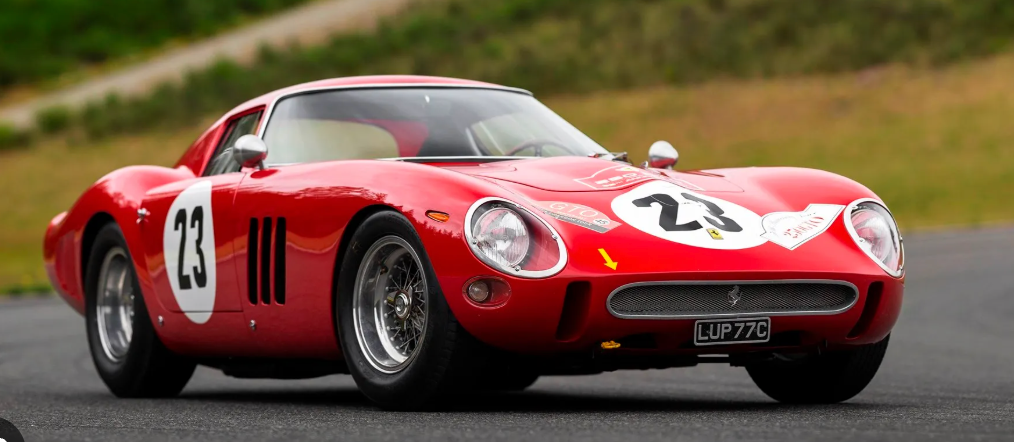
It is the car that needs no introduction, yet every petrolhead knows its name. The Ferrari 250 GTO is not merely an automobile; it is a masterpiece of sculpture, a champion of the track, and the benchmark by which all collector cars are measured. In November 2023, one example sold for $51.7 million, cementing its status as the most expensive Ferrari ever to change hands at public auction.
The Birth of a Legend
On February 24, 1962, during Ferrari’s annual pre-season press day in Maranello, the factory unveiled a car that would define the brand for generations. It was internally designated Comp.62, but English journalists at the launch quickly nicknamed it the 250 GTO — “250” referencing the cubic centimeter displacement of each of its twelve cylinders, “GT” for Gran Turismo, and “O” for Omologata (homologated). The unofficial name stuck immediately, and Ferrari never seriously fought it. The car was built for one purpose: to win the FIA International Championship for GT Manufacturers.
The timing was critical. Ferrari needed a weapon to take on the Jaguar E-Type and the Shelby Cobra, both of which threatened to end Maranello’s dominance of grand touring racing. The result was a car that could wear a number plate on the street yet dominate on Sunday — a machine that perfectly encapsulated Enzo Ferrari’s philosophy of the “real racing car with a number plate.”
The chassis, given the factory designation 539/62 Comp., was derived from the successful 250 GT SWB (Short Wheelbase), but the magic lay in the engineering and the aerodynamics layered on top of it. The engine — an evolution of the 3.0-litre Colombo V12, essentially sharing specification with the 250 Testa Rossa’s unit — produced a claimed 300 horsepower through six twin-choke Weber 38 DCN carburettors. Crucially, the switch to dry-sump lubrication allowed the engine to be mounted lower and further back in the chassis than in the SWB, dropping the center of gravity and transforming the car’s handling. A new five-speed all-synchromesh gearbox and a Watts-linkage rear axle completed a package that was, on paper, a modest evolution — and on the track, a revelation.
The Genius Behind the Metal
The mastermind who first sketched the GTO’s aerodynamic concept was Giotto Bizzarrini, a Livorno-born engineer who graduated from the University of Pisa and joined Ferrari in the late 1950s, eventually rising to head the experimental department. Bizzarrini was less a stylist than a test driver who happened to be an engineer — the kind of person who needed to know exactly why something failed so he could fix it.
Tasked with developing a car to beat the Jaguars, Bizzarrini reduced the frontal area and stretched the nose, cutting drag and taming the high-speed front-end lift that had plagued the SWB. The prototype — built on a donor 250 GT chassis — first appeared publicly during testing at Monza in September 1961, ahead of the Italian Grand Prix, wearing a rough, unfinished body that earned it the nickname “Il Mostro” (The Monster). Despite its ungainly looks, Stirling Moss lapped it to times far superior to anything the SWB had managed.
Bizzarrini, however, wasn’t at the official launch in February 1962. Late in 1961 he had been part of what’s remembered as the “Palace Revolt” — a mass walkout of key Ferrari personnel, including sales manager Girolamo Gardini and chief engineer Carlo Chiti, who had grown weary of Enzo Ferrari’s management style and, as the story is often told, his wife Laura’s growing influence over the company. The baton for final development passed to the young Mauro Forghieri, who reworked the suspension and added the small tail spoiler that stabilized the car at speed. The GTO’s exquisite, sensual bodywork was then shaped in metal by Sergio Scaglietti, who famously finished the panels by eye — piece by piece, without formal drawings — using the rough prototype as his only real guide.
A Dynasty of Victories
If the GTO looked fast standing still, its performance on the track was legendary. At its competition debut, the 12 Hours of Sebring in March 1962, chassis 3387GT — driven by reigning Formula 1 champion Phil Hill and endurance specialist Olivier Gendebien — finished second overall, beaten only by a Ferrari 250 Testa Rossa, and won its GT class comfortably. It was the perfect start to a three-year reign: the 250 GTO delivered the International Championship for GT Manufacturers to Maranello in 1962, 1963, and 1964.
These were not just racing cars; they were raced by legends, and one chassis in particular tells that story well. Number 3387GT — the second GTO built, and the first to actually race — was completed in March 1962 and sold almost immediately to Luigi Chinetti’s North American Racing Team (NART). After its class-winning Sebring debut, the car was shipped back to the factory, overhauled, and returned to competition at the 24 Hours of Le Mans that June. There, driven by NASCAR star “Fireball” Roberts alongside new owner Bob Grossman, it finished sixth overall and third in its class — a strong result, if a step down from its dazzling Sebring showing. The car went on to compete in 27 races over its period career, taking 17 class podiums, a résumé that later made it one of the most sought-after GTOs among collectors.
Only 36 examples of the 250 GTO were built between 1962 and 1964 (plus three later cars fitted with 4.0-litre engines and updated 250 LM–style bodywork), a scarcity that has only sharpened the model’s mystique as decades have passed.
The $51.7 Million Titan
In November 2023, RM Sotheby’s sold a specific 1962 Ferrari 250 GTO, chassis number 3765, for $51,705,000, making it the most expensive Ferrari ever sold in a public auction and, at the time, the second-most expensive car ever sold at auction of any kind, trailing only a 1955 Mercedes-Benz 300 SLR “Uhlenhaut Coupé.”
This wasn’t just any GTO. Cataloged by RM Sotheby’s as “The One,” chassis 3765 — sometimes referred to as a 330 LM/250 GTO — was the only Series I GTO built and campaigned directly by the Scuderia Ferrari works team, and the only Works example originally fitted from the factory with a 4.0-litre engine rather than the standard 3.0-litre unit. Driven by works drivers Mike Parkes and Willy Mairesse, it made its competition debut at the 1962 Nürburgring 1000 km, finishing second overall and first in class. It also ran at Le Mans that year with Parkes and Lorenzo Bandini before the car was reportedly rebuilt with a 3.0-litre engine, muddying its exact chassis identity in later record-keeping (some sources treat it as dual-numbered 3765LM/3765GT). The sale came after nearly four decades in the hands of a single American collector, and — despite a pre-auction estimate north of $60 million — the hammer eventually fell at $47 million, or $51.7 million with fees, still enough to eclipse the previous GTO auction record of $48.4 million set by chassis 3413GT in 2018.
A Lasting Legacy
The 1962 Ferrari 250 GTO remains the ultimate expression of the classic car market: part art, part history, part engineering perfection. From the aerodynamic genius of Giotto Bizzarrini and the hand-shaped artistry of Sergio Scaglietti to the racing exploits of Phil Hill, Olivier Gendebien, and the works Scuderia Ferrari drivers who campaigned it across Europe and America, the GTO endures as a symbol of a bygone era — one where passion, mechanical ingenuity, and a handful of stubborn Italians in Maranello briefly outran everything else on four wheels.