listen to the audio of this article:
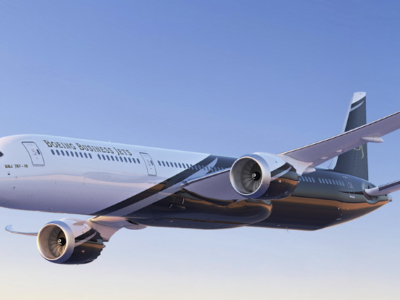
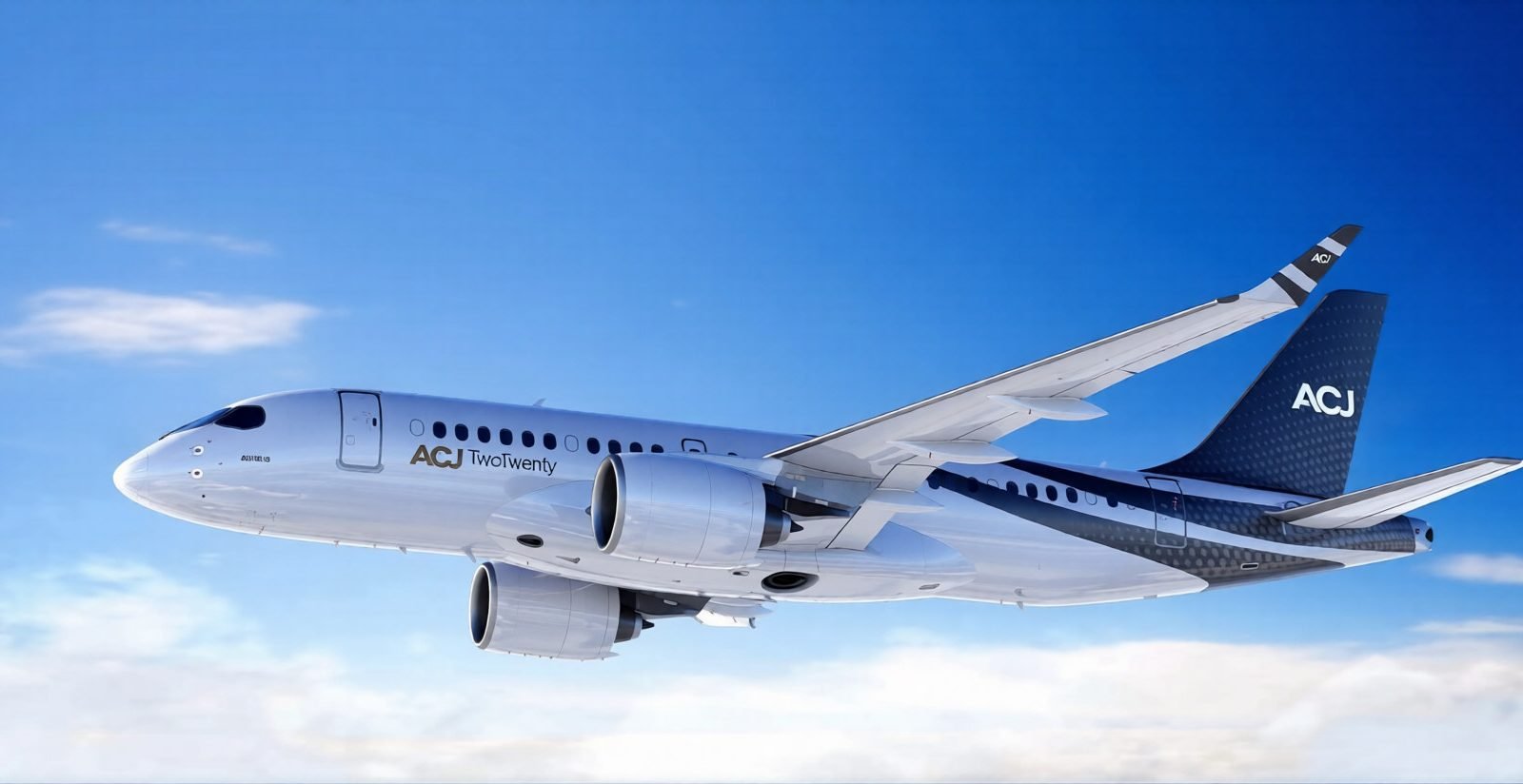
There’s a new shape in the sky above the world’s private terminals, and it doesn’t quite look like anything else parked on the ramp. It’s not a stretched airliner playing dress-up as a private jet, and it’s not a traditional long-range bizjet either. It’s something Airbus decided didn’t exist yet — and built anyway. Meet the ACJ TwoTwenty: the aircraft that convinced an entire industry to invent a new category just to describe it.
A Jet Born From a Bargain-Bin Buyout
The TwoTwenty’s origin story starts, unglamorously, with a fire sale. In 2017 and 2020, Airbus acquired what had been Bombardier’s CSeries program — an ambitious, all-new single-aisle airliner that had nearly bankrupted its Canadian creator — for a combined price of just $591 million. Bombardier had set out to challenge Airbus and Boeing’s duopoly in commercial aviation with a lighter, more fuel-efficient jet, and the market’s skepticism at the time drew comparisons to Icarus, the mythological figure who flew too close to the sun and paid for his ambition. Rebranded as the Airbus A220, the aircraft quietly proved itself: more than 200 are now in commercial service worldwide, with open orders for roughly 500 more.
It was this unglamorous corporate salvage job that gave Airbus Corporate Jets the raw material for something nobody had quite built before. On October 6, 2020, Airbus announced the ACJ TwoTwenty — a business-jet version of the A220-100, the shorter of the two A220 variants — and set out to prove that an airliner platform could deliver something no dedicated bizjet ever had: genuine widebody-style space, in a twin-aisle-adjacent single-aisle package, at a price that undercuts the ultra-long-range competition.
Redefining “Spacious”
Numbers tell the story better than adjectives here. The ACJ TwoTwenty’s cabin stretches 78 feet in length — more than 23 meters — with a width of 10 feet 8 inches and a height of nearly 7 feet, adding up to roughly 5,120 cubic feet of interior volume and more than 785 square feet of usable floor space. Airbus doesn’t shy away from the comparison: it says that’s more than double the cabin space of a traditional ultra-long-range business jet in the same performance class.
That volume gets carved into as many as six distinct living zones, with room for up to 19 passengers depending on configuration. Airbus and completion partner Comlux offer more than 200 possible layout configurations across four pre-defined design “ambiances,” letting owners tailor everything from a dedicated boardroom-style office to a master suite built around a California King bed with an en-suite, rain-shower bathroom — a level of residential comfort that’s simply never fit inside a conventional bizjet fuselage before.
Flying Farther Than Almost Anyone Needs To
Space alone wouldn’t matter if the TwoTwenty couldn’t also cross oceans, and this is where the aircraft’s airliner DNA pays real dividends. Powered by two Pratt & Whitney PW1500G geared turbofan engines producing up to 24,000 pounds of thrust each, the jet delivers a range of up to 5,650 nautical miles — more than 12 hours of non-stop flying. That’s enough to connect Los Angeles and London nonstop, or to cover roughly 99.9% of all departures originating in the United States without a fuel stop, according to Airbus’s own figures.
It’s also a surprisingly nimble performer for something this large: thanks to its GTF engines, the TwoTwenty needs only around 5,470 feet of runway, letting it access airports that would turn away many purpose-built long-range jets. Inside the flight deck, Airbus’s fly-by-wire system — the same three-axis, full-envelope-protection architecture used across the modern Airbus commercial fleet — pairs with a Collins Aerospace Pro Line Fusion avionics suite and five interchangeable 15.1-inch displays, giving pilots a genuinely modern, airliner-grade office up front.
The Price Tag That Changes the Math
Here’s the number that made the business aviation world sit up: at its 2023 launch, Airbus quoted a green (uncompleted) price for the TwoTwenty of around $72 million, with a fully outfitted, VIP-completed aircraft landing at roughly $100 million once cabin work is finished. That places it firmly in the same price bracket as traditional ultra-long-range jets from Gulfstream and Bombardier — while offering, by Airbus’s telling, more than twice the interior volume and materially lower projected operating and maintenance costs, since the airframe is built on a commercial platform with all the parts availability, reliability data, and worldwide support network that implies.
Airbus has leaned hard into this positioning, going so far as to coin an entirely new market label for the jet: the “Xtra Large Bizjet.” It’s a segment Airbus insists didn’t meaningfully exist before the TwoTwenty — one built around the idea that cabin space and range no longer have to trade off against each other the way they always have in purpose-built business jets.
From Green Airplane to Flying Boardroom: How It Actually Gets Built
Unlike a conventional business jet that rolls off a single assembly line as a finished product, the TwoTwenty is built in two very distinct stages, in two different countries. Airbus builds and delivers each aircraft as a “green” airframe — structurally complete but with no cabin interior — from the A220 final assembly line in Mirabel, Québec. From there, it’s ferried to Indianapolis, Indiana, where Swiss VIP completion specialist Comlux has built a dedicated center exclusively contracted to outfit the first 17 TwoTwenty cabins.
The pace of that pipeline has been accelerating steadily. The first completed aircraft entered service in early 2024, delivered to Dubai-based hospitality and investment group Five as the launch customer. By mid-2025, Comlux had received its fifth green airframe, with cabin completion times compressed to around 10 months thanks to what the company describes as streamlined manufacturing processes. Comlux has stated its ambition to deliver between four and six completed TwoTwenty cabins a year going forward — a production rhythm that, if sustained, would make this new category of jet a familiar sight on FBO ramps within just a few years.
Built by Pilots, for Pilots
One detail Airbus is especially proud of is how involved actual pilots were in shaping the TwoTwenty’s flight deck — a continuation of the same design philosophy used across the A220 program from day one. The result is a cockpit that Airbus frames less as a workstation bolted onto a luxury cabin and more as a genuine extension of the company’s commercial-aviation human-factors research: intuitive fly-by-wire control laws, a layout designed around long-haul crew comfort, and systems built to reduce workload on exactly the kind of 12-hour intercontinental legs the aircraft is designed to fly.
A New Category, Watching Its First Real Test
It’s worth being honest about where the TwoTwenty program actually stands: this is still a young aircraft, with a handful of deliveries completed and a production ramp that’s only just gathering speed. Whether “Xtra Large Bizjet” becomes a durable, industry-recognized category — the way “ultra-long-range” or “super-midsize” have — will depend on whether Airbus and Comlux can keep hitting their delivery targets, and on whether the private aviation market rewards space and value over the ultimate cachet of a bespoke, purpose-built hull.
But the early signals are hard to ignore. A jet born from one of the more unlikely corporate rescue stories in modern aerospace has, in a few short years, gone from PowerPoint slide to a genuinely new answer to an old question: what if a private jet didn’t have to choose between feeling like a home and flying like an airliner? For the first wave of owners now settling into California King beds at 41,000 feet somewhere over the Atlantic, the answer already seems clear.