listen to the audio of this article
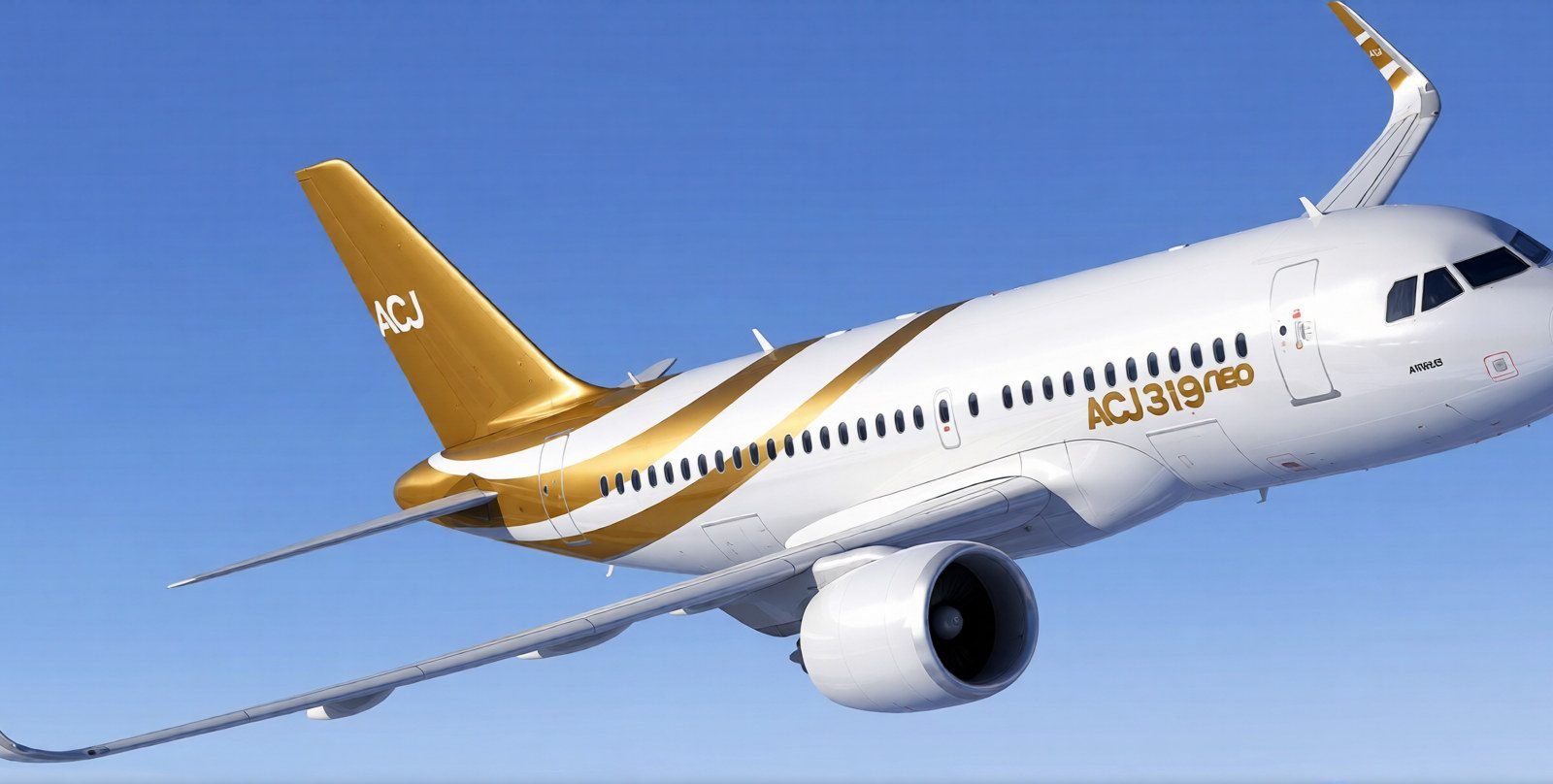
Not every extraordinary private jet needs a widebody fuselage or a headline-grabbing top speed to earn its reputation. The Airbus ACJ319neo — the smallest, most understated member of Airbus Corporate Jets’ current lineup — has quietly become one of the most range-capable aircraft in all of business aviation, narrow cabin and all. It won’t out-space the ACJ350 or out-run the newest Bombardiers. What it does instead is arguably more useful for the people who buy it: connect almost any two cities on Earth, in a cabin nearly ten feet wide, without stopping for fuel.
Built on the Best-Selling Airliner in History
The ACJ319neo’s foundation is about as proven as commercial aviation gets. It’s derived from the Airbus A319neo, part of the A320neo (“new engine option”) family — the reengined, more fuel-efficient successor to the A320 that Airbus first launched in December 2010 and which has gone on to become one of the best-selling airliner families ever built. Airbus Corporate Jets has offered VIP versions of the A320 family since the very first ACJ, the A319-based Airbus Corporate Jet, arrived in 1997. The “neo” designation simply signals which generation of engine and aerodynamic upgrades a given ACJ carries — and in the ACJ319neo’s case, those upgrades translate directly into money in the bank for owners logging serious annual hours.
Power comes from a choice of two modern engine families: the CFM International LEAP-1A or the Pratt & Whitney PW1100G, both representing a generational leap over the CFM56 engines that powered the original ACJ319. Paired with wingtip-mounted sharklets that reduce drag, the combination delivers more than 15% better fuel efficiency than the previous generation, along with roughly a 50% reduction in noise footprint — genuinely material improvements for an aircraft that may spend 15-plus hours a day, every day, in commercial-style operation for a private fleet.
The Launch Customer Nobody Expected to Wait For
Fittingly for an aircraft built around range rather than glamour, the ACJ319neo’s origin story runs through a charter operator rather than a head of state. Munich-based K5 Aviation ordered the aircraft in 2015 and was formally announced as launch customer, finalizing its LEAP-1A engine order at the Paris Air Show. The first ACJ319neo completed its maiden flight on April 25, 2019, and the very next day flew a 16-hour, 10-minute endurance test — at the time, a record for the longest flight ever completed by an Airbus A320-family aircraft. After EASA certification in July 2020, the aircraft entered a completion phase with Dutch outfitter Fokker Techniek before finally reaching K5 Aviation, becoming not just the first ACJ319neo delivered, but the first A320-family neo variant delivered anywhere — commercial or private.
K5 didn’t order a stock aircraft. Its ACJ319neo was fitted with five Additional Center Tanks (ACTs) — auxiliary fuel tanks slotted into the lower cargo hold — specifically to push the jet’s range to its practical maximum for very long, nonstop charter routes. It was, by K5’s own account, a continuation of a strategy the operator had already run with its earlier-generation ACJ319s and ACJ318: buy the longest-legged narrowbody VIP jet available, generation after generation.
Small Cabin, Enormous Reach
The numbers explain why an operator would go to that trouble. With a full complement of auxiliary tanks, the ACJ319neo offers a range of roughly 6,750 nautical miles — about 750 nautical miles farther than its CFM56-powered predecessor, the classic ACJ319. In practical terms, that’s enough to connect London and São Paulo, Los Angeles and Beijing, or New York and Dubai without a fuel stop — routes that would strand many larger, more famous business jets partway across an ocean or continent.
The cabin itself measures roughly 78 feet 10 inches long, 12 feet 2 inches wide, and about 7 feet 6 inches tall — modest next to a widebody ACJ350, but enormous by the standards of purpose-built business jets. Airbus and its completion partners routinely point out that the ACJ319neo’s cabin offers several times the usable floor space of a large-cabin bizjet like a Gulfstream G700 or Bombardier Global 7500, simply because it’s built on an actual airliner fuselage rather than a dedicated business-jet airframe. Typical VIP configurations seat up to 19 passengers and sleep as many as 18, with the interior split into lounge, dining/conference, and bedroom zones, plus a dedicated master ensuite — essentially airliner-scale real estate arranged as a private residence.
Comfort tech mirrors the rest of the ACJ family: a cabin altitude capped at roughly 6,400 feet even while cruising at 41,000 feet, meaningfully reducing fatigue on the 12-to-15-hour missions this aircraft is built for. A balanced field length of roughly 6,000 to 6,100 feet rounds out an aircraft that, despite its long-haul focus, retains solid airport flexibility.
Where It Sits on Price
Airbus and third-party valuation trackers put the ACJ319neo’s factory list price in the neighborhood of $100 million to $110 million as of recent market data, though fully outfitted examples with a bespoke VIP interior have been quoted well above that baseline once cabin work, connectivity, and customization are factored in. Pre-owned examples — still a thin market, given how few have been built and how tightly held they tend to be — have traded in the $70 million to $95 million range depending on age, hours, and configuration.
That places the ACJ319neo in an unusual competitive position: priced in the same broad territory as ultra-long-range purpose-built jets like the Bombardier Global 8000 or Gulfstream G700, but offering a cabin many multiples larger than either, at the cost of a narrower fuselage cross-section and a somewhat shorter outright range than the newest Bombardier flagship.
The Sibling Rivalry: ACJ319neo vs. ACJ320neo
Airbus doesn’t sell the ACJ319neo in isolation — it’s the shorter, longer-legged sibling to the ACJ320neo, and the choice between the two comes down to two different philosophies of private airliner ownership. The ACJ320neo offers a longer cabin and more usable floor space, at the cost of roughly 750 fewer nautical miles of range. The ACJ319neo trades some of that interior volume for endurance, making it the pick for operators whose missions are defined less by how many people they’re moving and more by how far they need to go without stopping. K5 Aviation’s own fleet strategy — stacking ACJ318s, ACJ319s, and eventually the ACJ319neo alongside its Bombardier Globals — reflects exactly that logic: keep the longest-range narrowbody in the world in the hangar, and let the mission dictate which aircraft flies.
A Business Jet That Doesn’t Need to Compete on Spectacle
The ACJ319neo will never be the aircraft written up for touching supersonic speeds or wearing a couture-designed cabin. Its case for itself is quieter and, in its own way, more persuasive: take a genuinely excellent commercial airframe, refine it with newer engines and better aerodynamics, add enough fuel capacity to erase the concept of a refueling stop, and let owners fill the rest with whatever version of a flying home they want. For operators who measure a jet’s worth in how rarely they have to think about it — how rarely a mission gets vetoed by range, how rarely a stopover interrupts a schedule — the ACJ319neo has quietly made itself very difficult to argue with.