listen to the audio of this article
Few brand stories begin with quite as improbable a meeting as this one: in 1904, at the Midland Hotel in Manchester, a wealthy young motoring enthusiast named Charles Rolls was introduced to an obsessive, self-taught engineer named Henry Royce. Rolls sold luxury cars in London and had grown frustrated with the unreliable French and German imports of the era. Royce, meanwhile, had just built his own small motorcar in a Manchester workshop, dissatisfied with the quality of the vehicle he already owned. The two men, from wildly different backgrounds — Rolls the aristocratic Cambridge graduate and pioneering aviator, Royce the self-made engineer who had left school at fourteen — struck a deal on the spot: Royce would build the cars, Rolls would sell them, and they would carry his name. Rolls-Royce Limited was formally founded in 1906.
The Reputation That Built the Myth
From the very beginning, the partnership was obsessed with a single idea: refinement through relentless engineering precision rather than raw horsepower or flash. That philosophy produced the Silver Ghost in 1907, a car so quiet and mechanically smooth for its era that a journalist reviewing it coined the phrase that would define the brand for the next century: “the best car in the world.” Rolls-Royce did not just accept the compliment. It built an entire identity around living up to it, prioritizing silence, smoothness, and understated craftsmanship over the era’s obsession with speed records.
The Spirit of Ecstasy
One of the most recognizable brand symbols in the world has a surprisingly romantic origin story. In 1909, John Montagu, 2nd Baron Montagu of Beaulieu, commissioned sculptor Charles Sykes to create a personal hood ornament for his own Rolls-Royce. Sykes modeled the figure on Eleanor Thornton, Montagu’s secretary and, by many historical accounts, his secret lover. Rolls-Royce’s management, worried that customers were affixing increasingly gaudy and inappropriate mascots to their cars, asked Sykes to create an official, more dignified alternative for the whole brand.
He returned to the same figure, refining her into what became known as the Spirit of Ecstasy, a woman leaning forward, arms outstretched behind her like wings, meant to embody, in the company’s own words, “the spirit of the Rolls-Royce: speed with silence, absence of vibration, the mysterious harnessing of great energy.” She has adorned the hood of every Rolls-Royce since 1911.
Wartime Reinvention
During the First World War, Rolls-Royce’s engineering expertise was redirected into building aircraft engines, a pivot so successful that aero-engine manufacturing eventually became just as central to the company’s identity as its cars. That dual identity lasted for decades, until 1973, when financial pressures forced a formal split: the automotive business became Rolls-Royce Motors, while the aerospace business became the separately traded Rolls-Royce plc, the same aerospace giant that exists today, entirely independent from the car brand people picture when they hear the name.
The Bidding War That Split the Brand From Its Own Name
By the 1990s, Rolls-Royce Motors, by then merged with Bentley under Vickers ownership, was put up for sale, triggering one of the strangest corporate ownership dramas in automotive history. Volkswagen won the bidding war in 1998, paying roughly £430 million to acquire the Crewe factory, the workforce, and the existing model designs for both Rolls-Royce and Bentley. But there was a catch nobody saw coming: the rights to the actual Rolls-Royce name and logo belonged not to the car company at all, but to Rolls-Royce plc, the aerospace business. BMW quietly negotiated directly with them, paying around £40 million for perpetual naming rights, plus roughly £26 million to Volkswagen for the Spirit of Ecstasy mascot and grille-shape trademarks.
The result was a genuinely strange outcome: Volkswagen ended up owning the factory and the cars, but could not call them Rolls-Royces. BMW got the name and the iconic symbols, but had to build an entirely new factory from scratch to use them.
The Goodwood Era
BMW used the standoff to relaunch Rolls-Royce as an entirely new operation, building a state-of-the-art production facility at Goodwood, West Sussex, and unveiling the first BMW-era car, the Phantom VII, at the stroke of midnight on January 1, 2003. Designer Ian Cameron reworked the Spirit of Ecstasy to be smaller and more aerodynamic, and able to retract into the hood to prevent theft or pedestrian injury, while keeping the brand’s signature long bonnet, upright Pantheon grille, and unmistakable proportions.
BMW’s unveiling strategy was famously theatrical, hosting invite-only previews in unmarked industrial buildings in Miami, Culver City, and New Jersey, building suspense worthy of, as one BMW executive put it, a James Bond-like quality.
A Living Legacy
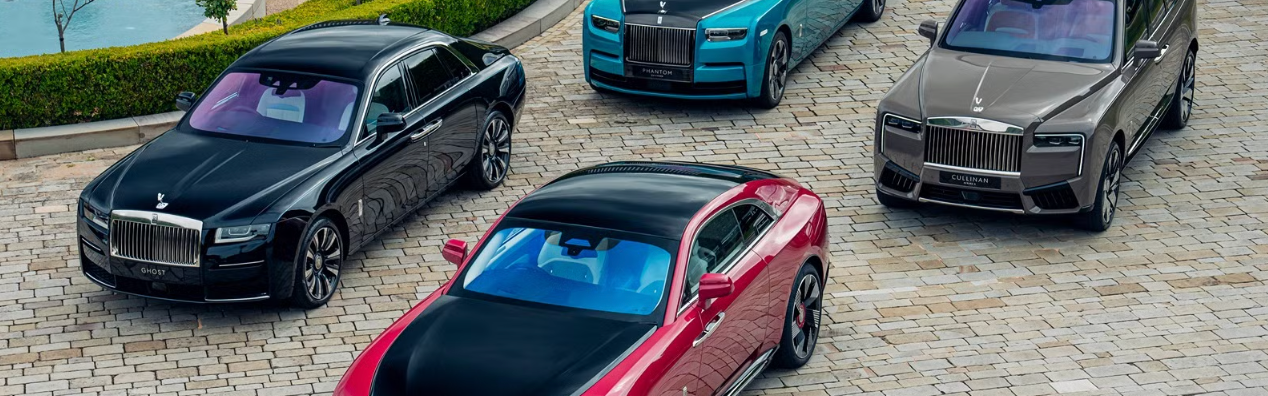
Rolls-Royce Motor Cars remains a wholly owned subsidiary of the BMW Group, operating as a distinct super-luxury marque with its own dealership network, design language, and clientele, entirely separate from the aerospace company that still carries the Rolls-Royce name. The current lineup, spanning the Phantom, Ghost, Wraith, Dawn, and the Cullinan SUV, continues the founding philosophy nearly one hundred and twenty years later: understated exteriors concealing extraordinary engineering, bespoke craftsmanship over mass production, and a continued obsession with silence and smoothness as the ultimate expression of luxury.
In 2011, the brand even previewed an all-electric prototype, the 102EX, foreshadowing its more recent push into electrification with the Spectre, proof that even a company this steeped in a century of tradition keeps finding new ways to chase the same founding promise: building, quite simply, the best car in the world.