For 119 years, the defining sound of a Rolls-Royce has been almost no sound at all — the famous “whisper” of a V12 so refined it seemed to erase itself. Now the marque has taken that obsession to its logical conclusion. The Spectre, unveiled in 2022 and delivered to its first clients in 2023, is Rolls-Royce’s first-ever series-production electric car, and the boldest bet Goodwood has made in a generation.
An Electric Future, Two-Door First
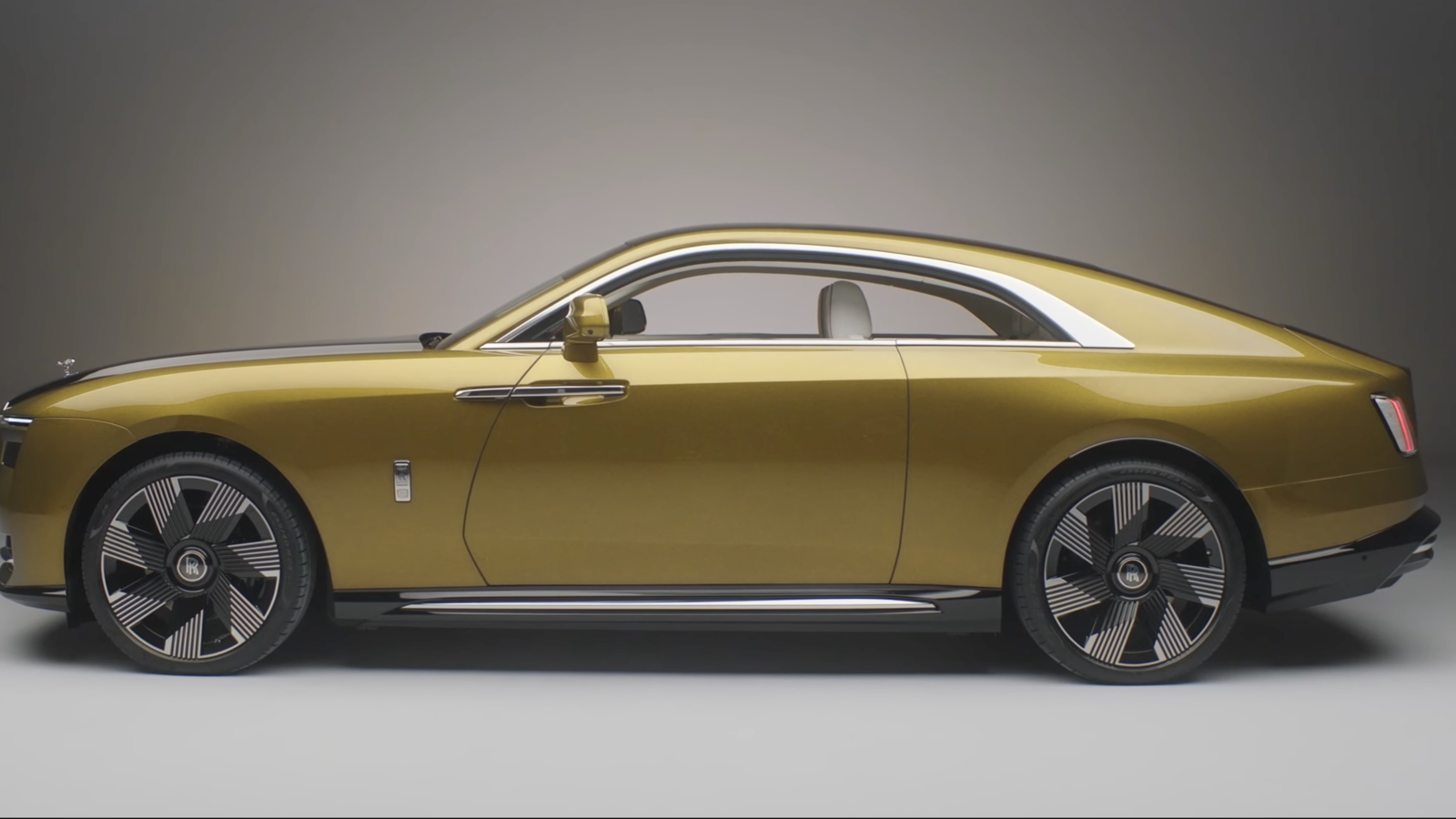
Rolls-Royce didn’t ease into electrification with a sedan or an SUV. It chose a coupé — a fastback grand tourer with the same low, sculpted roofline that once defined the Wraith, sharpened into something more sporting. The silhouette is deliberately theatrical: a long, uninterrupted bonnet line flowing into a compact cabin and a dramatically raked rear window, with coach doors that swing open to reveal a cocoon-like two-plus-two interior.
At the heart of it is a dual-motor, all-wheel-drive powertrain, drawing on a 120 kWh battery pack to produce 585 horsepower and 664 lb-ft of torque in the standard car. That’s enough to send a vehicle weighing over 6,400 pounds from 0 to 60 mph in roughly 4.3 seconds — brisk, if not headline-grabbing by EV hypercar standards, which is precisely the point. Rolls-Royce has never chased outright numbers; it chases the sensation of effortlessness, and an electric powertrain turns out to suit that philosophy remarkably well. There’s no gearbox to shift, no engine note to modulate, just a single, seamless surge of torque delivered in near-total silence.
For those who want more, there’s the Black Badge Spectre, the marque’s performance-oriented variant, which raises output to 659 horsepower and trims the 0-60 sprint to about 4.1 seconds — though, tellingly, Rolls-Royce caps top speed at the same 155 mph across the range rather than let either version chase a bigger number.
Range, Charging, and the Weight of Silence
The Spectre’s official range sits at roughly 266 to 291 miles depending on wheel and trim configuration, drawn from a 102 kWh usable portion of its 120 kWh battery. To that end, the Spectre supports DC fast charging alongside standard AC home charging, and the brand has built out its own “Whispers” ownership network and dealer charging infrastructure to make sure the electric transition feels invisible to the people paying for it.
That 6,400-plus pound curb weight is worth dwelling on. Much of it is the battery pack itself, mounted low in the chassis — which, unusually for Rolls-Royce, actually works in the car’s favor. A lower center of gravity gives the Spectre a planted, settled character that the brand’s traditionally top-heavy V12 cars have never quite had, even as engineers had to substantially reinforce the body structure to carry the extra mass without compromising the marque’s signature “magic carpet ride.”
Testing Built for a Rolls-Royce Timescale
Rolls-Royce doesn’t validate its cars the way most manufacturers do, and the Spectre’s development reflected that. Engineers reportedly subjected prototypes to more than 2.5 million kilometers of testing across extreme climates, from Arctic cold to Middle Eastern heat — a duration the company likes to describe as equivalent to roughly 400 years of use by a typical owner. Whether or not that framing is more marketing flourish than engineering metric, the underlying point stands: a Rolls-Royce is expected to last generations, not lease cycles, and the brand clearly wanted assurance that a battery-electric powertrain could meet that bar before it staked its reputation on one.
Design Details That Only a Coachbuilder Would Bother With
As ever, the details are where Rolls-Royce spends its effort. The Spectre carries an evolved version of the brand’s illuminated “Pantheon” grille, now with 22 individually lit vanes, and the Spirit of Ecstasy hood ornament has been made more aerodynamic to compensate for the car’s slipperier shape. Inside, the dashboard can be optioned with a starlit headliner extending into the door panels — a constellation of up to 4,796 fiber-optic “stars,” individually placed by hand, that has become something of a signature across the modern Rolls-Royce lineup.
The digital instrument cluster is new territory for the brand too: rather than a traditional power-reserve dial, the Spectre’s display shows electric range on one side and a “power reserve” gauge on the other, translating an EV’s charge state into the same visual language Rolls-Royce owners have read for a century.
Pricing and Positioning
The Spectre starts at roughly $398,000 in the U.S., with the Black Badge variant beginning around $468,000 before any bespoke commissioning — and bespoke commissioning is very much the point. Few Spectres will leave Goodwood in standard configuration; most will be individually specified through the brand’s Bespoke program, the same one responsible for one-off coachbuilt cars like the Boat Tail and Droptail.
Rolls-Royce has since introduced a Series II update to the Spectre, refining detailing and equipment without altering the car’s fundamental proposition. What hasn’t changed is the wager underneath it all: that the qualities buyers have always paid for — silence, weight, unhurried power delivery — turn out to belong just as naturally to an electric motor as to a V12, perhaps even more so. If the Spectre succeeds, it won’t be because it converted skeptics to electric cars. It will be because it proved, at the very top of the market, that going electric didn’t cost Rolls-Royce anything essential at all.