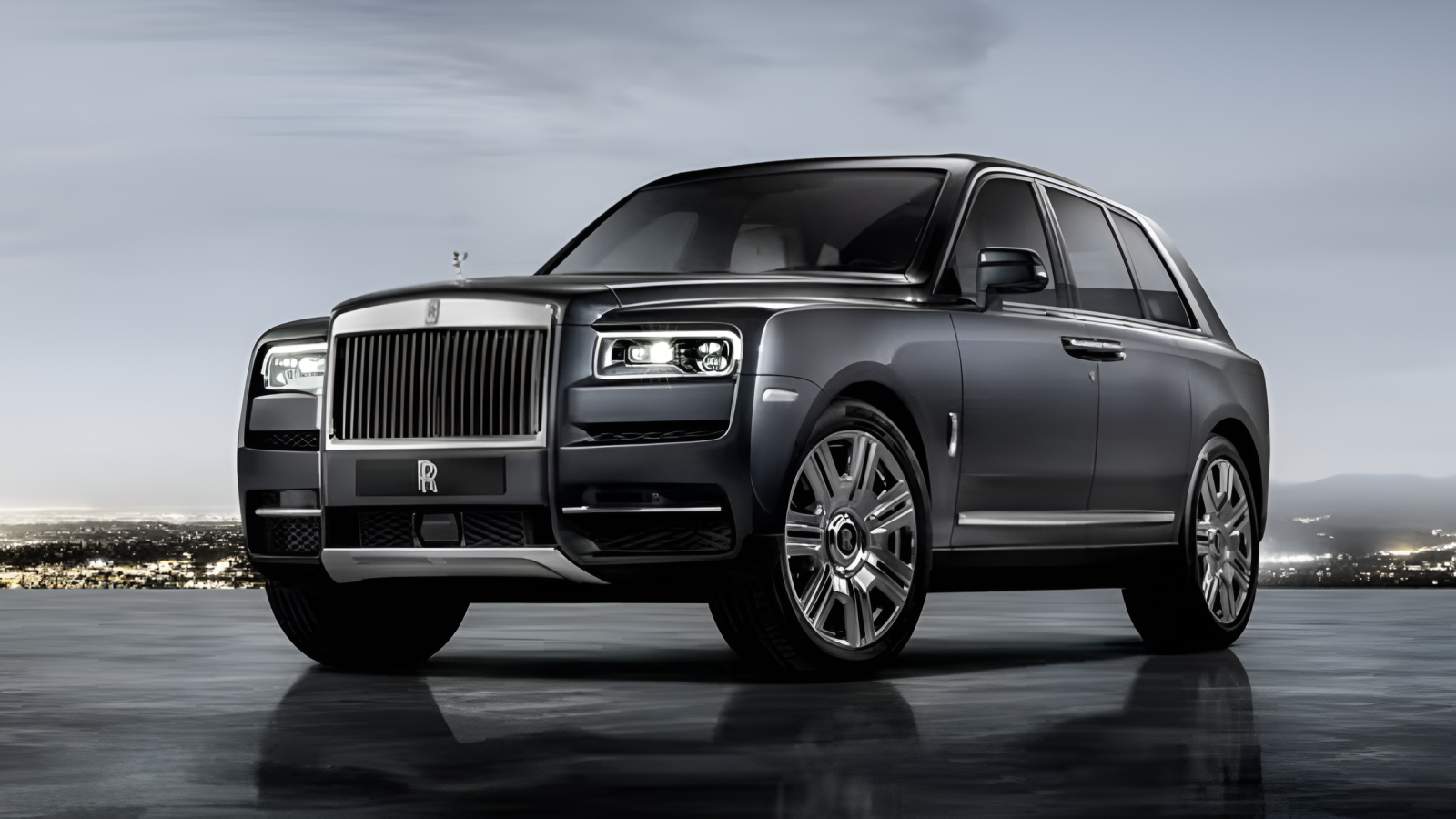
For more than a century, Rolls-Royce built exactly one kind of car: long, low, and chauffeur-driven. Then, in 2018, it built an SUV — or, as the company itself insists on calling it, “a high-sided car.” The Cullinan became the marque’s first entry into the segment that had already swallowed Bentley, Lamborghini, and eventually Ferrari, and it did so on its own terms: less an off-roader with leather seats bolted in, and more a Rolls-Royce that happens to sit six feet off the ground.
A Name Borrowed From the Crown Jewels
Rolls-Royce announced the car’s existence years before its 2018 debut, referring to it only as “Project Cullinan.” When the production name was confirmed, it turned out the working title was the real one all along: the car is named after the Cullinan Diamond, a 3,106-carat rough stone discovered in South Africa in 1905 and still the largest gem-quality diamond ever found. Cut into the Great Star of Africa and eight other major stones, pieces of the original diamond now sit in the British Crown Jewels. Rolls-Royce CEO Torsten Müller-Ötvös said at the time that the name reflected “the epic processes, over many millennia,” that went into the diamond’s creation — the kind of comparison only Rolls-Royce could make with a straight face about a car.
The Cullinan made its formal world premiere on May 10, 2018, at the Concorso d’Eleganza Villa d’Este on Lake Como — the same prestigious debut stage Rolls-Royce would later use for the Sweptail and Boat Tail.
Built on the Same Bones as the Phantom
Rather than adapting an existing SUV platform, Rolls-Royce built the Cullinan on its own bespoke aluminum spaceframe, which the company calls the “Architecture of Luxury” — the same underlying structure introduced with the eighth-generation Phantom sedan. The approach let engineers tune the SUV’s body stiffness and mass distribution specifically for Rolls-Royce’s ride requirements, rather than compromising with a shared mainstream platform.
Under the hood sits a 6.75-liter twin-turbocharged V12, producing 563 horsepower and 627 lb-ft of torque in standard form, paired with an 8-speed automatic and full-time all-wheel drive. That’s enough to move a vehicle weighing over 6,000 pounds from 0 to 60 mph in roughly 5.0 seconds. The Black Badge performance variant raises output to around 591 horsepower for a marginally sharper, more assertive character, though Rolls-Royce has never marketed the Cullinan on outright speed — the priority, as with every Rolls-Royce, is the sensation of gliding rather than accelerating.
Effortless, Everywhere
Rolls-Royce’s marketing tagline for the Cullinan was “Effortless, Everywhere,” and the engineering was built to back it up. Prototypes were tested across extreme conditions worldwide, including Arctic cold-weather trials, Middle Eastern desert heat, and North American canyon terrain, to validate genuine off-road capability rather than a cosmetically raised sedan. The production car can wade through water up to 21 inches deep and pairs self-leveling air suspension with the brand’s Flagbearer system — a stereo camera setup that scans the road ahead and pre-adjusts the suspension in real time, extending the marque’s signature “magic carpet ride” to broken pavement and unpaved trails alike.
Visually, the Cullinan was designed as what Rolls-Royce calls the segment’s first “three-box” SUV — a traditional hood, cabin, and cargo silhouette rather than a sloping crossover profile — riding on 22-inch wheels with rear-hinged coach doors. The rear tailgate, dubbed “The Clasp,” splits and opens in two powered sections, a design nod to the exterior-mounted luggage trunks of early 20th-century Rolls-Royces.
A Cabin Built Around a Picnic
Where most luxury SUVs treat the trunk as storage, Rolls-Royce treats it as a stage. The signature option is the Viewing Suite: two forward-facing leather seats that fold out from the tailgate area, designed to convert the rear of the car into a private box at a polo match, a picnic, or a sporting event, complete with a champagne cooler and picnic tables integrated into the design. An optional Recreation Module extends the same logic further, with a fold-out platform designed to carry bikes or outdoor equipment without compromising the cabin. Inside, buyers can specify the brand’s fiber-optic Starlight Headliner, along with the same bespoke wood, leather, and metal detailing found across the rest of the Rolls-Royce lineup.
Pricing and the Series II Update
The Cullinan launched in the U.S. in 2018 with a starting price of $325,000. Rolls-Royce introduced a Series II update in 2024, refreshing the exterior lighting, technology, and detailing without altering the car’s fundamental mechanical package. Today, the Series II Cullinan starts at roughly $432,000, with the Black Badge Series II beginning closer to $500,000 before options — and as with every modern Rolls-Royce, most buyers push well past the sticker price through the brand’s Bespoke commissioning program.
The wager behind the Cullinan was simple, if commercially unproven at the time: that Rolls-Royce buyers wanted the same silence, weight, and craftsmanship in a vehicle they could drive to a ski chalet or a safari camp, not just a five-star hotel. Nearly a decade later, the Cullinan has become the brand’s best-selling model — proof that at the very top of the market, raising the ride height didn’t cost Rolls-Royce anything it valued at all.