listen to the audio of this article
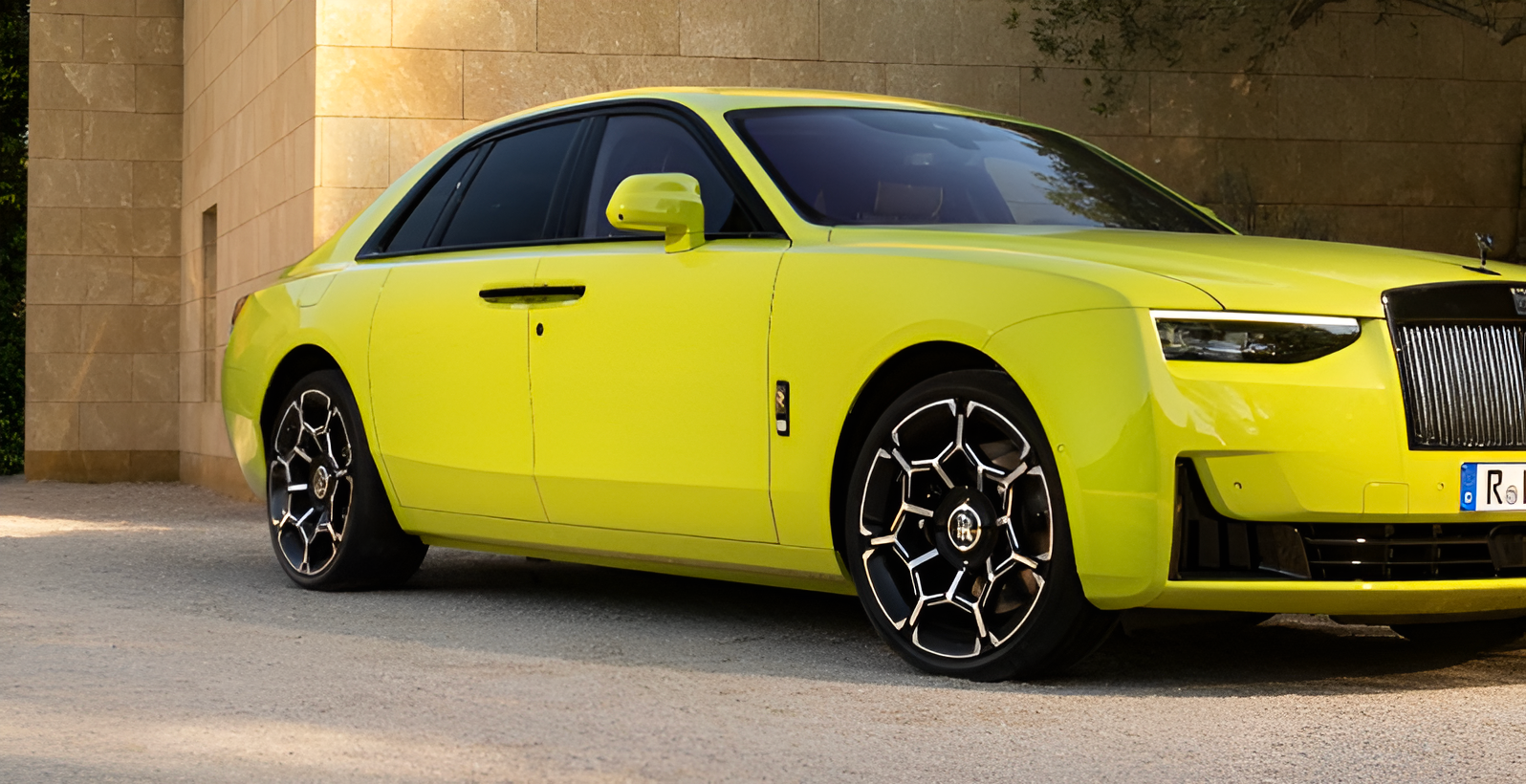
There is a particular kind of confidence that comes from not needing to prove anything, and few automobiles embody it as completely as the Rolls-Royce Ghost. Introduced in 2009 as the marque’s more accessible offering — a relative term, given the six-figure price of entry — the Ghost was conceived for a different sort of client than the chauffeur-driven Phantom: one who might, on occasion, prefer to drive. More than a decade and a half later, it remains the best-selling model in Rolls-Royce’s history, a quiet testament to the idea that restraint, executed with total conviction, is its own form of extravagance.
The name is not incidental. Rolls-Royce first used “Ghost” in 1906, for the Silver Ghost, a car whose imperviousness to mechanical failure did much to establish the marque’s founding reputation. Resurrecting the name for a twenty-first-century flagship was, in effect, a promise: that the same obsessive engineering standards would carry forward, even in a car built to feel less ceremonial than its stablemates.
The First Generation: A New Kind of Rolls-Royce
The original Ghost shared its underlying architecture with the BMW 7 Series, a pragmatic decision that allowed Rolls-Royce, under BMW ownership since 1998, to develop a smaller, lighter flagship without engineering an entirely new platform from the ground up. Whatever it borrowed mechanically, however, was rendered unrecognizable by the finishing: hand-stitched leather, veneers selected and matched by craftspeople at Goodwood, and a ride tuned with such deliberate softness that acceleration and braking alike seemed to occur without the driver’s involvement.
Beneath the composure sat a twin-turbocharged V12, delivering effortless, almost embarrassed power — brisk enough to unsettle far more overt performance cars, though the Ghost never seemed interested in the comparison. A long-wheelbase variant followed, along with a Black Badge edition, Rolls-Royce’s now-familiar formula for darkening the exterior trim and sharpening the car’s temperament for clients who wanted their restraint delivered with a touch more menace.
The Second Generation: Post Opulence
In 2020, Rolls-Royce retired the borrowed underpinnings entirely, moving the Ghost onto its own aluminum Architecture of Luxury platform — the same foundation used for the Phantom and the Cullinan. Freed from any BMW lineage, the design team pursued what they termed “post opulence”: the notion that, for a clientele who has already acquired everything conspicuous consumption has to offer, the more compelling gesture is subtlety.
The results are visible mostly in restraint — cleaner surfacing, fewer creases, a cabin stripped of unnecessary ornamentation. What luxury remains has simply moved inward and, in some cases, into the dark: a discreetly illuminated fascia bearing the Ghost nameplate, visible only to the driver, and the marque’s signature Starlight Headliner, which scatters fiber-optic pinpricks of light across the roof lining like a night sky commissioned to order.
Mechanically, the current car retains the 6.75-liter twin-turbocharged V12, now producing 563 horsepower and 627 lb-ft of torque, paired with a ZF eight-speed automatic and standard all-wheel drive. Its Planar suspension system — Rolls-Royce’s term for a camera-assisted ride-height control that reads the road ahead and adjusts before a wheel ever meets a flaw in the pavement — remains one of the more quietly remarkable pieces of engineering in the modern automotive landscape, less a suspension than a form of quiet clairvoyance.
The Series II Refresh
For 2025, Rolls-Royce introduced a Series II update, characteristically modest in its outward changes. The Pantheon grille is now illuminated, the headlights redesigned, and the taillights borrowed a visual language from the all-electric Spectre. Inside, a new digital interface — SPIRIT — spans the dashboard behind a single sheet of glass running pillar to pillar, folding technology into the cabin without disturbing its equilibrium. The 2026 model year carries this update forward without alteration, in keeping with Rolls-Royce’s longstanding indifference to the industry’s annual refresh cycle.
Living With a Ghost
The current range spans standard, Extended-wheelbase, and Black Badge configurations, priced against rivals such as the Bentley Flying Spur and Mercedes-Maybach S-Class, though the comparison is largely academic once options are specified and the price climbs well past half a million dollars. The Extended model, favored by clients who prefer to occupy the rear seats, adds reclining Serenity Seats with additional legroom, while every Ghost comes standard with four-zone climate control, a heated steering wheel, and an 18-speaker, 1,400-watt Bespoke Audio system engineered specifically for the car’s exceptionally quiet cabin.
Fuel economy — 12 mpg city, 19 highway — is not a figure Rolls-Royce dwells on, nor should its owners. It is, after all, beside the point in a car whose entire purpose is to make the miles disappear rather than the fuel.
The Case for Quiet Luxury
What the Ghost ultimately sells is a kind of silence — mechanical, acoustic, and social. It does not court attention the way its competitors sometimes do, and that omission has become its defining feature. Fifteen years on, it remains the rare luxury object whose most compelling details are the ones its owner alone is meant to notice: a starlit headliner, a hidden nameplate, a suspension that anticipates the road before the driver does. In an industry increasingly given to spectacle, the Ghost continues to make the more difficult argument — that the finest luxury is the kind that never announces itself.