listen to the audio of this article
An Open-Air Rolls, Properly Done
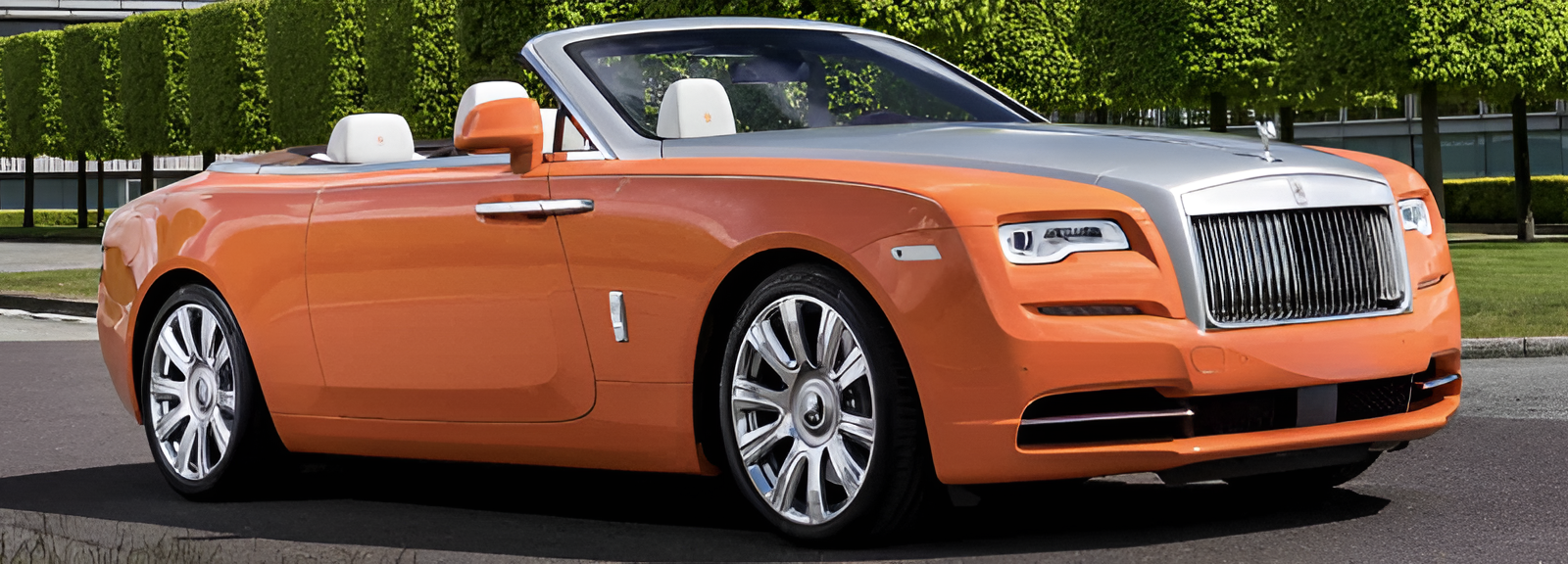
Rolls-Royce had built convertibles before, but the Dawn, unveiled at the 2015 Frankfurt Motor Show, was something more deliberate: a car engineered from the outset to answer a question the marque had never fully addressed — what does an open-top Rolls-Royce feel like when the wind, rather than a glasshouse of coachwork, is doing the enclosing? The answer, Rolls-Royce insisted, was that it should feel much like any other Rolls-Royce. Which is to say, close to silent.
The name borrowed from the Silver Dawn of 1949, a saloon built in the austere years following the war, and positioned the new car as spiritual successor to the Phantom Drophead Coupe. Mechanically, the Dawn descended from the Wraith coupe and, by extension, shared architecture with the BMW 7 Series — the same underpinnings supporting the Ghost of the era. But Rolls-Royce was quick to note that some eighty percent of the Dawn’s body panels were unique to the car, a figure meant to settle any suggestion that this was simply a Wraith with its roof removed.
Engineering Silence Into an Open Car
Convertibles are, by nature, a compromise: remove a roof and a car surrenders structural rigidity, acoustic isolation, and a measure of the composure that a luxury sedan takes for granted. Rolls-Royce’s engineers spent a disproportionate amount of effort clawing that composure back. The Dawn’s fabric roof, a blend of layered cloth and composite materials rather than a folding hardtop, was chosen specifically for its acoustic properties, and the marque marketed the result, without much hesitation, as the world’s quietest convertible. Raised or lowered, the roof could operate at speeds up to 30 mph, and did so with a hydraulic hush rather than the mechanical clatter more typical of the segment.
The doors, hinged at the rear in Rolls-Royce’s signature “suicide” configuration, opened wide enough to make entry and exit unhurried, in keeping with a car that never seemed to be in a rush. Four seats accommodated genuine adults, not the token rear perches common to most convertible grand tourers, reinforcing the Dawn’s intent as a car for touring in company rather than solitary indulgence.
Power, Delivered Without Drama
Beneath that long, louvered bonnet sat a 6.6-liter twin-turbocharged V12, sourced from BMW and tuned to Rolls-Royce’s own specification, producing 563 horsepower and 575 lb-ft of torque in standard form — enough to send the two-and-a-half-ton convertible from rest to 62 mph in 4.9 seconds, a figure that felt almost beside the point given how little drama accompanied it. An eight-speed ZF automatic handled the shifting, invisibly, as Rolls-Royce transmissions generally do.
In 2017, the Black Badge treatment arrived for clients who wanted the Dawn’s composure paired with sharper intent: 593 horsepower, 620 lb-ft of torque, a firmer suspension tune, and a darker aesthetic throughout, down to a blackened Spirit of Ecstasy figurehead that had, until then, always appeared in gleaming chrome. It was Rolls-Royce’s acknowledgment that not every client wanted their power delivered entirely without comment.
A Swan Song, Not a Handoff
Order books for the Dawn closed in March 2022, though production continued through 2023 to satisfy the backlog, ending a seven-year run as the marque’s best-selling convertible to date. Its retirement arrived alongside that of its coupe sibling, the Wraith, and marked, more broadly, the end of the two-door V12 Rolls-Royce altogether. The final cars left Goodwood in a run of bespoke liveries — a green-on-green example, a matte black commission, one finished in Midnight Sapphire with an Arctic White bonnet — each a small, individual send-off for a model that had spent its life resisting anonymity in the first place.
Rolls-Royce has offered no direct successor. The marque’s attention, and its considerable engineering resources, shifted instead to the Spectre, the brand’s first fully electric model, which arrived in 2023 as a coupe rather than a convertible. Whether an open-top electric Rolls-Royce eventually follows remains an open question, and Rolls-Royce, characteristically, has said nothing to resolve it.
What the Dawn Leaves Behind
The Dawn’s real achievement had little to do with horsepower or acceleration figures, both of which were almost incidental to the case it made. It proved that removing a roof from a Rolls-Royce did not have to mean removing the sense of enclosure that defines the marque — that silence, if engineered with sufficient obsession, could survive open air. For the clients who bought one, and for the secondary market that has since taken a keen interest in well-kept examples, the Dawn remains something increasingly rare: a V12 convertible built without compromise, at a moment when the rest of the industry had already begun looking elsewhere.