listen to the audio of this article
Replacing a car as commercially successful as the Roma was never going to be a straightforward assignment. Since its 2020 debut, the Roma had become something of a gateway model for Ferrari — the car that introduced a new generation of clients to the marque through elegance rather than outright aggression. Any successor risked either coasting on that formula or overcorrecting away from it. Ferrari’s answer, unveiled on July 1, 2025, split the difference with unusual precision: the Amalfi looks unmistakably related to the car it replaces, but drives, and behaves, like a company unwilling to let a winning design sit still.
The name itself signals the intent. Where Roma evoked the eternal city’s grandeur, Amalfi conjures something more visceral — a coastal road, hairpin turns, sunlight on water. Ferrari’s own materials describe the car as occupying a space between adrenaline and everyday usability, which is corporate language for a fairly direct proposition: this is meant to be a Ferrari you could drive every day and still be excited to drive.
An Evolution, Not a Reinvention
Underneath, the Amalfi retains the Roma’s front-mid-engine, rear-wheel-drive architecture, but Ferrari says every body panel apart from the glasshouse is new. The proportions read as familiar — a long, sculpted bonnet, a fastback roofline sloping toward a squared-off tail — but the details have sharpened considerably. The front end borrows visual language from the SF90 Stradale and the 12Cilindri, with a more assertive, shark-nosed intake and a blacked-out grille that conceals the car’s cooling architecture without disrupting its surfacing. At the rear, a reworked active spoiler operates across three positions, functioning as an airbrake when fully deployed, and Ferrari claims the changes yield up to 110 additional kilograms of downforce over the outgoing car at speed.
Inside, the redesign is just as deliberate, and in some ways more telling. The Roma had leaned into a minimalist, almost austere cabin, built around capacitive touch controls that critics — and no small number of owners — found more frustrating than elegant. The Amalfi walks a portion of that back, reintroducing physical switchgear, including the return of Ferrari’s red engine start button in tactile form. A new 10.25-inch horizontal touchscreen anchors the center console, paired with an 8.8-inch passenger display and a redesigned instrument cluster housed within what Ferrari describes as a monolithic cockpit structure. The center tunnel takes the form of a suspended aluminum bridge, and the door panels carry styling cues borrowed, appropriately, from nautical design.
More Power, Sharper Reflexes
The Amalfi’s 3.9-liter twin-turbocharged V8 — a member of Ferrari’s award-laden F154 engine family — has been reworked rather than replaced, and the changes are meaningful. Lighter camshafts, faster-spinning turbochargers now capable of 171,000 rpm, and a recalibrated engine control unit push output to 640 metric horsepower (631 hp) at 7,500 rpm, roughly 19 to 20 horsepower over the Roma, with torque holding steady at 760 Nm. The redline climbs to 7,600 rpm. Ferrari quotes a 0-to-62-mph sprint of 3.3 seconds, a 0-to-124-mph time of 9.0 seconds, and a top speed beyond 199 mph — figures that place the Amalfi comfortably ahead of its predecessor without asking it to abandon the character that made the Roma so approachable in the first place.
Power reaches the rear wheels through an eight-speed dual-clutch transmission, while a new brake-by-wire system with ABS Evo delivers what Ferrari claims is roughly a nine percent improvement in stopping distance over the Roma. Recalibrated magnetorheological dampers round out the chassis updates, aimed at sharpening turn-in response without surrendering the long-distance comfort that remains, after all, the entire point of a grand tourer.
The Spider: The Same Argument, Made With the Roof Down
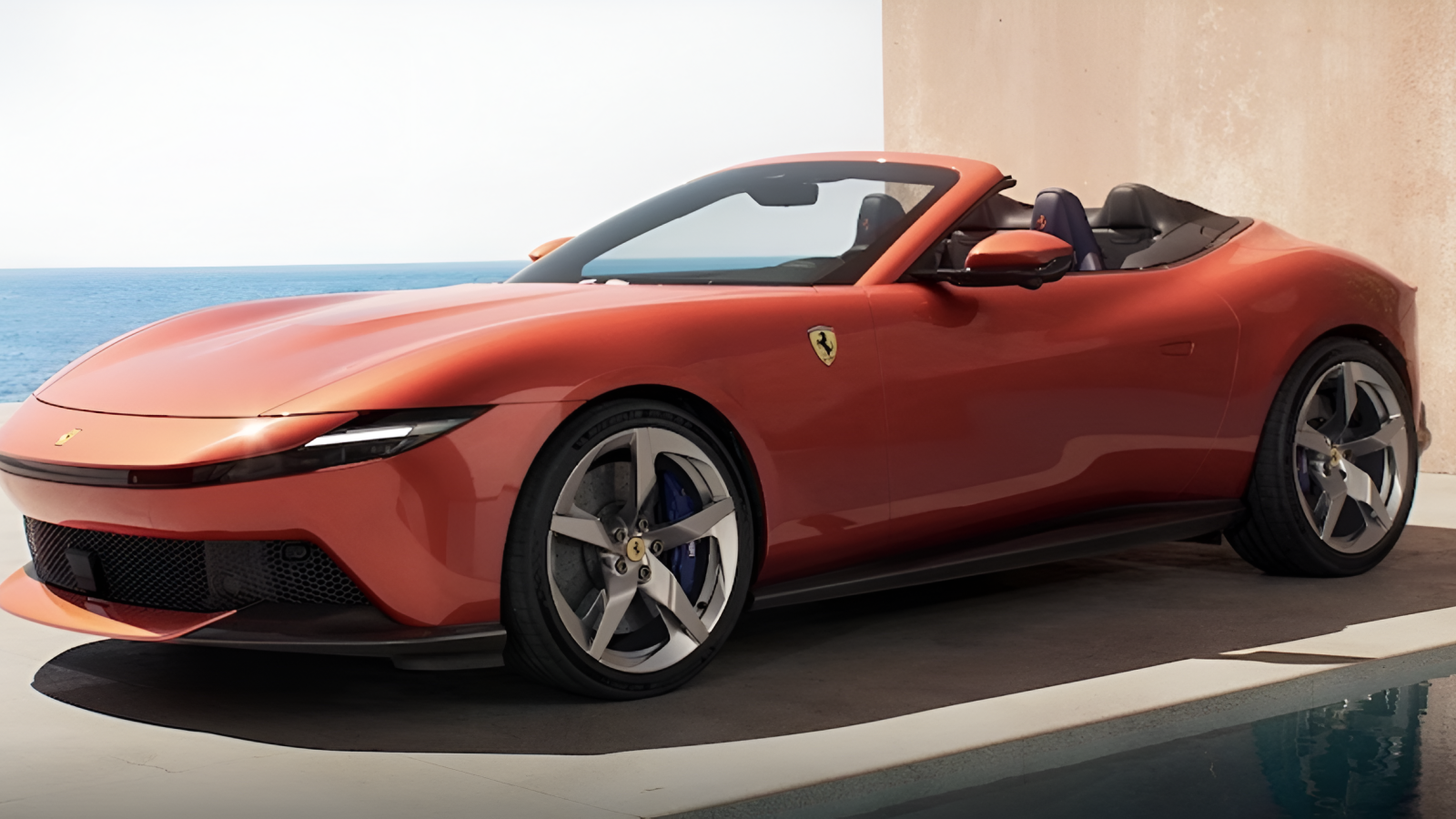
The Amalfi Spider dispenses with the coupe’s fixed roof in favor of a fully automatic soft top, engineered specifically for the car rather than adapted from the Roma Spider it replaces. Ferrari’s design studio built the Spider to read as a complete statement in either configuration: with the top raised, it echoes the coupe’s silhouette closely enough that the change is barely perceptible from a distance; lowered, the proportions shift toward something more overtly theatrical, with the folded roof mechanism — some 220 millimeters thick when stowed — becoming a visible part of the car’s rear architecture rather than an afterthought hidden beneath a cover.
Mechanically, the Spider carries over the coupe’s 640-horsepower V8 essentially unchanged, along with its 3.3-second sprint to 62 mph, though the convertible does concede some practicality: luggage space drops from 9.0 cubic feet with the roof up to 6.1 cubic feet with it down, a trade Ferrari clearly expects most Spider buyers to make without hesitation. As with the coupe, the interior brings back Ferrari’s tactile control philosophy, with the same instrument architecture and infotainment layout, adjusted only to account for the open-air experience the car now exists to deliver.
Measured Against the Competition
The Amalfi arrives into a segment that has grown more competitive, and arguably more thoughtful, than it was when the Roma first appeared. The Porsche 911 Turbo S remains the default reference point for outright drivability, the Aston Martin Vantage trades some of the Amalfi’s polish for a rawer, more analog character, and the McLaren Artura pushes hybrid technology further than Ferrari has chosen to here. What the Amalfi offers that none of them quite matches is the specific blend of Ferrari’s road-going pedigree with genuine four-seat, front-mid-engine usability — a formula the marque has been refining, in one form or another, since the 1950s, when its earliest grand tourers established exactly this template.
Ferrari’s decision not to hybridize the Amalfi, at a moment when the 296 and 849 Testarossa both lean heavily on electrification, reads as deliberate rather than incidental. The V8 here is meant to be heard and felt in something closer to its unfiltered form, a choice that separates the Amalfi’s identity from the rest of the current lineup rather than blurring it. Whether that remains the case through the car’s full production cycle is an open question — Ferrari’s broader roadmap points firmly toward electrification — but for now, the Amalfi stands as one of the more mechanically straightforward cars the company builds.
Where It Sits in the Lineup
Priced from roughly $275,000 to $283,000 depending on specification, the Amalfi occupies Ferrari’s traditional entry point — a position that, at this level, still carries a fairly significant asterisk. It now shares that segment briefly with the outgoing Roma Spider, which remains in limited production as Ferrari manages the handover, and it sits just below the 296 GTB and GTS in the broader hierarchy, cars that trade a measure of the Amalfi’s everyday composure for hybrid-assisted mid-engine intensity.
What distinguishes the Amalfi within that company is less about outright performance than intention. It is not attempting to be Ferrari’s sharpest instrument, nor does it pretend otherwise. Its case rests on the idea that a car can be genuinely thrilling without demanding constant vigilance from its driver — that the long drive to dinner and the spirited run up a coastal road can be, credibly, the same car doing two different jobs equally well.
The Verdict, For Now
It is early in the Amalfi’s life to render a final judgment, but the early signals are consistent: more power, sharper aerodynamics, a chassis tuned with slightly more urgency, and — perhaps most tellingly — an interior that listens to what actual owners wanted rather than what looked most striking in a press photo. Ferrari built the Roma to open a door for new clients. The Amalfi, and its open-top Spider counterpart, are tasked with the harder job of keeping them once they’re through it, and doing so by getting sharper rather than simply getting louder.