A Knockout Result at Monterey
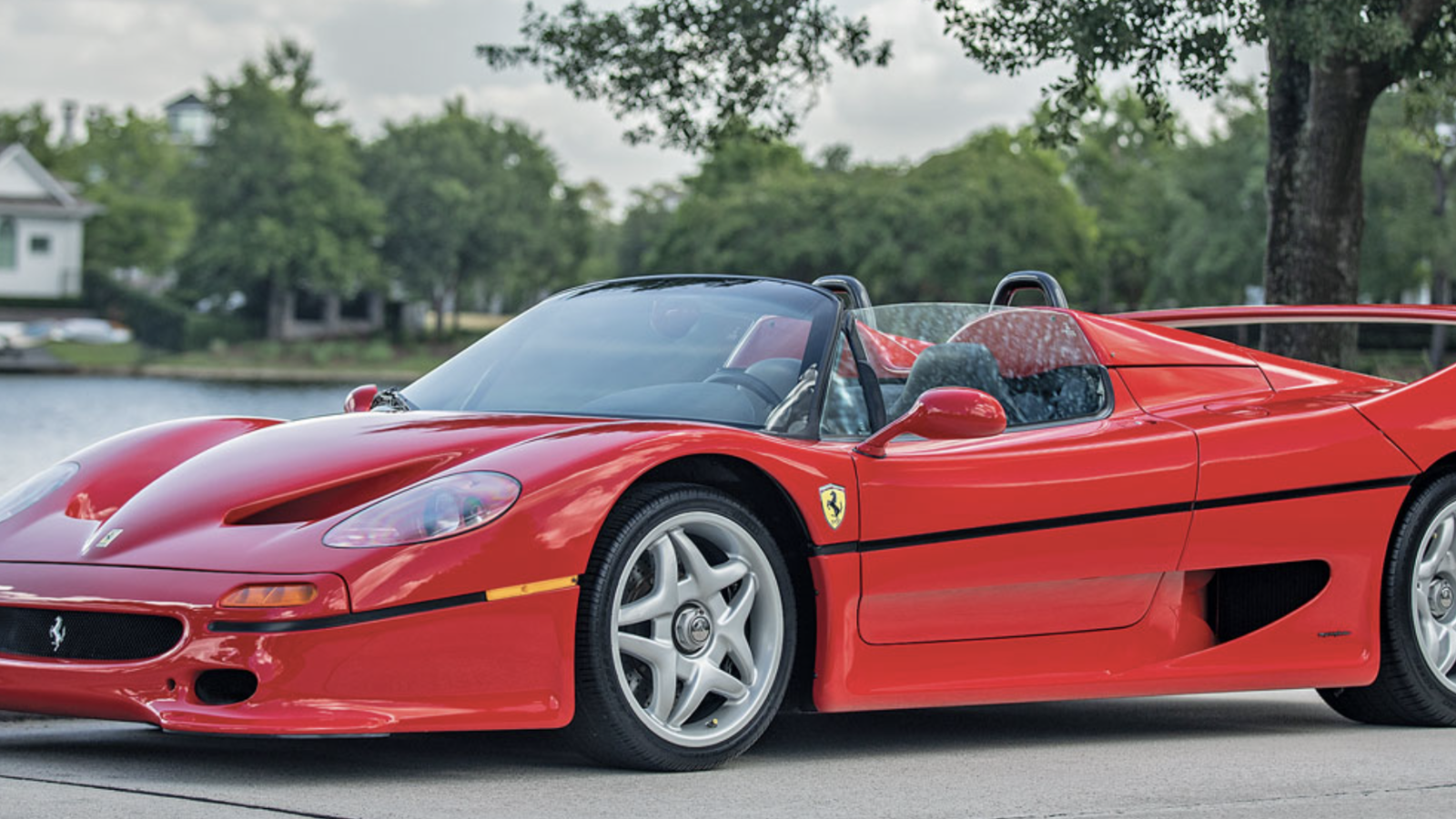
On the evening of August 15, 2026, as the Monterey fog rolled in off the Pacific, the gavel fell at RM Sotheby’s flagship auction with a number that would have seemed unimaginable just a few years earlier: $12,105,000 for a 1995 Ferrari F50. The car—chassis number 104220, Rosso Corsa over Nero with rosso seat inserts, and 6,196 miles on its odometer—wasn’t just any F50. It was the former property of Mike Tyson, the youngest heavyweight champion in boxing history, and it arrived on the block carrying both a Ferrari Classiche Red Book and a pair of autographed Everlast boxing gloves.
The result was staggering. The pre-sale estimate had been $7 million to $9 million, and the car was offered without reserve. When the bidding finally stalled, the price had eclipsed the high estimate by nearly 35 percent. It was, at the time, the second-highest price ever paid for a Ferrari F50 at public auction—beaten only hours later by a Giallo Modena example at Mecum Monterey that fetched $14.5 million.
But the RM Sotheby’s car was the one that told the deeper story: about provenance, about the re-rating of Ferrari’s modern halo cars, and about how quickly the market for the so-called “Big Six” had transformed from enthusiast territory into the stratosphere of blue-chip collectibles.
The Machine: Ferrari’s F1 Car for the Road
To understand why this particular F50 commanded such attention, one must first understand what Ferrari built.
The F50’s chassis was a Formula 1-style carbon fiber tub. Its body—designed by Pininfarina and constructed from carbon fiber, Kevlar, and Nomex honeycomb—abandoned the wedge aesthetic of the 1980s in favor of flowing curves reminiscent of Ferrari’s 1950s and 1960s sports racers.
The heart of the car was the 4.7-liter naturally aspirated V-12, designated F130B. It was not merely inspired by Ferrari’s F1 program—it was Ferrari’s F1 program. The engine began life in the 1992 Ferrari Formula 1 car, was further developed in the 333 SP sports racer, and then enlarged and detuned for road use. The result was 513 horsepower and 347 lb-ft of torque, enough to propel the F50 from 0 to 60 mph in 3.6 seconds and on to a top speed of 202 mph.
Ferrari produced just 349 numbered examples through 1998—an intentional reduction from the F40’s production run, designed to preserve rarity and protect the model’s collectible status from the outset.
Of those, only 55 were specified for the US market. Chassis 104220 was the 73rd built, and one of those 55 American-market cars.
The Provenance: From Maranello to “Iron Mike”
The ownership history of chassis 104220 reads like a cross-section of American cultural and collecting history.
Production commenced in November 1995. The car was finished in Rosso Corsa with a Nero interior and rosso seat inserts, specified with US-market instruments in miles. After assembly was completed in February 1996, it was delivered via Ferrari of North America to Beverly Hills Sports Car in California.
It was there that Nader Amirvand, a respected dealer and broker based in Fountain Valley, acquired the car and quickly sold it to its first private owner: Mike Tyson. In 1996, Tyson was at the height of his powers, having just regained the undisputed heavyweight championship. The F50 was the crown jewel of a supercar collection befitting a man who had earned, and spent, hundreds of millions of dollars in the ring.
Tyson’s ownership, however, was brief. Later that same year, he sold the car back to Amirvand. The F50 then passed through a series of dedicated collectors who understood what they had. Around 2000, it went to a private collector in Simi Valley, California. A year later, Kevin Marcus, a Seattle-based technology magnate, acquired it and kept it for four years, even displaying it at the 2004 Kirkland Concours d’Elegance.
In 2005, Bruce Weiner of Atlanta purchased the car and commissioned significant mechanical work from Rod Drew at Francorchamps of America, including an engine-out service, electronic updates, lighting upgrades, and a clutch rebuild. In 2006, it moved to Brian Ross, a major Ferrari collector in Ohio, who installed a new fuel tank and retained the car for several years.
The critical moment came in January 2008, when the car was factory-certified with a Ferrari Classiche Red Book, confirming the presence of the original matching-numbers chassis, engine, transaxle, and bodywork.
By 2017, it was in the collection of Todd Morici in New Jersey, then passed to Victor Roof Jr. in 2018, and to an unknown enthusiast in 2020. Following a major service by Ferrari of Fort Lauderdale in May 2022, it was acquired by an RM Sotheby’s client who passed away a few years later—leaving the car to be offered by his estate at Monterey.
In preparation for the 2026 sale, Ferrari of Newport Beach performed another major service. The odometer read 6,196 miles—meaning the car had accumulated only about 500 miles since its last auction appearance.
The Price Arc: From $2.6 Million to $12.1 Million in Nine Years
The financial trajectory of this specific F50 tells the story of a market that has been completely re-rated.
The car first appeared at public auction at RM Sotheby’s Amelia Island in 2017, where it sold for $2,640,000 with 5,694 miles on the clock. Five years later, at Gooding Pebble Beach in 2022, it brought $4,625,000—a 75 percent gain, but still a figure that placed it firmly in the realm of “expensive but attainable” for serious collectors.
Then came 2026. In January of that year, the Ferrari F50 market exploded. A 1995 example sold for $8.8 million at RM Sotheby’s Arizona. Another brought $9.25 million at RM Sotheby’s Monterey in 2025. A Kissimmee example hit $12.2 million. And then, in August, this car—Tyson’s former F50—reached $12,105,000 at Monterey.
In less than a decade, the same chassis had appreciated by roughly 360 percent. The buyer in 2017 who paid $2.64 million had, if they held on, watched their asset more than quadruple in value. Even the 2022 buyer, at $4.625 million, would have been sitting on a paper gain of over 160 percent in just four years.
What changed? The answer lies in the market’s evolving understanding of Ferrari’s “Big Six”—the 288 GTO, F40, F50, Enzo, LaFerrari, and the then-new F80. Collectors began to view these not as used supercars, but as a coherent asset class: the modern equivalent of the 250 GTO, but with the added appeal of drivability, contemporary performance, and cultural relevance. At Monterey 2026, Ferrari dominated the top of the market, taking seven of the top ten positions at RM Sotheby’s alone and accounting for more than $107 million in sales.
The August 15 2026 Auction
RM Sotheby’s returned to the Portola Hotel and Monterey Conference Center for its 29th year at Monterey Car Week, presenting 199 lots across August 13 and 15. The docket was stacked with blue-chip metal: a 1996 McLaren F1 GTR that sold for $34.7 million, a 1963 Chevrolet Corvette Grand Sport at $18.7 million, a 2023 Ferrari Daytona SP3 at $17.8 million, and a 1985 Ferrari 288 GTO that set a model record at $11.6 million.
The F50 was Lot 349, and it carried the weight of both its celebrity provenance and its mechanical integrity. It came with the hardtop roof panel, owner’s manuals in the leather pouch, fitted F50 luggage, the sales brochure, a commemorative F50 book, and those autographed gloves.
The room was packed. Bidding opened strong and climbed steadily, blowing past the high estimate of $9 million without hesitation. When the hammer finally fell at $12,105,000, it represented not just a validation of the car’s quality, but a statement about where the market for these machines had arrived. The F50 was no longer the “forgotten” middle child of Ferrari’s hypercar lineage, sandwiched between the iconic F40 and the technologically dazzling Enzo. It had become a standalone blue-chip collectible, with prices to match.
Beyond the numbers, the new owner acquired one of the most documented and carefully preserved F50s in existence.
The car retains its original matching-numbers chassis, engine, transaxle, and bodywork—confirmed by Ferrari Classiche in 2008 and still valid at the time of sale.
It had been serviced by some of the most respected names in the Ferrari world: Rod Drew at Francorchamps of America, Ferrari of Fort Lauderdale, and Ferrari of Newport Beach. The 6,196 miles were genuine, and the car had been driven just enough to keep its mechanical systems healthy without accumulating the wear that can plague even low-mileage examples.
The color combination—Rosso Corsa over Nero with rosso inserts—was the quintessential Ferrari specification, the automotive equivalent of a pinstripe suit: timeless, correct, and universally appealing. And the Mike Tyson provenance, while brief, added a layer of cultural resonance that pure automotive history cannot manufacture. Tyson remains one of the most recognizable athletes of the 20th century, and the image of him taking delivery of this exact car in 1996—at the peak of his fame, wealth, and notoriety—gives chassis 104220 a place in pop culture that transcends the automotive world.
The Bigger Picture: The “Big Six” and the Future
The $12.1 million result for this F50 was not an isolated event. It was part of a broader repricing of Ferrari’s modern halo cars that accelerated dramatically in 2025 and 2026.
At the same RM Sotheby’s sale, a 1991 F40 sold for $8.4 million, a 2003 Enzo for $9.4 million, a 2015 LaFerrari for $8.7 million, and the 1985 288 GTO for $11.6 million. Together, these results demonstrated that collectors were no longer distinguishing between the “classic” Ferrari halo cars and the modern ones. The entire lineage—from the 288 GTO through the F80—was being treated as a single, continuous narrative of Maranello’s engineering ambition.
For the F50 specifically, the Monterey 2026 results cemented its status as an eight-figure car. The model record would be set just hours later at Mecum, where the Giallo Modena car reached $14.5 million, but the Tyson F50’s $12.1 million was arguably the more significant result. It proved that even a “standard” Rosso Corsa example—albeit one with exceptional provenance, documentation, and condition—could command a price that would have seemed absurd just a few years earlier.
The question now is whether these prices represent a new plateau or a peak. The 2022 buyer who paid $4.6 million for this chassis and sold it in 2026 for $12.1 million realized a gain of over $7 million in four years—an annualized return that would make most hedge fund managers weep. But the 2026 buyer is betting on continued appreciation, or at least on the F50’s enduring status as one of the most significant road cars Ferrari ever built.
Given the car’s mechanical pedigree—a Formula 1-derived V-12 in a carbon tub, wrapped in Pininfarina coachwork, with only 349 examples ever made—and given the cultural weight of its ownership history, that bet may not be as speculative as it appears. The 1995 Ferrari F50 is no longer just a supercar. It is art, it is history, and as Monterey 2026 proved, it is now firmly entrenched in the financial stratosphere of the world’s most valuable automobiles.