listen to the audio of this article
When the bidding finally stopped at $34,655,000 at the auction room at RM Sotheby’s Monterey, the 1996 McLaren F1 GTR, chassis 10R, had just become not only the most expensive car sold during Monterey Car Week 2026, but one of the most valuable British automobiles ever to cross an auction block. What made this figure extraordinary wasn’t merely the number itself, but the convergence of history, provenance, and pure cultural magnetism that this single machine represented.
Gordon Murray designed it as the ultimate road car — a three-seat, center-steering, naturally aspirated masterpiece built without a single concession to motorsport homologation. Yet its race-derived components proved so capable that, when the BPR Global GT Series emerged in the mid-1990s, privateers began pressing McLaren to build a competition variant. What followed was one of the most improbable success stories in motorsport history: on its competitive debut, the McLaren F1 GTR won the 1995 24 Hours of Le Mans outright, defeating purpose-built prototypes with a car that was essentially a lightened road machine.
That victory, achieved by chassis 01R under the Kokusai Kaihatsu Racing banner, transformed the McLaren F1 from a celebrated supercar into a motorsport legend. But the 1996 season brought new threats. Porsche had developed the 911 GT1, a purpose-built racer wearing a thin veneer of road-car legitimacy. To compete, McLaren had to evolve. The result was the 1996 McLaren F1 GTR — lighter, faster, and more aerodynamically aggressive than its Le Mans-winning predecessor. The bodywork gained extensions at both front and rear, a more pronounced front splitter increased downforce significantly, and a magnesium-cased gearbox saved 38 kilograms. Only nine were built, and they would prove to be the fastest F1 GTRs ever produced, outpacing even the final 1997 “Long-Tail” variants.
Chassis 10R: The Prototype, The Icon, The Pop Art Masterpiece
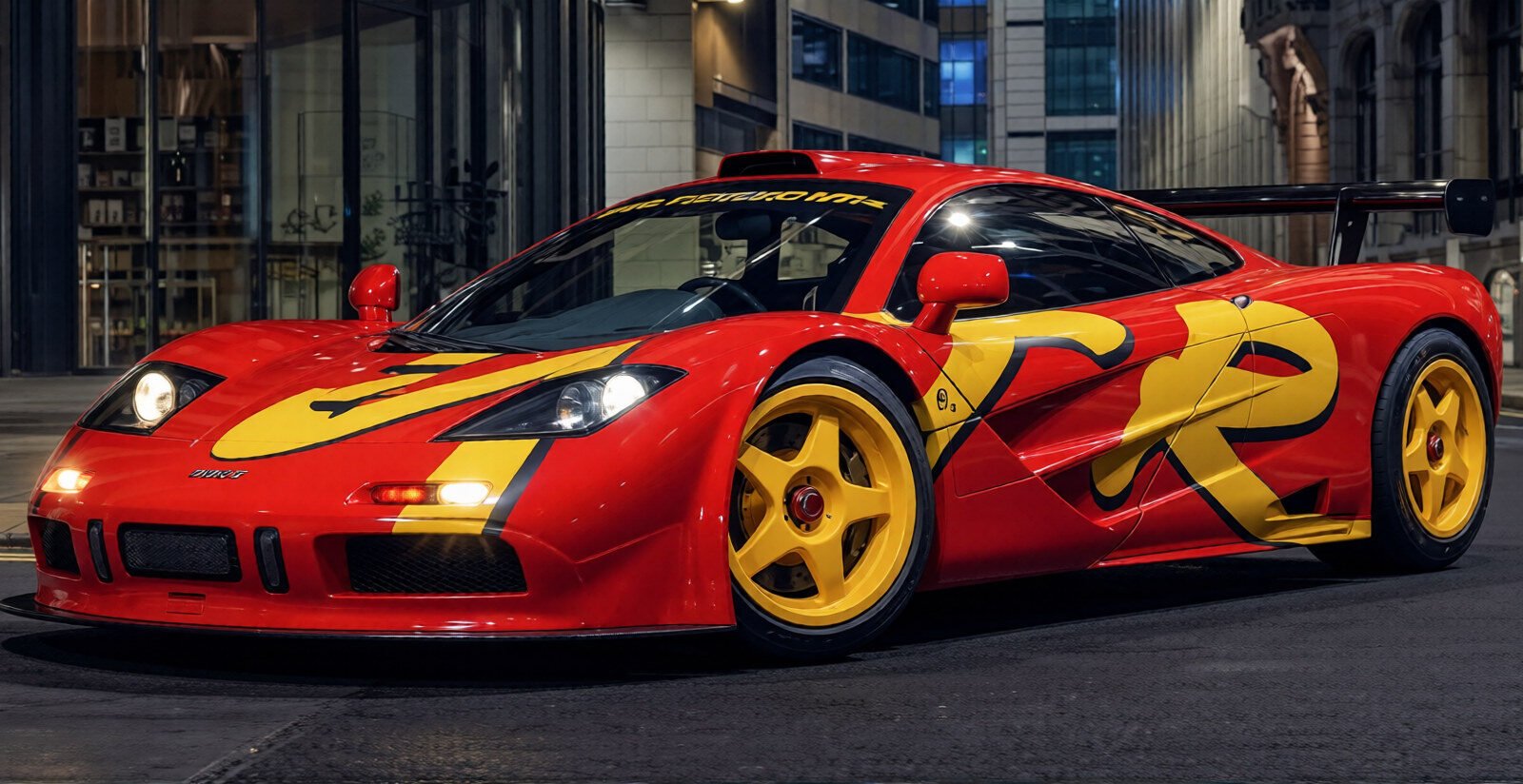
Of those nine 1996 cars, chassis 10R occupies a category entirely its own. It was the first 1996-specification GTR built, leaving the Woking factory in December 1995 as McLaren’s own prototype and development vehicle — the direct successor in role to the Le Mans-winning 01R. During winter testing at Magny-Cours, it was driven by McLaren’s top drivers including JJ Lehto, the 1995 Le Mans winner. It served as a promotional tool for the marque, appearing at BPR Global GT Series rounds in its now-famous livery: Blood Red with contrasting yellow “96 GTR” graphics, a 1990s pop-art influenced design that would make it the most visually recognizable McLaren F1 in existence.
The car’s racing credentials are impeccable. In April 1996, it participated in 12 hours of testing in preparation for that year’s Le Mans assault, then traveled to the Circuit de la Sarthe for Pre-Qualifying, driven by McLaren Works driver David Brabham under the Kokusai Kaihatsu Racing banner. It ranked 8th in class and 20th overall, though sister car 11R would contest the race proper. What distinguishes 10R from every other F1 GTR is that it is the only one to wear its unique factory livery — that scarlet and yellow palette, as bold and graphic as anything to emerge from the British visual tradition.
From Race Track to Rock Royalty
After its factory service, chassis 10R was sold directly to Nick Mason CBE, the legendary drummer and co-founder of Pink Floyd. For a man whose collection already included a Ferrari 250 GTO, Maserati 250F, Bugatti Type 35, and Jaguar D-Type, the F1 GTR was a natural addition — a modern disciple of the groundbreaking racing designs he had spent decades curating.
McLaren converted the car for road use directly, and it was registered “K40 MCL” in 1999. Chassis 10R was among the earliest of approximately 16 F1 GTRs converted for road use, taking one of the most feted racing cars of the 1990s full circle: from track weapon to road-legal masterpiece.
The Monterey Moment
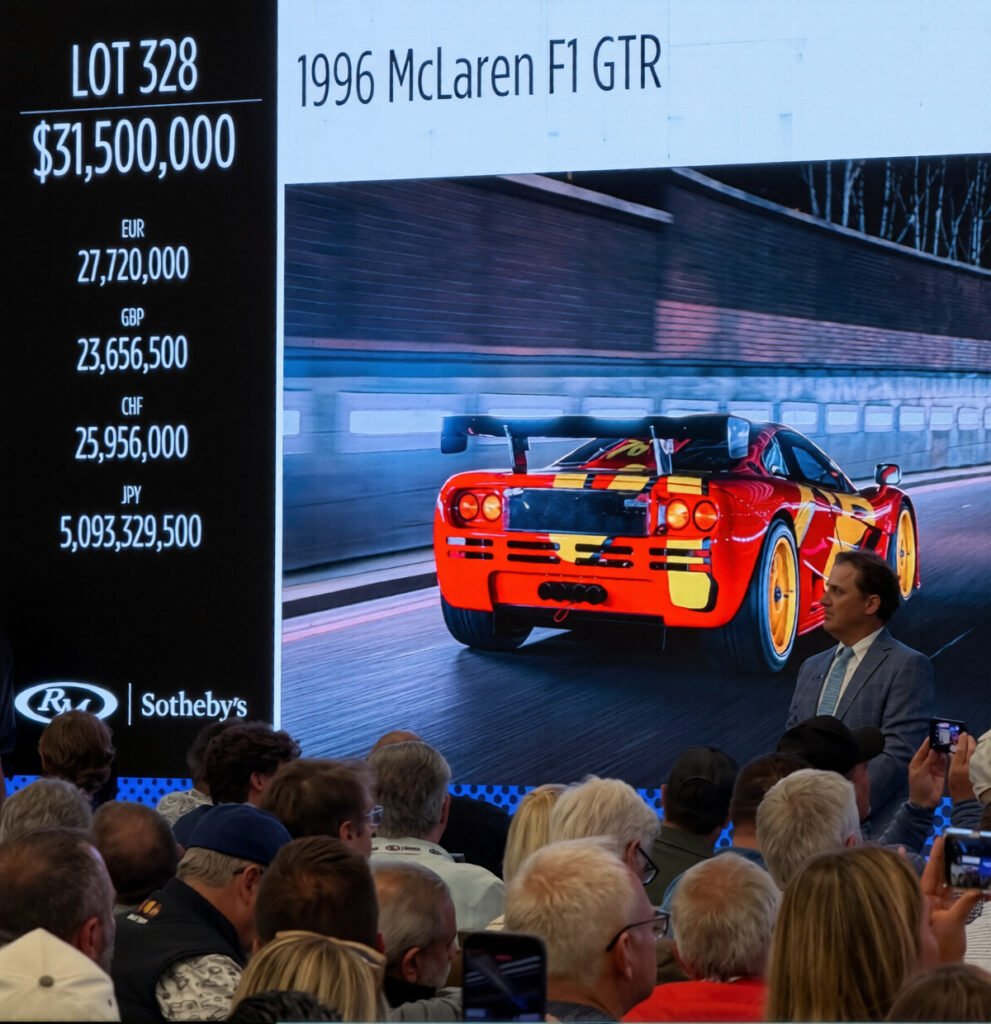
By the time chassis 10R arrived at RM Sotheby’s Monterey auction in August 2026, anticipation had reached fever pitch. The pre-sale estimate of over $35 million already signaled that this would be a landmark event. The car’s provenance was unimpeachable: a factory prototype, the first 1996-spec GTR built, one of only two short-tail GTR prototypes alongside the 1995 Le Mans winner, converted for road use by McLaren itself, and owned for a quarter-century by one of rock music’s most iconic figures. The pop-art livery — that scarlet and yellow graphic explosion — made it instantly the most recognizable McLaren F1 on Earth.
When bidding opened, the room knew history was being made. The figure climbed past $20 million, then $25 million, then $30 million. When the hammer finally fell at $34,655,000, it wasn’t just a record for an F1 GTR. The F1 GTR represents the definitive end of an era: the last outright Le Mans winner that could be driven on the road, developed directly from a GT hypercar, conceived as the ultimate driver’s machine and proven at La Sarthe.
Why It Matters
The significance of this sale extends far beyond the Monterey peninsula. The McLaren F1 GTR stands as a monument to an analog philosophy. Its BMW-sourced 6.1-liter V12 produced over 600 horsepower without a single turbocharger. Its chassis was carbon fiber in an era when most race cars still used aluminum monocoques. And its three-seat, center-steering layout was conceived not for racing regulations, but because Gordon Murray believed it was the optimal way to build a car.
Chassis 10R, with its pop-art livery and rock-and-roll provenance, transcends even the F1’s already stratospheric status. It is a cultural artifact as much as a mechanical one — a convergence of British motorsport excellence and British creative legacy. That the most visually iconic McLaren F1 GTR should have belonged to a founding member of the band whose Dark Side of the Moon prism became one of the most reproduced graphic images in human history feels less like coincidence than cultural inevitability. Two pillars of Britain’s extraordinary creative output, united in scarlet and yellow.
For the new owner, the acquisition represents more than an investment or a trophy. It is custodianship of a machine that embodies a moment in time when the boundary between road and race car dissolved completely — when a vehicle conceived for the street could arrive at Le Mans and defeat the world’s finest purpose-built prototypes on its very first attempt. The $34.6 million price tag is staggering, but for those who understand what this car represents, it is merely the cost of preserving a piece of history that will never be replicated.
As the Monterey fog rolled in over the Del Monte Golf Course and the auction tents emptied, one truth remained evident: some cars are worth more than the sum of their parts. The 1996 McLaren F1 GTR, chassis 10R, is one of them.