listen to the audio of this article
Somewhere over the Pacific at forty thousand feet, when the sun rises twice in the same morning. The first dawn breaks beneath you, staining the clouds pink and gold as the earth turns away from the light. Then the aircraft banks, climbs, and catches the sun again, pulling it back over the horizon like a curtain rising on a second act. Most people never experience this. Mike Cannon-Brookes experiences it whenever he wants. He owns a Bombardier Global 7500, and the sky is his living room.
The Aircraft
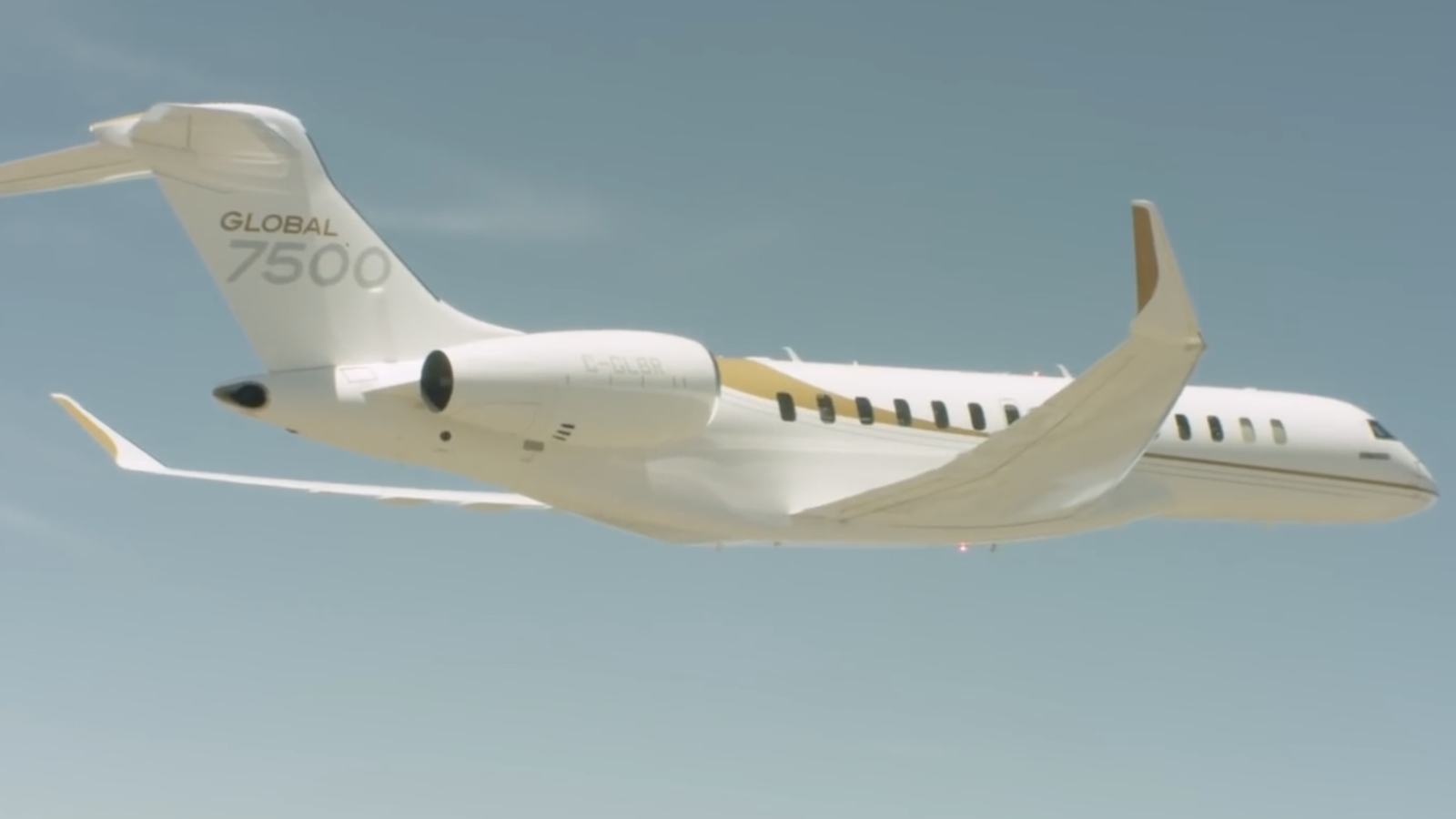
The Bombardier Global 7500 is not subtle. At one hundred and eleven feet long, with a wingspan of one hundred and four feet, it is the largest purpose-built business jet ever certified for civilian use. It can carry nineteen passengers, sleep eight, and fly from Sydney to Los Angeles without stopping to refuel. Its top speed is Mach 0.925, just shy of the sound barrier, and its range of fourteen thousand three hundred kilometres renders the Pacific Ocean little more than a large pond.
When Bombardier unveiled it, they called it a revolution. When Cannon-Brookes took delivery around 2020, he acquired what is arguably the most capable private aircraft on the planet.
Inside: Four Rooms at Altitude
The interior is divided into four distinct zones, each designed to replicate a room in a luxury home rather than a seat on a plane.
The Principal Suite, aft, contains a full-sized double bed, a private work area, and an ensuite bathroom with a stand-up shower. Consider that for a moment: a stand-up shower, with running water, heated and pressurized, at forty thousand feet and six hundred miles per hour.
Forward of that sits the Entertainment Suite, centred on a fifty-five-inch television and a divan that converts into an additional bed. Bombardier describes the space as feeling “as cozy as a living room,” which undersells it—most living rooms do not come with panoramic windows engineered to reduce fatigue and a cabin altitude equivalent to 1,800 feet above sea level.
The Conference Suite seats six for dinner or deal-making, with a table that spans the full width of the fuselage. Meals are prepared in the industry’s largest business jet galley, then served on china that stays level through turbulence.
Up front, the Club Suite is configured for quiet conversation and reflection—corporate speak for a space where the world shrinks to the size of a leather armchair and a view of the curvature of the earth.
The entire cabin is served by a sophisticated air purification system that Bombardier claims can eliminate jet lag. The windows are larger than any previous business jet, engineered to flood the space with natural light and trick the brain into believing it is not trapped in a metal tube hurtling through the stratosphere.
It is, by any engineering standard, a masterpiece.
The Owner’s Calculus
Cannon-Brookes co-founded Atlassian, the Australian software giant, and built it into a fifty-four-billion-dollar company employing twelve thousand people across a dozen time zones. He invests in solar farms, grid batteries, and climate technology. He sits on boards, attends COP conferences, and raises four children.
When the jet became public knowledge, he addressed it directly. On LinkedIn, he cited personal security and time management—the need to run a global business from Sydney while remaining what he called a “constantly present dad.” He acknowledged the tension between his climate advocacy and his choice of transport, calling it a “hard, continual trade-off.” But he did not apologise for the machine itself.
And the machine is extraordinary. When Cannon-Brookes is aboard, the Global 7500 becomes a mobile headquarters. He travels with security, with assistants, with colleagues, sometimes with his children. The aircraft is a bubble of controlled environment in an uncontrollable world: no queues, no baggage carousels, no jet lag—or at least, far less of it. Just you, your people, and the sky.
The Engineering
The Global 7500 is built to fly for thirty years. It is designed to cross oceans ten thousand times. Its carbon-fibre wing is the largest ever mated to a business jet. Its engines, a pair of General Electric Passport units, produce enough thrust to lift a fully loaded aircraft off a short runway yet sip fuel with a thrift that would have been unimaginable a generation ago.
The flight deck features Bombardier’s Vision flight deck, with synthetic vision, head-up displays, and fly-by-wire controls derived from the company’s experience building regional airliners. The pilots, up front, monitor systems that cost more than most houses.
This is not a toy. It is a tool—a tool for collapsing geography, for preserving the one resource no amount of money can manufacture: time.
When Cannon-Brookes is aboard, the jet is rarely empty. It becomes a flying home, a house that moves at nearly the speed of sound. It coddles its occupants in a tranquillity that Bombardier’s marketers call “soothing” and that everyone else simply calls wealth.
The Bottom Line
A single trip on Mike Cannon-Brookes’ Global 7500—say, Sydney to Los Angeles and back—costs roughly $300,000 to $400,000 in direct operating expenses. Over a year of heavy use, the aircraft consumes $3 to $4.5 million just to keep flying.A single trip on Mike Cannon-Brookes’ Global 7500—say, Sydney to Los Angeles and back—costs roughly $300,000 to $400,000 in direct operating expenses. Over a year of heavy use, the aircraft consumes $3 to $4.5 million just to keep flying.
The Bombardier Global 7500 coddles its occupants in a level of luxury that most people will never experience on the ground, let alone at Mach 0.925. It is a tool of immense power for a man who runs a global empire from the edge of the Pacific.