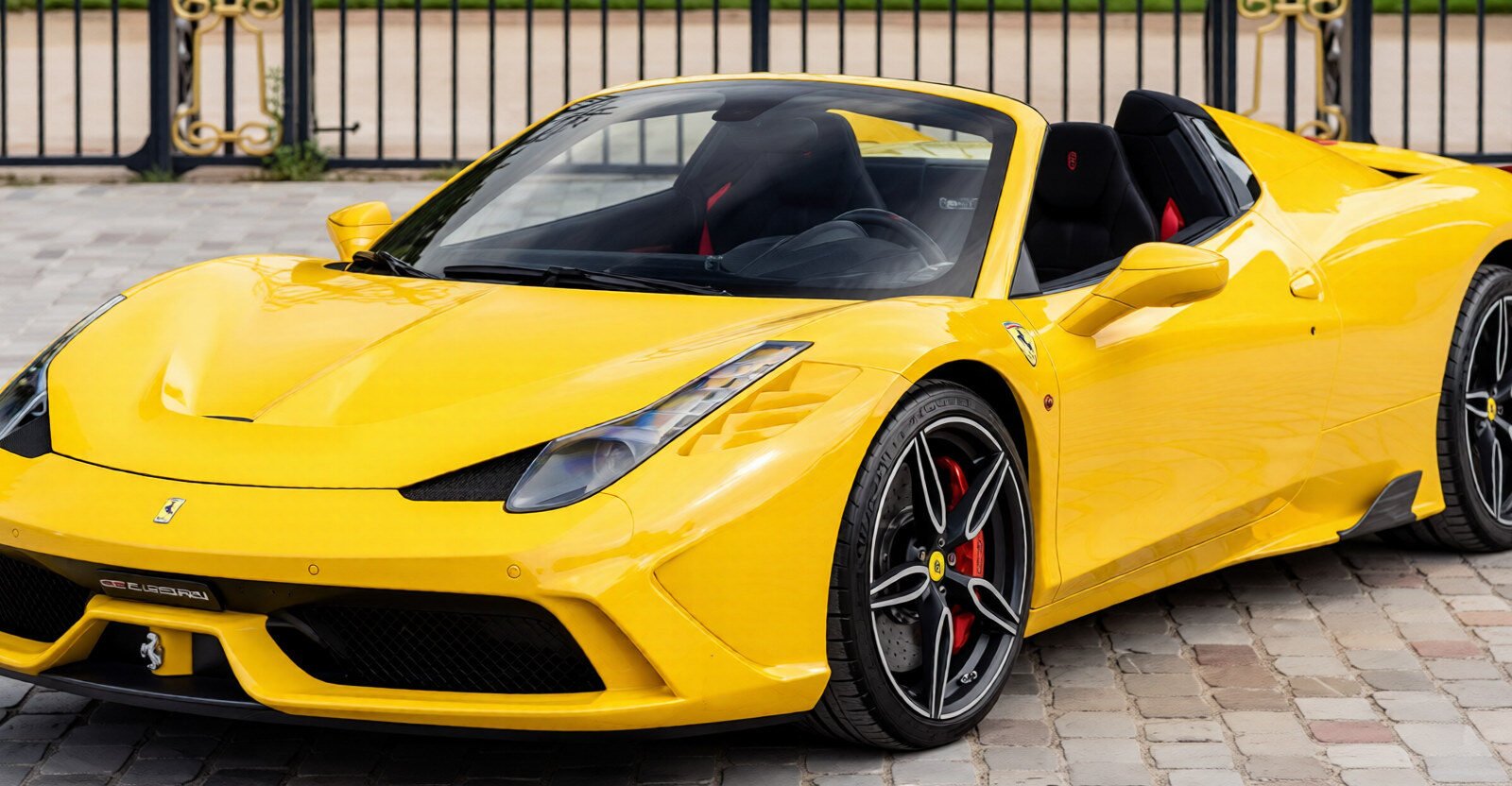
There are auction moments that make the room hold its breath, and then there are moments that make the entire collector car world gasp in unison. The sale of the 1996 Ferrari F50 in Giallo Modena at Mecum’s Monterey auction in August 2026 was unmistakably the latter. When the gavel finally fell, the winning bid stood at $14,575,000 — a figure that didn’t just set a new model record for the F50, but obliterated it, nearly doubling the previous benchmark and cementing this particular Prancing Horse as the most valuable of its kind ever to cross an auction block.
A Rarity Among Rarities
To understand why this car commanded such an astronomical sum, one must first appreciate just how unusual it is. Ferrari built only 349 examples of the F50 between 1995 and 1997, and of those, a mere 31 left the Maranello factory wearing the luminous Giallo Modena paintwork. This particular car, chassis number 106690 and the 239th of the 349-car production run, was originally delivered new to a customer in Switzerland — a European-market specification that later found its way to American shores, adding transatlantic provenance to its story.
In a world where Ferrari red dominates the imagination, yellow Ferraris have always occupied a special, almost rebellious place in the hearts of collectors. Giallo Modena is not merely a color; it is a statement. It transforms the F50’s already dramatic Pininfarina-sculpted bodywork into something that looks as though it were carved from solid sunlight. On the manicured fairways of the Del Monte Golf Course during Monterey Car Week, this F50 didn’t just stand out — it glowed.
The Anatomy of a Record
The F50 has always been the misunderstood genius of Ferrari’s halo-car trilogy. Sandwiched between the raw, turbocharged iconoclasm of the F40 and the techno-wizardry of the Enzo, the F50 arrived in 1995 with a mission that seemed almost absurd on paper: to build a road car with a genuine Formula 1 pedigree. And Ferrari wasn’t exaggerating. The F50’s naturally aspirated 4.7-liter V12 is essentially a detuned version of the engine that powered the 1990 Ferrari 641 F1 car, producing 513 horsepower and 347 lb-ft of torque, channeled through a six-speed manual gearbox mounted directly to the rear differential.
Where the F40 was a sledgehammer wrapped in Kevlar, the F50 was a surgical instrument. Its carbon-fiber monocoque chassis, derived directly from F1 engineering, made it the first road-going Ferrari to use such construction. The engine served as a stressed member of the chassis — just as in a Grand Prix car — and the suspension was a pushrod-actuated inboard system that would look more at home at Silverstone than on Sunset Boulevard. Ferrari never intended the F50 to be the fastest car in a straight line; they intended it to be the most honest.
Preservation Over Patina
What made this particular example so desirable wasn’t merely its rare color or its Swiss delivery provenance. It was the almost supernatural state of preservation. At the time of cataloging, the odometer showed just 4,500 miles — or 7,253 kilometers — a figure so low for a 30-year-old supercar that it suggests a life of careful curation rather than enthusiastic use.
More importantly, the car retained its matching chassis, engine, gearbox, and bodywork, with factory stampings still clearly visible — the holy grail for any serious Ferrari collector. It carried Ferrari Classiche certification and the coveted Red Book, the factory’s official seal of authenticity that verifies every component against original build sheets. In an era where restored cars often command premiums, this F50’s value lay in its untouched originality.
The car also came with a treasure trove of accessories that spoke to the completeness of its preservation: a Schedoni luggage set crafted specifically for the F50, original tools, rare TOD’S driving boots, and even the F50 flight case for its Barchetta conversion — the removable roof panel that transforms the Berlinetta into an open-cockpit spyder. It currently wore a Tubi exhaust system, but the original factory exhaust had been carefully preserved by the previous owner, ensuring that no modification was irreversible.
The Market Context: A Perfect Storm
The $14.575 million result didn’t happen in a vacuum. It was the culmination of a remarkable surge in F50 values throughout 2026. Earlier that same year, a 1995 F50 sold for $12.21 million at Mecum Kissimmee, and just days before the Monterey sale, another example hammered at over $12 million at RM Sotheby’s Monterey. The market had been sending signals for months: collectors had finally recognized what enthusiasts had long known — that the F50, with its naturally aspirated V12, manual gearbox, and unfiltered driving experience, represents the last of an extinct breed.
Mecum itself had estimated the car’s value at approximately $6.5 million, a figure that already reflected the model’s appreciating status. When bidding sailed past that number and kept climbing, past $8 million, past $10 million, past the $12 million mark set earlier in the year, the auction room transformed into something closer to a sporting event. Two bidders, locked in a duel that seemed to defy rational market analysis, pushed the price into uncharted territory. When the hammer finally fell, the car had achieved more than double its high estimate.
The Significance of the Sale
The Monterey result matters beyond the headline number. It represents a fundamental recalibration of how the market values the analog supercar. In an age where hybrid hypercars and electric megacars generate headlines with their acceleration figures and battery ranges, the F50 offers something that no amount of kilowatts can replicate: purity. There are no driving aids to save you, no dual-clutch transmission to smooth out your mistakes, no turbochargers to mask the linearity of power delivery. The F50 demands skill, rewards courage, and punishes arrogance — a mechanical contract between car and driver that has become increasingly rare.
For the new owner, the acquisition of this Giallo Modena F50 represents more than a trophy. It is a custodianship of one of Ferrari’s most ambitious engineering endeavors, a piece of Formula 1 history licensed for the road, preserved in a color that fewer than three dozen examples ever wore. At $14.5 million, it is undeniably expensive. But for those who understand what the F50 represents — the end of an era, the peak of analog supercar engineering, a V12 screaming to 8,500 rpm just inches behind your head — the price is merely the cost of admission to a club that will never issue new memberships.
As the Monterey sun set over the Del Monte Golf Course and the crowd dispersed, one thing was clear: the Ferrari F50 had finally received its due. No longer the overlooked middle child of Ferrari’s hypercar dynasty, it had stepped into the spotlight — painted in brilliant Giallo Modena, and valued accordingly