listen to the audio of this article
The Hammer Falls in Monterey
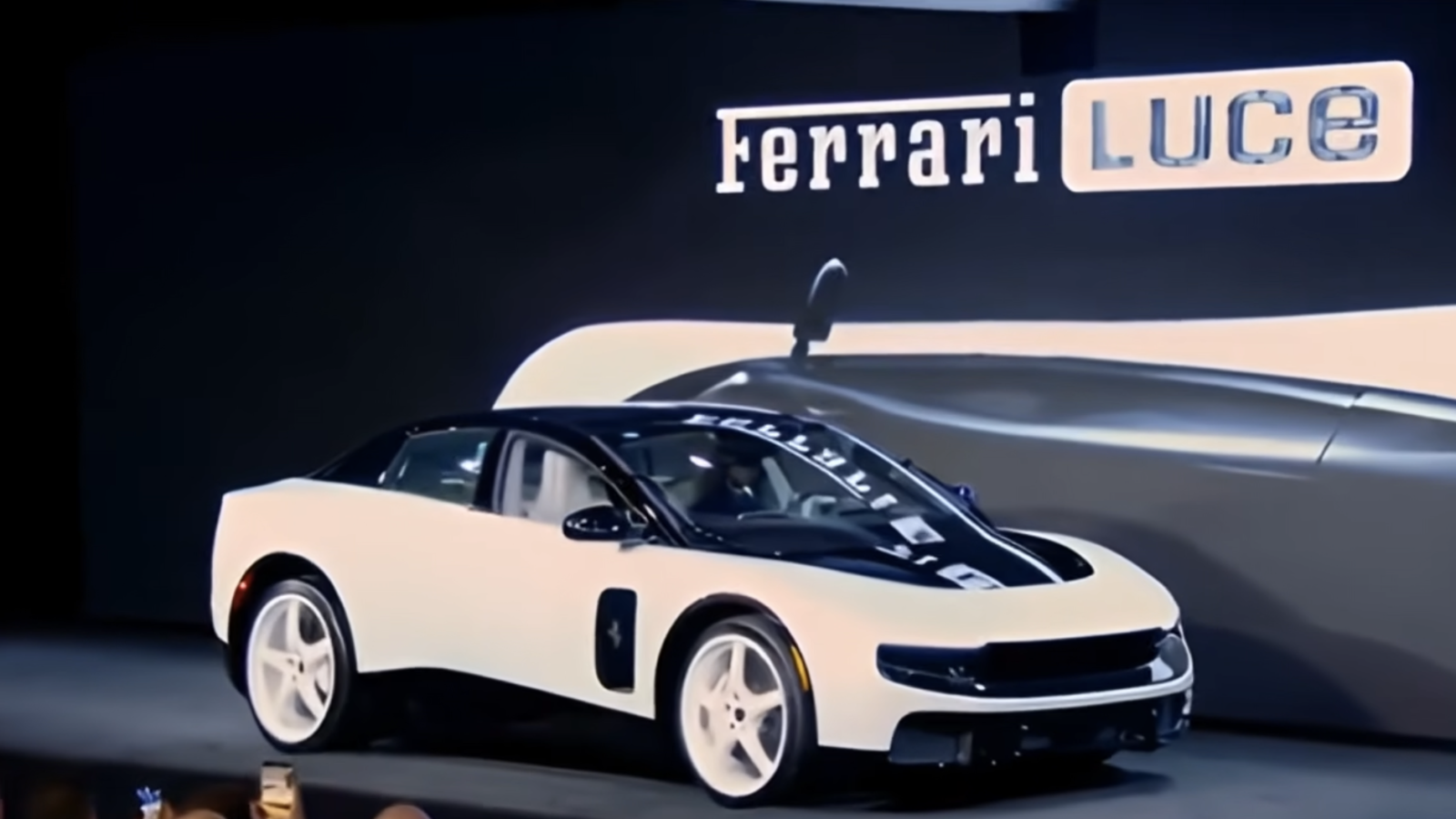
On a Saturday evening in August 2026, beneath the amber lights of the RM Sotheby’s tent in Monterey, California, an auctioneer brought down a gavel on a figure that stopped the room. The bid was $40 million. The lot was a single automobile: the Ferrari Luce “Chassis 0″—the very first production example of Maranello’s debut electric vehicle. In that moment, a car that had not yet turned a wheel in anger became the most expensive new vehicle ever sold at public auction, surpassing Ferrari’s own previous record of $26 million set just one year earlier by a one-off Daytona SP3.
The buyer, whose identity remains undisclosed, did not merely acquire an automobile. They acquired a lightning rod.
A Sale That Defied Every Estimate
To grasp the magnitude of the transaction, consider the expectations. RM Sotheby’s had placed a pre-sale estimate on the Luce of $1.1 million—already a premium over the standard car’s list price of roughly €550,000 (about $640,000). The final hammer price of $40 million exceeded that estimate by a factor of 36. It placed the Luce within $8.4 million of the all-time auction record for any car, the $48.4 million paid for a 1962 Ferrari 250 GTO in 2018. A brand-new electric vehicle, controversial before it had even reached a customer, had nearly matched the value of the most storied racing Ferrari in history.
And here is the remarkable part: not a single dollar went to Ferrari’s bottom line. RM Sotheby’s waived its standard buyer’s premium, meaning the entire $40 million hammer price was donated to The Ferrari Foundation, a public charity that funds educational initiatives. The sale was philanthropy dressed in carbon fiber and iridescent paint.
The Most Controversial Ferrari Ever Built
The Luce was never destined for a quiet arrival. As the first Ferrari without an internal combustion engine, it represented a rupture with 77 years of Maranello tradition. But the controversy ran deeper than the powertrain. The car’s design came from the pen of Jony Ive, the former Apple design chief who shaped the iPhone, and his collaboration with Ferrari produced a vehicle that looked like nothing else in the company’s bloodline.
When the Luce debuted in Rome in May 2026, the backlash was immediate and ferocious. Automotive purists savaged its futuristic, almost minimalist silhouette. The criticism was so intense that Ferrari’s marketing chief departed less than a month after the launch. Ferrari’s stock dropped on the reveal.
Then something unexpected happened. The entire 2026 allocation of just under 500 Luce models sold out in under two months—before a single customer had taken delivery. The controversy, it seemed, had only amplified the desire.
Inside Chassis 0: A Car Like No Other
The auction car is not a standard Luce. It is a Tailor Made commission, Ferrari’s bespoke personalization program, and it carries the designation “Chassis 0″—the first production chassis from the Luce program.
Its exterior is finished in a one-off Madreperla Semi-Gloss paint developed specifically for this vehicle. Ferrari describes the finish as producing iridescent reflections that shift from green to violet depending on the angle and intensity of light. The wheels are exclusive color-matched units hiding bespoke brake calipers, and the prancing horse emblem sits on an optical white background.
Inside, the cabin deliberately departs from Ferrari convention. Rather than the traditional black trim, the Luce features Le Mans metallic leather in Perla with Grigio Corvara secondary elements—materials sourced from specially selected Swiss hides. A plaque identifies the car as Ferrari’s first production EV.
Mechanically, the quad-motor powertrain produces 1,035 horsepower, identical to the standard Luce. The buyer will not take delivery immediately; the car returns to Maranello for final assembly, with handover scheduled for the first quarter of 2027.
A Tradition of Charity and Record-Breaking
This sale continues a pattern Ferrari has established over the past decade. In 2017, a unique LaFerrari Aperta sold for $10 million at Ferrari’s Maranello sale for earthquake relief. In August 2025, a one-off Daytona SP3 built beyond the 599-car production run fetched $26 million at the same Monterey auction, then billed as the most expensive new car ever sold. Twelve months later, Ferrari beat its own record by 54 percent—with its first battery-electric car.
The charity component is genuine. But it also serves a strategic purpose. Charity auctions unlock wallets that might otherwise remain closed. Collectors who would hesitate to pay a premium for a new car will pay a fortune for the same car if the proceeds benefit a foundation. The $40 million figure is simultaneously an act of philanthropy and a masterstroke of marketing—proof that even Ferrari’s most controversial vehicle can command prices reserved for museum-grade classics.
What It Means for the Future
The Ferrari Luce Chassis 0 is a Rorschach test for the modern automobile. To its defenders, it is the inevitable future of performance, a 1,035-horsepower statement that Ferrari can dominate any propulsion technology it chooses. The money will educate children. The car will sit in a climate-controlled garage. And Ferrari, having weathered the storm of controversy, will deliver 500 Luce models to customers who decided they wanted one anyway.