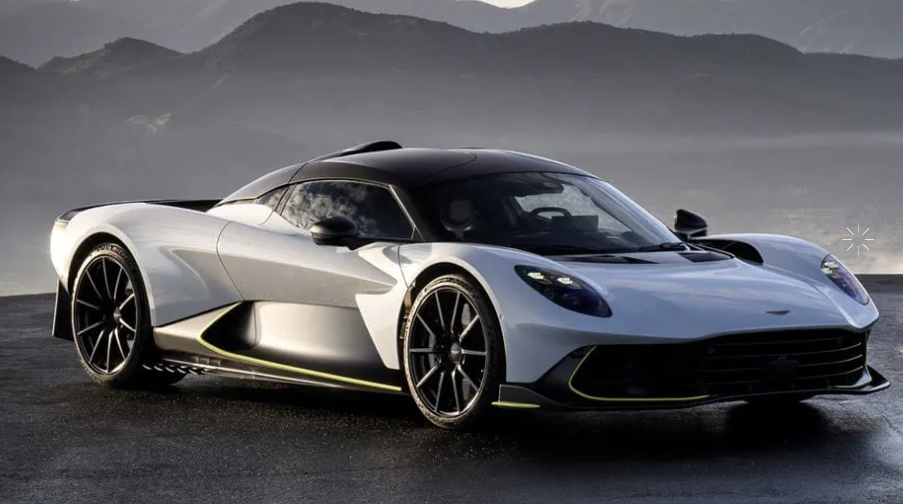
After years of anticipation and a development cycle that saw the project evolve through multiple iterations—from concept to reality, and through no fewer than four different Aston Martin CEOs along the way—the Aston Martin Valhalla has finally arrived. It represents not just a new model for the British marque, but a bold step into a new era. As Aston Martin’s first series-production mid-engined supercar, the Valhalla is a plug-in hybrid (PHEV) that marries Formula 1® technology with breathtaking performance and, surprisingly, a refined character suitable for grand touring.
The car’s roots stretch back to 2019, when it was first shown publicly as the AM-RB 003 concept at the Geneva Motor Show. The project has since been through a striking evolution: an original in-house V6 hybrid layout was eventually scrapped in favor of an AMG-derived twin-turbo V8, and the target power figure climbed substantially over successive revisions—from an initially quoted 937 hp up to the 1,064 hp the production car ultimately delivers. That long, occasionally turbulent gestation makes the finished Valhalla’s polish all the more notable.
The Heart of the Beast: A Hybrid Powertrain
At the core of the Valhalla is a complex and potent powertrain designed to deliver both immense power and cutting-edge efficiency. The system combines a bespoke 4.0-liter twin-turbo V8 engine with three electric motors to produce a combined 1,064 bhp (1,079 PS) and 811 lb-ft of torque.
The V8 engine itself is a flat-plane crank unit derived from Mercedes-AMG architecture but heavily reworked by Aston Martin—new cylinder heads, camshafts, larger turbochargers, and a dry-sump lubrication system, with the finished unit built by an outside contractor rather than by AMG itself. On its own, the engine produces just over 800 hp, making it the most powerful V8 ever fitted to an Aston Martin. The three electric motors add the remainder of the output. Two motors are located on the front axle, providing torque vectoring and enabling all-wheel-drive capability, while the third is integrated directly into the new 8-speed dual-clutch transmission at the rear, engaging the gearbox’s even-numbered gears independently of the combustion engine. There is no mechanical connection between the front and rear axles; instead, the system is managed by sophisticated electronics that constantly monitor and distribute power for optimal grip and handling.
This advanced hybrid system allows for a 0-60 mph sprint of just 2.5 seconds and an electronically limited top speed of 217 mph. It also offers a pure EV mode for silent, zero-emission driving—front-wheel-drive only in this mode, using the two front motors—with a range of up to 9 miles and a top speed capped around 80 mph, making it the first Aston Martin production model built with dedicated EV-only range capability.
The Art of Flight: Aerodynamics
The Valhalla’s aggressive and sculpted form is not just for show; it is a testament to its F1-inspired engineering. The car is designed to generate over 600 kg of downforce, a figure achieved and sustained in Race mode from roughly 150 mph up through top speed.
This downforce is maintained consistently through an active aerodynamic system. A concealed front wing and a dramatic rear wing—which rises 255mm in Race mode—work in concert, reacting within 0.5 seconds to adjust the car’s aerodynamic balance. The rear wing can also function as an air brake under heavy deceleration, while the system features a DRS (Drag Reduction System) function to reduce drag on straights. A flat underbody, prominent underfloor venturi tunnels, and an F1-inspired roof snorkel further manage airflow, feeding the engine and intercoolers with cool air and enhancing overall stability.
A Cockpit Fit for a Pilot
The driver-focused interior of the Valhalla is a masterclass in minimalist design. The seating position is low and central, inspired by Formula 1, with a raised-heel configuration that provides a heightened sense of control and connection to the car. The cabin is constructed with lightweight materials, including bespoke carbon-fiber seats and forged carbon-fiber trim, accessed through forward-hinged dihedral doors that cut into the roofline.
Technology is present but unobtrusive, centered around a 10.25-inch column-mounted digital display and a central touchscreen, with a Full Digital Display Mirror replacing the conventional rearview mirror—a necessity given that the roof snorkel leaves no room for a traditional rear window. In Race mode, the display adopts F1-inspired graphics and a large linear tachometer designed to support peripheral vision at high speeds. For an immersive audio experience, an optional 14-speaker, 745-watt Bowers & Wilkins surround-sound system is available, with a choice of ‘Studio’ and ‘Stage’ listening modes.
Chassis and Dynamics
The Valhalla is built on a bespoke carbon fiber monocoque tub weighing roughly 164 pounds on its own, developed in partnership with Aston Martin Performance Technologies (AMPT), the brand’s Formula 1 division, using resin-transfer-moulding and F1-derived autoclave processes. Aluminum subframes front and rear carry the suspension, motors, engine, and transmission. This provides a rigid and lightweight foundation, which is crucial for the car’s dynamic prowess—the complete car weighs in at around 1,655 kg (roughly 3,650 lb), remarkably light for a car with this much hardware on board.
The front suspension uses an F1-inspired push-rod design with inboard springs and dampers, which helps optimize airflow, reduce aerodynamic drag, and frees up space for the front motors. The rear features a five-link suspension with Bilstein DTX dampers, offering exceptional control and ride quality both on the road and the track. Braking duties fall to the largest brake rotors ever fitted to an Aston Martin—410mm front and roughly 391mm rear carbon-ceramic discs, gripped by six- and four-piston calipers respectively, with a brake-by-wire system that also manages energy recovery from the front motors. The overall balance is tuned to offer what Aston Martin describes as a ‘friendly, approachable’ handling character, making the car engaging without being intimidating even at the very limits of its performance envelope.
Pricing, Production, and Positioning
The Valhalla is a landmark vehicle for Aston Martin. With a price tag starting at £850,000 (roughly $1,050,000–$1,100,000 depending on exchange rates and market) before any bespoke personalization through Aston Martin’s Q division, and a production run strictly limited to 999 units, it is a rare and exclusive machine—with customer deliveries beginning in the UK in late 2025 and continuing through 2026. It successfully bridges the gap between the extreme, track-focused Valkyrie and a more traditional grand tourer, offering an unprecedented combination of performance, technology, and everyday usability that few rivals, including cars costing several times as much, can genuinely match.
The Valhalla is not just a supercar; it is a glimpse into the electrified future of Aston Martin—proof that the marque’s first modern hybrid hypercar could arrive not as a compromise, but as one of the most complete and genuinely usable machines in its entire class.
Design Details and Exhaust Note
Beyond the headline mechanicals, the Valhalla’s exterior is full of small, functional details that reward a closer look. The quad exhaust system pairs a set of top-exit tailpipes—chosen for both visual drama and acoustic effect—with a second, lower-mounted pair flanking the underbody venturi tunnels. Wing-like opening panels flank the roof snorkel, providing access to fuel, oil, and coolant fillers as well as the plug-in hybrid’s charging port, all integrated so as not to disrupt the car’s surfacing. Wheels come in a choice of 20-inch front and 21-inch rear forged aluminum as standard, with an optional lighter magnesium wheel set shedding several kilograms of unsprung weight for buyers chasing every last dynamic advantage.
Customization runs deep through Aston Martin’s in-house ‘Q’ personalization division, which offers buyers the option to leave the Valhalla’s body in exposed carbon fiber—tinted red, blue, or green if desired—alongside a virtually unlimited conventional paint palette and a handful of dedicated motorsport-inspired liveries. Unsurprisingly, given the depth of the options list, the ‘basic’ £850,000 starting price is something of a formality: real-world transaction prices for well-specified cars reportedly average closer to £1 million once buyers have worked through Q’s catalogue.
Where the Valhalla Sits in the Hypercar Landscape
Aston Martin has stated an ambition for the Valhalla to lap the Nürburgring Nordschleife in around six and a half minutes, a target that would place it firmly among the fastest production cars ever to tackle the circuit. That ambition also frames how the car is positioned commercially: at roughly £850,000, the Valhalla undercuts seven-figure hypercars like the McLaren W1 and Ferrari F80 by a significant margin, while still delivering downforce, power, and outright pace in the same conversation as those far pricier rivals. Compared with more conventional hybrid supercar rivals such as the V12-hybrid Lamborghini Revuelto, the Valhalla commands a substantial premium, but backs it up with genuine Formula 1 pedigree via its direct development partnership with Aston Martin Performance Technologies—a level of motorsport involvement few rival manufacturers can claim to match quite so directly.
That positioning—priced below the true seven-figure hypercar elite, but engineered with technology and ambition that wouldn’t look out of place among them—is ultimately what makes the Valhalla such a significant model for Aston Martin. It isn’t simply a halo car built to generate headlines; it’s a genuine statement of engineering intent, and an indication of how the company plans to blend its Formula 1 involvement with its road car business going forward. For a manufacturer that has weathered its share of financial and leadership turbulence in recent years, delivering a car this technically ambitious, this close to its original vision, and largely on the timeline it promised, is itself a meaningful achievement—one that bodes well for whatever comes next in Aston Martin’s hybrid and electrified lineup.