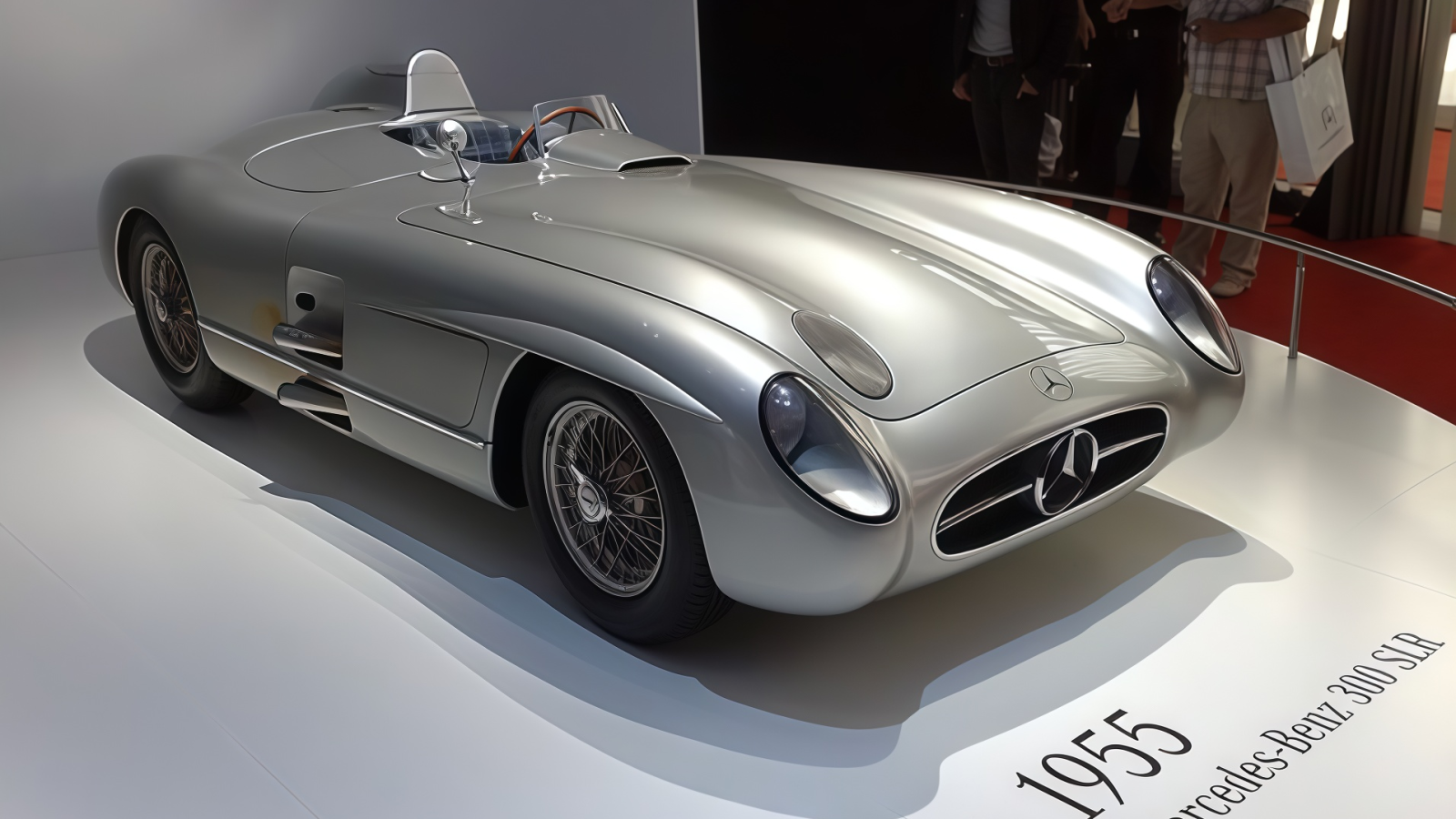
Few cars in motorsport history carry the mythic weight of the Mercedes-Benz 300 SLR. Built for a single, dominant season of racing in 1955, the 300 SLR (internally coded W196 S) was the sports car derivative of Mercedes-Benz’s all-conquering Formula One machine, the W196. In the space of one year it swept the World Sportscar Championship, produced one of the most celebrated drives in racing history, and was also present at the darkest afternoon the sport has ever known. It remains, more than half a century later, one of the most revered and valuable cars ever built.
Origins: Born from a Grand Prix Winner
By the mid-1950s, Mercedes-Benz was in the midst of a full-scale return to top-level motorsport after a long postwar hiatus. The company had reentered Formula One in 1954 with the W196, a technically advanced Grand Prix car under the direction of engineer Rudolf Uhlenhaut, and it immediately proved dominant, winning back-to-back drivers’ championships with Juan Manuel Fangio in 1954 and 1955.
For 1955, Mercedes-Benz set its sights on the World Sportscar Championship as well, and rather than developing an all-new car from scratch, the engineering team adapted the W196 Grand Prix chassis into a two-seat sports racer. This was a departure from the earlier 300 SL “Gullwing” line, which had descended from the W194 racer of 1952; the 300 SLR shared almost nothing mechanically with the road-going 300 SL beyond its general concept and family name. Instead, it was essentially a Formula One car wearing a two-seat body, widened just enough to accommodate a second occupant and fitted with headlights, fenders, and other equipment required for endurance racing on public roads.
Engineering: A Grand Prix Car in Disguise
At the heart of the 300 SLR sat the M196 S engine, a 2,982cc straight-eight developing around 302 to 310 horsepower depending on specification and tune, at roughly 7,400 rpm. It was essentially the same architecture as the F1 car’s engine, enlarged from 2.5 to 3.0 liters, complete with desmodromic valve actuation—a mechanically closed-valve system that eliminated the risk of valve float at high revs, a Mercedes specialty that allowed the engine to rev higher and more reliably than conventional spring-valve designs of the era. Fuel was delivered through Bosch mechanical direct injection, an exotic technology for the time and a direct forebear of systems used in modern engines.
The chassis was a lightweight tubular spaceframe clothed in a body made largely of Elektron, a magnesium alloy prized for its low weight but notorious for burning fiercely if ignited. The car weighed only around 900 kilograms in racing trim, giving it an extraordinary power-to-weight ratio for its day. Suspension consisted of double wishbones at the front and a swing axle at the rear, both using torsion bars, while inboard drum brakes helped keep unsprung weight low. Mercedes engineers also devised an unusual air brake: a large hinged flap that rose from the rear bodywork under hard braking, increasing drag and downforce simultaneously, first tested in period at circuits like Le Mans.
Top speed varied by bodywork and gearing but reached in excess of 280 km/h (roughly 175 mph), while the car could sprint from a standstill to 100 km/h in well under seven seconds—blistering figures for a mid-1950s sports racer.
The 1955 Season: Total Dominance
The 300 SLR’s competition debut came at the 1955 Mille Miglia, the grueling thousand-mile open-road race across Italy. It was here that the car earned its most enduring legend. British driver Stirling Moss, partnered with journalist and navigator Denis Jenkinson, completed the course in an average speed and time that shattered the previous record, using a specially prepared roll of pace notes that Jenkinson read aloud from a scrolling case throughout the drive—an innovation that changed how endurance rallying and racing would be approached for decades afterward. Their winning run remains one of the most celebrated single performances in motorsport history. Fangio finished second in another 300 SLR, meaning the marque claimed the top two positions.
The car went on to win the Eifelrennen at the Nürburgring, the Swedish Grand Prix, and the Targa Florio in Sicily, and Mercedes-Benz secured the 1955 World Sportscar Championship for manufacturers. Fangio, already the reigning Formula One World Champion that same year, added the sports car crown to his résumé as well.
Le Mans, 1955: Triumph and Tragedy
The 300 SLR’s season was inseparably marked by the events of the 1955 24 Hours of Le Mans. During the race, a collision involving French driver Pierre Levegh’s 300 SLR and another competitor’s car sent Levegh’s Mercedes airborne into the crowd along the main straight. The car disintegrated on impact, and debris, including the burning magnesium engine block, tore through the packed grandstands. More than eighty spectators and Levegh himself were killed, making it the deadliest accident in motorsport history.
In the aftermath, and out of respect for the victims, Mercedes-Benz withdrew its remaining cars from the race despite running competitively, and the disaster prompted sweeping safety reforms across motorsport, including circuit redesigns and, for a time, outright bans on racing in several countries such as Switzerland and France. The tragedy remains a defining and sobering chapter in the story of the 300 SLR, inseparable from its racing triumphs.
Withdrawal and Legacy
At the close of the 1955 season, having secured championships in both Formula One and sports car racing, Mercedes-Benz made the decision to withdraw from motorsport entirely, a withdrawal that would last until the 1980s. The timing meant the 300 SLR’s competitive career was extraordinarily brief: essentially a single season, yet one of nearly unmatched success.
Before departing racing, Mercedes also built two closed-roof variants of the car, today known as the 300 SLR “Uhlenhaut Coupé,” named for Rudolf Uhlenhaut himself, who reportedly used one as a personal road car and was said to favor it for high-speed commutes between company sites. These coupés never raced, since the team’s withdrawal came before they could be entered in the planned Carrera Panamericana, but they became icons in their own right. In 2022, one of the two Uhlenhaut Coupés was sold at a private auction by Mercedes-Benz’s own museum trust for roughly 135 million euros, at the time making it, by a wide margin, the most expensive car ever sold—a striking testament to how the 300 SLR’s reputation has only grown in the decades since it last turned a competitive lap.
The Mercedes-Benz 300 SLR occupies a singular place in automotive history. It was a car of extremes: extreme performance for its era, extreme success in a single dazzling season, and extreme tragedy that changed motorsport safety forever. Built for barely a year of competition, it produced a driving legend in Stirling Moss’s Mille Miglia victory, cemented Mercedes-Benz’s engineering reputation, and left behind a small handful of surviving cars now counted among the most coveted machines on earth. Few vehicles pack so much triumph, innovation, and sorrow into so short a career, and fewer still are remembered with such enduring fascination nearly seventy years later.