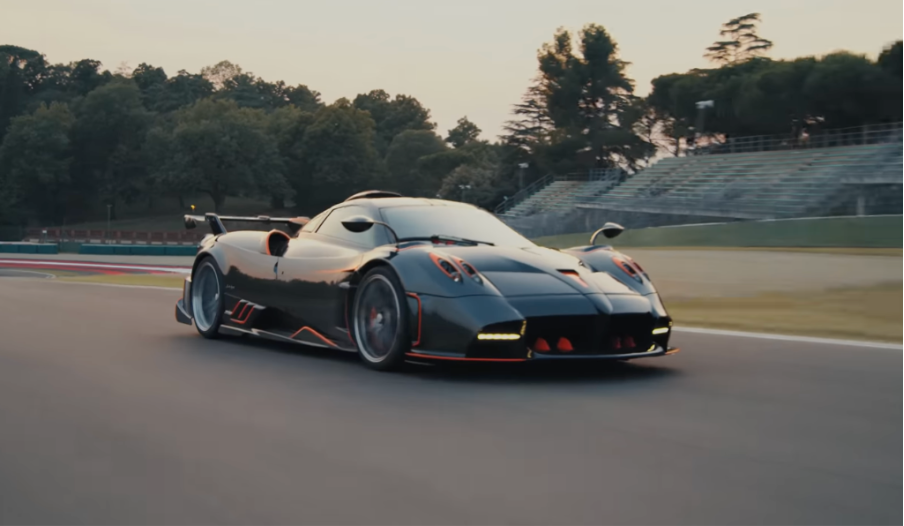
There are only five of them in the world, plus the prototype Horacio Pagani kept for himself. Each one sold before it was ever built, for roughly $5.4 million before taxes. And each one is named not after a god, a wind, or a place of personal significance to its maker, but after a strip of asphalt in Emilia-Romagna that has humbled some of the greatest drivers who ever lived. This is the Pagani Imola — arguably the most track-focused, most extensively tested road car the small Italian atelier has ever built.
A Name Borrowed From Motorsport’s Most Storied Circuit
Most Pagani models carry names steeped in the company founder’s Argentine heritage — the Zonda is named for a hot, dry wind that blows down from the Andes, and the Huayra takes its name from Huayra-tata, the Incan god of wind. The Imola breaks that pattern entirely. It’s named directly after the Autodromo Enzo e Dino Ferrari — the circuit better known simply as Imola, a track whose tight, blind corners and demanding elevation changes have tested road and race cars alike for more than seven decades. Pagani leaned into that reputation rather than shying away from it: as the company put it at launch, Imola is “a fast, difficult, technical circuit that has always separated the wheat from the chaff, in terms of both men and machines.” The implication was clear — this was meant to be a car built to survive that separation.
Built and Broken In, On Track
Unveiled in February 2020, the Imola is based on the architecture of the Huayra, but it’s less a variant than a purpose-built evolution of it. Pagani subjected the car to more than 16,000 kilometers (about 10,000 miles) of testing at full racing speed at the Imola circuit itself before ever handing a car to a customer — roughly three times the distance of the 24 Hours of Le Mans, and by Pagani’s own description, the most severe on-track validation test the company had ever applied to one of its cars. The goal wasn’t just durability; it was to use the Imola as what Pagani calls a “vehicle-laboratory,” refining solutions — in aerodynamics, suspension, and materials — that would go on to appear in later cars like the Huayra Roadster BC.
What’s Under the Skin
Visually, the Imola reads as a sharper, more aggressive Huayra, and Pagani makes no secret of that lineage — the teardrop headlights, insect-like wing mirrors, and central quad exhaust are deliberate design signatures the company chose to carry forward. Underneath, though, nearly everything was retuned for the track:
- Engine: A 6.0-liter twin-turbocharged Mercedes-AMG V12, built specifically for Pagani, tuned to 827 horsepower and 811 lb-ft (1,100 Nm) of torque — a meaningful step up from the standard Huayra.
- Transmission: A 7-speed Xtrac automated transmission with a triple-disc clutch and an electro-mechanical rear differential, sending power to the rear wheels.
- Structure: A central monocoque built from Carbo-Titanium HP62 G2 and Carbo-Triax HP62 composite materials, paired with front and rear tubular steel subframes — keeping the car’s total weight to about 1,246 kg (2,747 lbs) despite its enormous power output.
- Aerodynamics: An evolution of the active aerodynamics system Pagani introduced on the original Huayra — the first road car ever fitted with it — using four independently controlled mobile winglets that adjust in real time to driving conditions, including generating aerodynamic braking assistance under hard deceleration.
- Suspension and brakes: Reworked suspension geometry to cut brake dive and body roll, paired with electronically controlled active dampers at each corner, and Brembo carbon-ceramic brakes with six-piston front calipers.
- Weight-saving details: Even the paint contributes — Pagani’s “Acquarello Light” finishing process is claimed to save roughly 5 kg over a conventional paint job.
Pagani never published official 0-60 mph or top speed figures for the Imola, but automotive press at the time widely estimated a sub-3-second sprint to 60 mph and a top speed north of 240 mph (386 km/h), squarely in line with what the car’s power-to-weight ratio would suggest.
Five Cars, One Waiting List
True to Pagani’s boutique scale, production was capped at just five customer cars, plus the founder’s own prototype. All five sold immediately, each priced at roughly $5.4 million before taxes and options — a figure that reflected not just exclusivity but the sheer scope of bespoke engineering behind each one, since Pagani builds cars essentially by hand in its atelier in San Cesario sul Panaro, near Modena.
The Imola wasn’t the end of the idea, either. In November 2023, Pagani introduced the Imola Roadster, an open-top interpretation limited to eight examples, which borrowed styling cues from the track-only Huayra R and paired them with an even more powerful 850-hp evolution of the V12 — proof that the “Imola” name had become a sub-series in its own right rather than a one-off experiment.
The Company Behind the Car
The Imola is, in many ways, a distillation of what Pagani Automobili has always been about. Founded in 1992 by Horacio Pagani — an Argentine engineer who moved to Italy in the early 1980s and spent years working on composite materials and design for Lamborghini before striking out on his own — the company spent seven years developing its first car, the Zonda, before it debuted at the 1999 Geneva Motor Show. The Huayra followed in 2011, and by the time the Imola arrived in 2020, Pagani had built a reputation for treating each car less as a mass-market product and more as what the company calls a marriage of art and science, in the Renaissance tradition of Leonardo da Vinci that Horacio Pagani has cited as a personal inspiration throughout his career.
Seen in that light, the Imola isn’t just a faster, lighter Huayra — it’s Pagani using a legendary racetrack as both a namesake and a proving ground, then handing the results to five owners willing to pay millions of dollars for a car that had already logged more racing miles than most professional endurance racers see in a career.