Most car companies measure themselves in factories, market share, and annual sales. Pagani measures itself in something closer to couture: about fifty cars a year, built almost entirely by hand, by a company of roughly two hundred people, in San Cesario sul Panaro, a small town outside Modena, Italy. There is no other manufacturer quite like it — not Ferrari, not Lamborghini, not Bugatti — because Pagani has never tried to be a mass producer of anything. It has spent more than three decades building a reputation on the idea that a car can be engineering and sculpture at the same time, and that the wait to own one is part of the point.
From a Boy in Argentina to an Atelier in Modena
The company’s founder, Horacio Pagani, was born on November 10, 1955, in Casilda, a small town in Argentina’s Santa Fe province, the son of a baker. As a child he built model cars from balsa wood and became fascinated with Leonardo da Vinci’s belief that art and science were not separate pursuits but two expressions of the same creative instinct — an idea that would later become the guiding philosophy printed on Pagani’s own website. He built his first single-seat racing car by hand in Argentina in the late 1970s, and in 1983 moved to Italy to chase a bigger dream: working for Lamborghini.
At Lamborghini, Pagani worked on the Countach and Diablo and became head of the composites department, developing an early expertise in carbon fiber that would define his later career. He also built the Countach Evoluzione concept, a testbed for advanced composite materials. When Lamborghini refused his request to invest in an autoclave — the industrial oven needed to cure carbon fiber parts in-house — Pagani borrowed the capital and bought one himself in 1987. In 1991 he left to found his own consultancy, Modena Design, producing composite parts for Formula One teams and manufacturers including Ferrari and Mercedes-Benz.
The following year, in 1992, he founded Pagani Automobili itself and began work on a prototype then called the Fangio F1, named for his friend, the five-time Formula One champion Juan Manuel Fangio. When Fangio died in 1995, Pagani renamed the project out of respect, and in 1999 the car finally debuted at the Geneva Motor Show as the Zonda C12 — named, in another nod to Argentina, after a hot, dry wind that blows down from the Andes.
It’s worth noting that Pagani’s own materials aren’t entirely consistent on the company’s founding date. While most independent sources and the bulk of Pagani’s own history point to 1992, the company’s 25th-anniversary press materials in 2023 described the business as “officially established” in 1998 — likely reflecting a formal corporate reorganization rather than a dispute over when Horacio Pagani actually started building cars.
The Zonda: A Slow Start That Became a Legend
The Zonda took seven years to bring to market and, in its early years, sold in tiny numbers. But it grew into one of the defining supercars of its era, spawning more than a dozen variants over roughly two decades — roadsters, lightweight track editions, and ultra-limited specials built for individual clients.
Its most extreme descendant, the track-only Zonda R, became something of a legend in 2010 when it lapped the Nürburgring Nordschleife — the 12.9-mile German circuit nicknamed the “Green Hell” — in 6 minutes 47.5 seconds, a time that beat Ferrari’s own track-only 599XX by roughly eleven seconds and briefly made the Zonda R one of the fastest production-derived cars ever recorded there. Only a handful of Zonda R units were ever built, and the car was never intended for road use, but the record cemented Pagani’s reputation as a company capable of genuinely world-class engineering, not just striking design.
The Huayra: Pagani Goes Mainstream (Relatively Speaking)
In 2011, after nearly a decade of development, Pagani replaced the Zonda with the Huayra — named after Huayra-tata, the Incan god of wind. Built around a twin-turbocharged, 6.0-liter Mercedes-AMG V12 and a carbon-titanium monocoque, the Huayra introduced active aerodynamics to a road car: four independently controlled winglets that adjusted in real time to driving conditions.
Like the Zonda before it, the Huayra spawned an entire family of variants over the following decade, including:
The Huayra BC, dedicated to Benny Caiola, Pagani’s very first customer and personal friend
The open-top Huayra Roadster
The aviation-inspired Huayra Tricolore, built to mark 60 years of the Italian Air Force’s Frecce Tricolori display team and limited to just three examples
The Imola, a five-unit, track-honed special producing 827 horsepower, priced at roughly €5 million, that logged more than 16,000 kilometers of testing at racing speed on the Imola circuit before a single customer car was delivered
The Utopia: A Hypercar That Bets on the Manual Gearbox
Pagani’s current flagship, the Utopia, arrived in 2022 as the Huayra’s successor, and it made headlines less for its power figures — 852 horsepower and 811 lb-ft of torque from a similar AMG V12 — than for a decision that ran directly against industry trends: Pagani offered it with a genuine seven-speed manual gearbox, at a moment when most hypercar makers were racing toward hybrid powertrains and dual-clutch automatics.
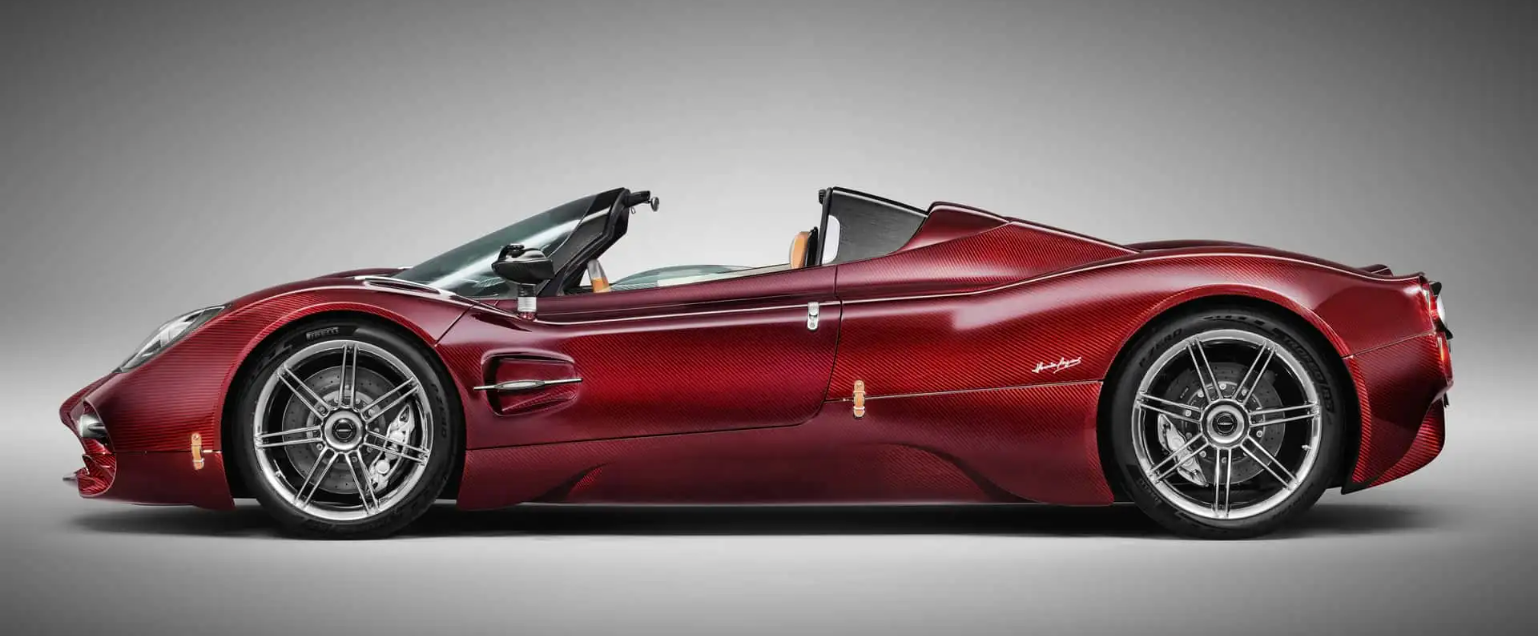
Horacio Pagani set three design priorities for the Utopia himself — simplicity, lightness, and the pleasure of driving — and the manual option became the clearest expression of that last goal, winning over skeptics who doubted a stick shift could handle that much torque. With a dry weight of roughly 1,280 kg (2,822 lb), thanks to its Carbo-Titanium HP62 G2 and Carbo-Triax HP62 monocoque, the Utopia coupe is limited to just 99 units. An open-top Utopia Roadster followed in 2024, priced at roughly €3.1 million (approximately $3.4 million), with production capped at 130 units.
Why People Buy a Pagani
Pagani buyers are not, for the most part, paying simply for speed — plenty of cars costing a fraction of the price will out-accelerate a Huayra or Utopia in a straight line. What Pagani sells instead is a combination of scarcity, craftsmanship, and participation:
Radical exclusivity. Pagani builds around fifty cars a year, and many special editions are limited to single digits. Owning one places a buyer inside a genuinely tiny club, in contrast to supercar makers producing thousands of units annually.
Hand craftsmanship over automation. Pagani describes its factory as an atelier rather than a plant. Body panels, interior trim, and switchgear are largely assembled and finished by hand by technicians the company says customers can call by name.
Deep personalization. Through its Unico program, Pagani treats each customer as a co-creator of their own car, offering an enormous range of paint, trim, exposed-carbon, and mechanical configurations, so that in practice no two Paganis are ever identical.
The relationship, not just the transaction. Pagani has described the wait for a car — often spent configuring details alongside the designers and engineers who will build it — as part of the ownership experience itself, not simply a delay before delivery.
Ongoing aftercare. A dedicated division, Pagani Officina, restores, updates, and maintains customers’ cars over time, including through the Rinascimento restoration programme, reinforcing long-term value and a continued relationship with the factory long after a car is delivered.
There’s also a collector-market logic at work: because production numbers are so low and demand among ultra-wealthy buyers has stayed strong, well-specified Paganis — particularly rare variants like the Zonda Cinque or Huayra BC — have often held or increased their value on the secondary market, behaving less like a depreciating car and more like a piece of limited-edition art or a fine watch. That comparison isn’t accidental: Pagani’s in-house division for special, ultra-limited projects is literally named Grandi Complicazioni, borrowing a term from high-end Swiss watchmaking to describe its most technically ambitious, hardest-to-produce cars. Recent examples from this division include the Huayra Codalunga, a long-tail tribute to 1960s Le Mans racers limited to five units at €7 million each, and the one-off Huayra Epitome.
A Company That Still Feels Like One Person’s Obsession
More than three decades after Horacio Pagani first bought his own autoclave rather than wait for Lamborghini’s approval, the company he built still runs on a very similar instinct: an insistence on doing things by hand, on a small scale, exactly the way its founder believes they should be done. Pagani has invested heavily in research even as it stays small — spending tens of millions of euros and tens of thousands of engineering hours per year on continued development — while resisting the industry-wide rush toward electrification for as long as it reasonably can, most visibly by keeping a naturally aspirated feel and, in the Utopia, an actual manual transmission alive in the hypercar segment.
Whether that combination of scarcity, artistry, and stubborn craftsmanship continues to define the brand as it moves into an increasingly electrified future is one of the more interesting open questions left in the supercar world. But it’s the same question, in one form or another, that Horacio Pagani has been answering his own way since he was a ten-year-old carving balsa wood in Casilda.